
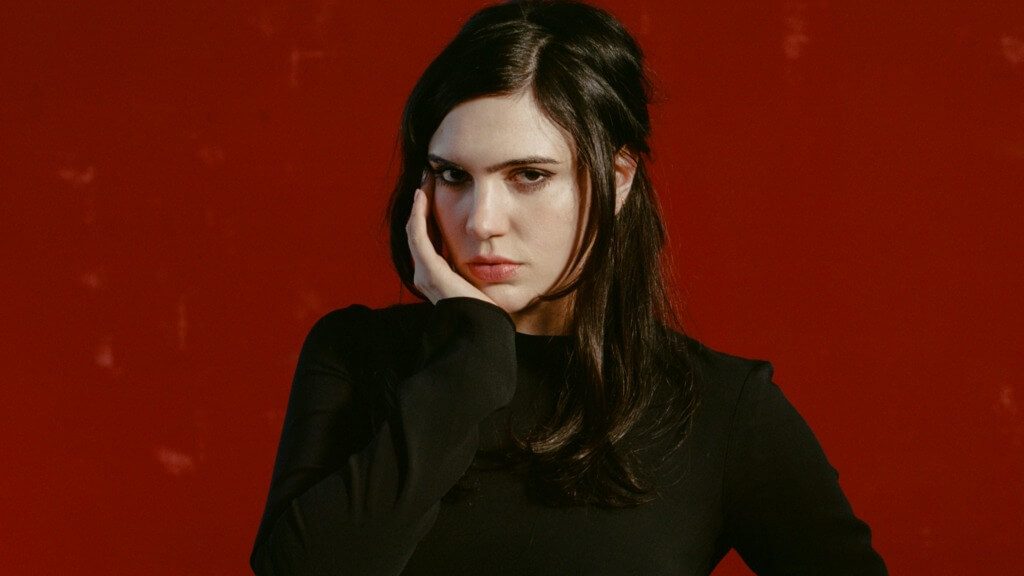
I grew up in the sweaty armpit of Florida, weighed down by dense heat and surrounded on all sides by Confederate flags. I was never going to be a sorority girl or a trad wife, and my desperate efforts at pretending otherwise were thoroughly unconvincing. I lay awake at nights furious that I was born a stubby weird kid in the Bible Belt who listened to music no one liked instead of some cool, fashionable New York chick in ripped fishnets, stubbing skinny cigs on the soles of my platform boots before strapping on an electric guitar and sauntering into a dive bar for a gig. Not that I knew it, but I was fantasizing, essentially, about living what seemed to be the life of one Julia Cumming: a Manhattan girl-about-town who began gigging with her first band (the acoustic psych-rock group Supercute!) when she was roughly 13, walked in a Yves Saint Laurent show in Paris a few years later, and got signed to a label (with her second band, the still-active Sunflower Bean) by the time she graduated high school. If I had known about her when I was a teen, I would’ve thought her invulnerable, the coolest girl in the world. The Platonic ideal of coolness, really.
All that would have come as a surprise to Cumming herself. Maybe, to someone like 15-year-old me, her image would’ve seemed pristine, untouchable; everything I wanted to be and then some. But it turns out our younger selves had far more in common than I would’ve guessed: all Cumming wanted was to fit in, and all she knew was the life of a perennial outsider. “I looked towards other people to learn about how to be cool,” she admits to me over Zoom, dark hair swept loosely across one eye. “I had to observe to see how other people navigated everything to try to just fit in, even in settings that should’ve been the ones where I felt most comfortable being a weirdo, being an individual. It didn’t matter where I was or what I was doing, I would still find a way to feel lame.” She felt this way even—or perhaps especially—in Supercute!, awkwardly swallowing down some of her artistic influences and references in order to seem cool enough to be in that kind of band. This feeling followed her all the way through Sunflower Bean, the longtime rock trio made up of her, Nick Kivlen, and Olive Faber. In other words: she started making music and playing shows in 2009. But it’s only now that she feels confident enough to step out on her own and play whatever damn things she wants.
This is the throughline running through Julia, Cumming’s first-ever solo record, which will be released on Partisan this Friday. Just look at the chorus of lead single and opening track “My Life”: “I don’t do this to impress you,” she sings, soulful and resonant. “I don’t need you to define me or approve of what’s inside me.” It’s much more complicated than it sounds, though; it’s not just a “fuck you, I do what I want” mantra. That is, in Cumming’s words, “level one of looking at the record.” It’s the surface. But for her, and for all girls who grew up molding themselves into the cookie-cutter shapes they thought men wanted from them, it’s not that simple. “What’s more interesting to me,” she says, “is how we take what people put onto us, and we let it become ourselves. It’s easier to become what others perceive you as than it is to actually try to love and accept and learn about yourself. I’ve had so many incredible experiences, both in music and fashion, where people see things in me that I couldn’t in myself, and those moments will stay with me for the rest of my life. But I internalized all of that through insecurity, and this record is the first time I’m taking responsibility for that.”
“When you’re a musician, especially when you start playing music as young as I did, your self-worth becomes tied to the validation loop of the industry,” she continues. Even your most inner thoughts and emotions feel subject to judgment, because they’re the meat of your music, and your music exists to be assessed. Cumming describes the cycle: “You feel something, you make something from that thing, you go and you show that thing to other people, you see how people feel, and how people feel tells you how you’re supposed to feel about it. So that hole that you have of confusion gets bigger and you need more outside validation, more sound, more applause, more attention to fill it up. And you hope that, one day, the applause will get loud enough that you might actually accept yourself.”
While all musicians have to gig in order to make music, Cumming arguably has a more intense relationship with performance than most. After all, Sunflower Bean first rose to prominence specifically because of the intensity, frequency, and utterly absurd number of live shows they played. They were dubbed “the #1 hardest working band of 2014” for a reason: they played as much as humanly possible, and then they played even more. For Cumming, then, the most important line in “My Life” doesn’t come in the chorus, but in the very first lyric: “I sing these words for me to hear the sound.” As she puts it, “For someone whose whole relationship to loving music became about how to perform music, how to perform oneself, it was very liberating to allow myself to think about what it would be like to just hear, what it would be like to just enjoy the sound of singing in a room for no other purpose than for the purpose of the sound.”
This l’art pour l’art mindset was catalyzed by a rather unexpected force: a sudden global pandemic. “It was drilled into me from a very young age that you have six months to write a record, you have a year and a half to tour it, and if you don’t do that, you’re going to lose everything. I took every part of it so seriously. But then the pandemic happened,” she says. “Seeing everything dissolve and change was very eye-opening. It made me realize that everything I thought was set in stone was not.” And much of what was “set in stone” went deeper than general notions of industry rules—it was Cumming’s own sense of self, shaped as it was by off-handed comments she received throughout her youth.
When Cumming was about 17, she found herself between bands. Not one to lay low, she set out with her guitar—and her father, who played bass alongside her—and performed at intimate venues across the city. She didn’t know it then, but it’d be the last time she would play without a band until after she turned 30. This was in no small part due to the feedback she received at the time, much of which ended up inspiring the verses of “My Life” (“I’m too wholesome or too boring or too quiet or loud / I’m too sexy or too modest or I’m lost in the crowd”). She relays distinct incidents in our conversation: someone she trusted informing her that her music was too confessional, another dismissing it as boring. “When you’re a young girl looking towards these men—or women, too—just pouring your heart out and asking people what they think, you’re too young to understand that what they’re saying isn’t the objective truth,” she says. “It’s just one person’s opinion, but you don’t think about it that way. You’re just so raw.” It’s like cutting out your whole heart and placing it, still-beating, in the hands of a god, and then being found lacking. Being in a band functioned, then, as something of a shield. “There was always a part of me that really felt like who I was as a musician was inherently not good enough—but if I was in a band, they’d protect me from myself. They’d protect me from my instincts that are too confessional, too boring. They’d make me into somebody that is worthy of love.”
The Evolution of Artistry
Cumming doesn’t like being in a band; on the contrary, she still worships at the altar of bandhood. She spent over a decade vehemently pushing back against even the slightest mention of a solo career. She loves Sunflower Bean, loves Nick and Olive, and insists that none of this “era,” as she calls it, would be possible without their support—without the past 13 years of their support. “Sunflower Bean is very much a family operation, and when you’re a family, you also have to give space for everyone’s individual development,” she says. “When love is at the forefront of what you’re doing, you want to see your bandmates be the versions of themselves that they want to be. Growth is only ever a good thing when it comes to art, I feel.”
Loathe as she was to admit it for a long time, Cumming began to feel something new calling her, something that didn’t fit the model of the band she spent the past decade-plus crafting, but it didn’t crystalize into anything coherent until about 2022, shortly after the release of Sunflower Bean’s Headful of Sugar. Fittingly, it all started with “My Life,” a song that she says “found her” rather than the other way around. This album began to build in the back of her mind that night. As such, the record has been in the works for longer, perhaps, than one might guess; Cumming tells me that it was actually recorded prior to Mortal Primetime, last year’s Sunflower Bean release. In fact, her work with producer Chris Cody on Julia heavily informed Mortal Primetime’s self-production: “I learned a lot from observing him and seeing how he conducted himself making the record and what his methods were—I tried to absorb all of that and bring it to Sunflower Bean.”
But even though Cumming wrote, recorded, and completed a full press cycle for a different album between the time she wrote Julia and its release this Friday, the music still feels as fresh to her today as it did two years ago. This is at least partly due to the album being kept a secret from the outside world until the day of its announcement—the lack of public knowledge made the record feel “outside of perception, outside of time,” Cumming gushes. “My dream with this record was to make a fortress, something that couldn’t be torn apart by time or context. Sure, my life is very different now than it was when I recorded [Julia]. But I feel as strongly about the work itself as I did when I wrote it.”
As far as the writing itself goes, Cumming’s process is somewhat unusual: rather than fitting words to an already-discovered tune or finding a melody between already-written lines, she insists, in almost all cases, on everything happening at once—some kind of immaculate conception that sees melody, music, and lyrics spontaneously and simultaneously materialize in her mind. Although, of course, it’s hardly that easy or painless. She describes the experience as kneeling beside a flowing river with an outstretched cup, dipping it into the water for hours on end in hopes of catching something, anything. Like fishing, but without the bait, without the line, without the reel. All that’s there is patience. “It’s like having a conversation with your subconscious—the deepest part of yourself that really does not want to communicate with you on any level, at least not in any terms that you can understand,” she says. “Doing that takes a lot of focus, a lot of meditation, a lot of time. You have to sit there the same and you have to expose yourself to some stuff that really is not comfortable being exposed. It’s a practice. It’s a muscle. It’s a dedication. Making this record, I would sit at the piano for eight hours a day, sometimes.” But when the moment of truth strikes, when something finally fills that cup of hers, it doesn’t come as a trickle. It comes as a flood. A deluge.
“It can be very painful,” Cumming says. “Sometimes you get something brilliant. Sometimes you just sit there and cry and have to walk away. Sometimes you scream or want to bang your head against the wall. Sometimes you work for a month and get nothing. Sometimes you work for three days and get everything. But the problem is, it’s all true. You can’t ever look at it and say ‘this is wrong,’ because it’s not wrong. It’s the purest essence of your mind. And while songwriting doesn’t always have to be that way, I felt like, for this record, I owed it to myself to see what was there.”
What was there? A diagnosis or two, for one thing: “This is an album for the neurodivergent baddies and the neurodivergent saddies.” In the process of making Julia, Cumming was diagnosed with ADHD and OCD—the latter as a result of one specific song, actually: the poppy ballad “Please Let Me Remember This.” “I’ve always had this problem of ruminating and obsessing over things to a very, like, disturbing, mentally ill level,” she reveals. “Then getting the OCD diagnosis… I’m like, ‘Oh my God, is this thing that I thought was an inherent part of who I am, of my personality, literally just because I have OCD? Am I even a writer, or am I just a mentally ill person?’” At the same time, though, that exact feeling is what sets you free: you realize that it’s only a part of you, not your whole being. The mid-album number “Ruled By Fear” was a response to that experience, and writing it felt like the beginning “of the healing journey,” Cumming says.
All things happen in the time that they should, though; as Cumming puts it, “I have to believe that you’re ready when you’re ready, and only then.” She pauses a moment, then huffs out a cheeky laugh. “In the words of Kamala Harris, you exist in the context of all in which you live and what came before you. You did not just fall out of a coconut tree!” (After another beat, Cumming clarifies that she really doesn’t want the album to be associated with Kamala Harris.) And the context in which Cumming lives just so happens to be the breezy, polished adult contemporary world of the 1960s-70s; her list includes Burt Bacharach, Dionne Warwick, Carole King, Carly Simon, Simon and Garfunkel, Neil Diamond, and Steely Dan. In other words, all references that would not be particularly welcome in a rock-forward band like Sunflower Bean. As a result, Julia was surprisingly hard to shop around.
“There’s a lot of people who thought, ‘Well, she should be doing a fucking rock record,’” she gripes, rolling her eyes. “When ‘My Life’ came out, someone commented on YouTube, ‘Is this, like, easy listening?’ And I’m like, “Yes, you get it!’ Honestly, the most radical thing that I could have done is make an ‘easy listening’ record. You have to use your brain to get that, but once you get it, you realize that this record is the most punk rock thing I’ve ever done. I mean, I think doing pretty much anything else would have been more expected—anything other than something that sounds like Olivia Newton-John. But I think that Olivia Newton-John is fucking cool! Karen Carpenter is the coolest person in the world! When people are like, ‘This record sounds like Barbra Streisand,’ I’m like, ‘Yeah! Yes!’ If you’re a 60 year old dude, the stuff that your sister listened to on her record player, that’s what I’m doing. Put your fucking Who record away. This is the shit your sister played that you heard through the wall.”
Cumming is still fully expecting to get some pushback upon the album’s release; she didn’t just fall out of a coconut tree, after all. She turned 30 earlier this year; no longer the impressionable kid in dive bars who felt her stomach hollow out every time a faceless adult snidely commented that the art she poured her whole being into was bland, unworthy. She knows how this industry works now, which means she knows exactly how to handle it. “I’m sure after putting out this record, I’ll receive a whole bunch more heinous information about, like, what a loser I am, and that will create a whole other bunch of complexes, and then I’ll do something else to process that,” she says, cracking a smile. Music, for her, is no longer about the audience, the performance, or the murmur of the crowd. It’s about the sound of her own voice echoing off the walls. But even self-actualization takes a village: “I needed everything I’ve learned from my band, all the strength that they’ve given me, just to be brave enough to go on this journey.”
Julia is out April 24 on Partisan.