
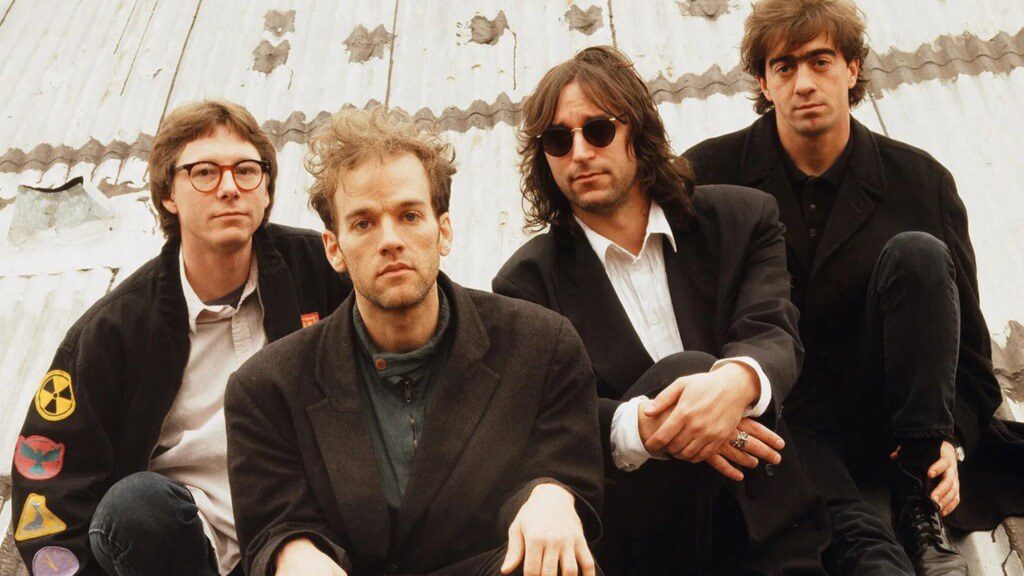
R.E.M. already had five albums under their belt before major labels came calling. In their eight years together prior to signing with Warner Bros. and recording 1988’s Green, the Athens, Georgia, outfit had gradually evolved while climbing the ranks as college radio stalwarts with a DIY ethos. In a sense, a major-label deal changed very little about the band’s attitude toward songwriting and recording. While a younger act might’ve focused on nailing down the sound that got them signed in the first place, bandmates Michael Stipe, Peter Buck, Mike Mills, Bill Berry, and longtime producer Scott Litt were only concerned with where R.E.M.’s creative compass would point them next.
Green, in many ways, had been an extremely experimental album. “Anything that sounded too much like R.E.M. was out,” recalled bassist Mike Mills about the band’s determination to not repeat themselves. Among the differences, songs had been written in major keys, new instruments were brought in, and band roles had switched, not to mention Stipe, the group’s frontman and lyricist, had begun a departure from overtly political fare. The record had also solidified the band as highly bankable pop stars, even as they had begun dismantling R.E.M. as we knew them. Their newfound commercial clout gave them the freedom to take 1990 off after an exhausting year of touring Green to rethink the band’s future and begin work on their next release. “There was change in the air,” Stipe remembered. “As artists, we were instinctually responding to that change in the way we approached making our next record.” That album, 1991’s Out of Time, not only would catapult the band to international superstardom but continue to challenge the boundaries of what alternative rock could be.
The first voice heard on Out of Time doesn’t belong to Stipe or even Mills, the band’s main backing vocalist. That distinction goes to seminal rapper KRS-One of Boogie Down Productions. It wasn’t the first time the rock and hip-hop genres collided on a major release. In 1986, Run-D.M.C. rummaged through the toys in rock band Aerosmith’s attic and scored a major hit with their cover of “Walk This Way.” While kudos goes to Run-D.M.C. for recognizing that certain rock songs lend themselves to rapping, “Radio Song” sparked synergy between genres in a far less obvious manner. After KRS-One bemoans not finding anything worth listening to across the radio dial, Buck’s flickering guitar enters—like stars emerging and darting from sight—and Stipe laments that the world is collapsing around his ears. The rest of the song finds the singer in limbo between the melancholy fare at song’s opening and a playful, funk-driven counter that includes a KRS-One verse and the rapper acting as the band’s hypeman. The latter wins out, of course, as modern radio’s stale formatting goes down for the count.
Part of what made an unconventional opener like “Radio Song” possible was that R.E.M. had already decided they weren’t going to tour behind what would become Out of Time. This choice to stay home freed up the band to write songs on different instruments and record an album without needing to worry about recreating it onstage. For instance, it allowed Mills to play both funky basslines and double-agent organ on “Radio Song,” with The dB’s Peter Holsapple adding more bass and Kidd Jordan puffing three types of saxophone. Similarly, Berry drums, plays piano, and sings backup to help create the richly woven textures of “Near Wild Heaven” a few tracks later. Many of the intricacies and the creative interplay so crucial to these songs might have been lost if the band had limited themselves to elements that traveled easiest.
Of course, nobody would be talking about Out of Time in remotely the same breath all these years later if not for Buck’s instantly recognizable mandolin riff from “Losing My Religion.” It’s as iconic a sound as anything else that stalked the ‘90s alternative rock airwaves, not just the driving pulse of this song about obsession and unrequited love. Green had seen the band implement the “uncool” mandolin on three of its tracks—to the chagrin of some fans—but “Losing My Religion” unleashed Buck’s new favorite instrument as a driving force to be reckoned with while a tormented Stipe wrestled with his emotions. “You’ve got a song over five minutes long, it’s got no chorus, and the lead instrument is a mandolin,” Mills joked years later. “How could it not be a hit?”
Against conventional wisdom, Warner Bros. agreed to release “Losing My Religion” as the album’s lead single. The move proved transformative, surprising the entire band when it climbed domestic charts and became a global smash. Even if the song’s title, a Southern colloquialism roughly meaning to “lose one’s composure,” did not translate across languages, Buck’s mandolin, coupled with Stipe’s performance and strings from the Atlanta Symphony Orchestra, certainly seemed to bridge the cultural gap. “Losing My Religion” would become the band’s signature song, and its dimly lit music video, with Stipe bearing feathery angel wings and Buck plucking the mandolin like a minstrel of olde, has become a definitive part of R.E.M.’s enduring image.
[embedded content]
If “Losing My Religion” had tapped into a dark, moody vein, then its subsequent singles surge like mainlined sugar rushes by comparison. The tongue-in-cheek “Shiny Happy People,” a near cousin to Green’s “Stand,” takes an infectious crack at a giggling, bubbly children’s song, including an intro that sounds like a frolic through an enchanted meadow. “I’m right there beside you laughing at myself, laughing at the song,” Stipe insisted. “And, at the same time, really, really grooving on it.” As admittedly silly as the song may be, the band poured no less of their creativity into the track: incorporating handclaps and “dip-dip” backing vocals, a rare time signature switch, and shiny, happy follow-the-leader singing between Stipe, Mills, and Kate Pierson from The B-52s. Pierson also joins the band on “Near Wild Heaven,” a song whose musical frosting belies that its protagonist is at wits’ end over the collapse of a relationship. Mills takes on lead singing duties for the first time ever on an R.E.M. original, Stipe tagging along throughout and Berry contributing Beach Boys-flavored backing vocals. It all leans into the spirit that the band were far more willing to follow a playful notion down a rabbit hole than follow industry trends.
Not all the experiments on Out of Time are intended to be as frivolous as “Shiny Happy People.” The band closes the first half of the record with “Endgame,” their first instrumental to make a proper record. Intended to give a sense of finality, like a film’s closing credits, the beautiful piece finds Stipe softly vocalizing as guitars, bass melodica, saxes, flugelhorn, and strings all drift along together in space. The vague mother-child narrative of “Belong” bounces in on finger snaps, handclaps, and bass before Stipe enters with spoken-word verses and Mills and Berry add ethereal backing harmonies where choruses might normally go. While we may not know exactly what has happened—Stipe has described it as a political song of sorts—we still feel the bond of mother and child and the heft of the song’s emotional exchange. Again, as ambiguous as it all may be, it’s hardly the type of feeling we usually took away from a record all over the alt-rock charts at the time.
In hindsight, Green might feel like a stepping stone to Out of Time. On a broader scope, that album definitely showed the band that there was more than one way to be R.E.M. However, we can also hear toe-dips on Green that directly carried over into more ambitious creations on its successor. For instance, it’s hard to imagine a “Radio Song” without Keith LeBlanc, a former house drummer for Sugar Hill Records, first bringing a sampling of funk to “Turn You Inside-Out.” Likewise, we can trace the rural flavors of beloved late-album pairing “Texarkana” and “Country Feedback” back to Bucky Baxter’s pedal steel guitar on “World Leader Pretend.” On “Texarkana,” with Mills singing lead for Stipe, guitars and percussion kick up dust down a country road, strings like a stiff wind at our backs as we seek whatever’s out there waiting for us. “Country Feedback” runs country melodies through guitar feedback as Stipe gives one of his most pained performances of the record. “It’s crazy what you could’ve had,” he laments, a laundry list of all the ways the relationship fell apart running through his mind.
The original vinyl pressing of Out of Time referred to Side A as the “Time Side” and B as the “Memory Side.” These labels were intended to distinguish between styles and themes. “Time” intended to be poppier and more experimental while the takeaway from “Memory” would be a softer, more introspective vibe. However, more interesting than these distinctions is that Out of Time has Stipe’s attempts at love songs scattered across both sides. From the “every breath you take” obsession of “Losing My Religion” to the cataloged offenses of “Country Feedback,” these aren’t typical love songs. They’re on the fringes of love and what occurs when relationships break down or potholes fill the road in all directions. “I skipped the part about love,” Stipe confesses on “Low,” stumbling around Berry’s congas as Mills’ funereal organ pipes into the room. The line works on two levels: that of its brooding protagonist and as a comment on Stipe’s natural aversion to most love songs. “Low” also shows just how loud this relatively quiet album can get as it swells and Stipe thrashes back and forth about the passage of time.
Other love-adjacent songs that probably won’t ever end up on a Valentine’s playlist include closer “Me in Honey.” Stipe wrote the lyrics in response to “Eat for Two” by Natalie Merchant of 10,000 Maniacs, a song that depicts the struggles of an unplanned pregnancy from a young mother’s perspective. Stipe’s take, from a young father’s viewpoint, asks where he now fits into all of this (“What about me?”). At the time, Stipe talked about how he detested how manipulative most love songs could be. However, it’s remarkable how he finds so many fascinating ways across Out of Time to address love from the margins. On arguably the album’s most beautiful song, “Half a World Away,” Buck’s mandolin and Mills’ harpsichord gorgeously mingle as Stipe contends with loneliness and pain brought on by emotional distance, working up the courage to exit a relationship that turned out to be something different than he thought. Apparently, it just wouldn’t be a Michael Stipe love song if the guy got the girl; however, there’s also a subtle hint of hope, even celebration, that stems from being truthful and able to make a difficult decision despite understanding the lonely consequences.
The last aspect of R.E.M.’s seventh album to come together was the title itself. Stuck for a name for their strange, new child, the band finally landed on Out of Time when Warner Bros. threatened to delay the release. In interviews, band members would explain the title as being out of step with popular music rather than facing a deadline. “I think Out of Sync would’ve been a better title,” Stipe once joked. In sync or not, the album blew up upon release, topping the charts in both the US and UK and cementing R.E.M. as the biggest band in the world right as Seattle was set to explode later that year. True to their plan, the band opted not to tour behind Out of Time and instead started working on what would become their most successful album, 1992’s Automatic for the People. And true to R.E.M., it would take them as far away from Out of Time as possible.
[embedded content]