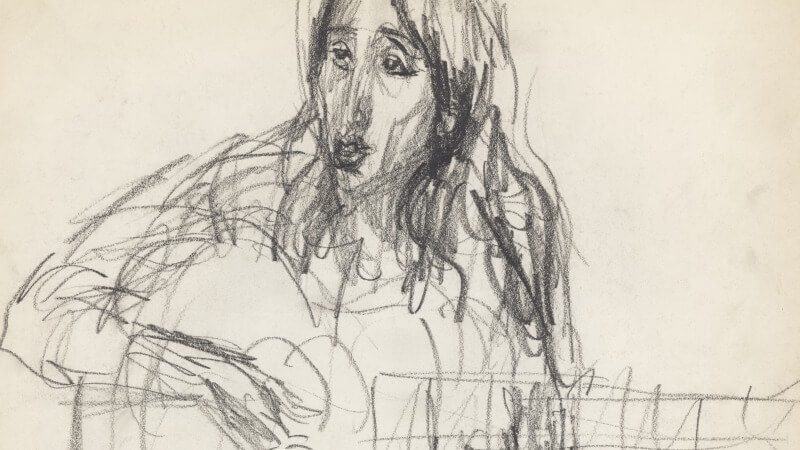
The first guitar that mattered to me was not mine. It was my dad’s: a regular‑guy acoustic in the corner of the office/playroom, strings a little dead, wood a little scuffed, transformed into a magic trick every time he played “Casey, Casey, Casey is my daughter / Casey, Casey, Casey, she loves running water” for the seventh time in a row while I spun myself dizzy behind the couch. In the grown‑ups’ world, guitars were supposedly dying, edged out by laptops and controllers and a whole discourse about “the end of rock.” In our house, the guitar was very much alive, if mildly exhausted, trying to keep up with a toddler shouting “(A)GAIN! ’GAIN! ’GAIN!” (I had yet to graduate to two syllable words) until its player’s fingers gave out. All I knew was that if my dad stopped playing “the monkey song” (the Grateful Dead’s “Monkey and the Engineer”) on his acoustic, I would riot.
Good thing he liked playing, because I was a menace. Whenever he tried to switch to the CD player to give his hands a break, I’d shove the guitar back at him. The crown jewel of my childhood setlist was “Casey Jones,” mostly because being a tiny kid with that name and hearing it shouted in a chorus felt like proof the universe had been written just for me. I spent years confidently belting “Driving that train, high on lo mein,” secure in the belief that the world’s greatest rock band had composed a song about eating too much takeout on public transit. My parents decided, reasonably, that replacing the whole drug thing with Chinese food was easier than explaining cocaine to a preschooler. Lucinda Williams’ “Drunken Angel” quietly became “kung fu angel” for the same reason. When I finally learned the real lyrics, it felt like someone had yanked up the backdrop behind my childhood and revealed a much grimmer set. The sky was blue, the grass was green, Lucinda was singing about a martial‑arts guardian with a guitar, and Casey Jones nearly derailed a train because he ate too much Chinese food—until, suddenly, all of it came into question. The guitar, it turned out, wasn’t just a purveyor of Family Fun Time Party Music ’GAIN ’GAIN ’GAIN, but an instrument of grief and heartbreak, a beautiful vehicle for the kind of wreckage adults try to filter out until you’re old enough to handle it.
The first time the guitar felt bigger than our living‑room ecosystem was in London, where my dad taught a course abroad one summer. I was nine, armed with borrowed headphones and a very exciting new iPod, and “London Calling” tried to tear the earbuds out of my ears. Their guitars sounded like the city: big, angry chords tolling over bass lines that felt like the chug of the Tube, Joe Strummer’s gruff, very British snarl piercing through the guitar clatter. “London Calling” didn’t feel like history to me so much as a forecast. It wasn’t about the grim conditions of the late 1970s; it was about what I imagined adulthood might be: chaotic and terrifying and electrifying and cathartic, all at once. Somewhere in there, a greedy thought crept in: I don’t just want to listen to this; I want to do this. That was the moment the guitar stopped being my dad’s property and started becoming a future version of mine.
In the meantime, my future arrived filtered through television and hand‑me‑down CDs. At home, my dad was basically a one‑man record club, slipping me albums by Pavement, Wilco, Silver Jews, Hole, Liz Phair, PJ Harvey, Modest Mouse, Built to Spill, and whoever else he thought might “take” with me on the drive to school. On my own time, I discovered Car Seat Headrest, Courtney Barnett, Hop Along, Jeff Rosenstock—all records that shaped my idea of what the guitar could be before I ever laid a finger on a fretboard. I thought of it less as one sound and more as a pack of personalities: the lazy‑sounding Pavement riff that turns out to be meticulously crooked when you try to play it; the Modest Mouse pattern that makes your right hand feel like it’s about to cramp; the Hole‑style power chords that feel like slamming a door; the delicate Built to Spill lead that somehow manages to be both huge and fragile at once. All of that lived in my head as possibility, waiting for a body.
Television, in the form of a brief tween American Idol obsession, added another layer: the guitar as a prop, as a credential. I watched contestants stand behind acoustics, fingerpicking ballads under soft lighting, and thought, with the naive certainty of a 10-year-old, that this was what being a musician meant: holding a guitar and letting the cameras zoom in while the audience cheered. I had a massive crush on Steven Tyler and that stupid fucking feather in his hair; I thought “Dream On” might literally be the best song ever written. In that world, the guitar wasn’t the punk engine or the key indie‑rock organ—it was a kind of halo, proof that you were “real” even on a glorified karaoke show.
By the time I finally got my own guitar, I was 14 and embarrassingly late to my own mythology. The instrument itself was nothing glamorous: a cheap acoustic that smelled like varnish and Amazon packaging, strung with nylon that sat just high enough off the fretboard to chew up my fingertips. No amp, no pedals, no distorted bliss.—just wood, strings, and the realization that the thing I’d been worshipping from a distance was, up close, stubbornly physical. My dad signed me up for group lessons at a local music store. Fridays were pizza days; the back room was full of kids trying to wrestle their hands into the shapes for “Pompeii,” “Smells Like Teen Spirit,” and “Blackbird”—whatever they had most recently printed out from Ultimate Tabs.
At home, I covered my bed with those same printed tabs and tried to turn listening into muscle memory: “Casey Jones,” “London Calling,” Modest Mouse progressions, Courtney Barnett’s scorched strumming, Car Seat Headrest’s lurch, a Pavement riff that refused to sound casual in my hands. Mostly, everything flattened into a singular kind of fuck-up, at first. My barre chords were crimes; my strumming patterns collapsed into the same muddy up‑down churn. But in those hours on my bed, pressing my too‑soft fingers into ridged strings, something shifted: the listening life I’d built around all those “cool” bands started to leak into my hands. Even that clumsiness felt like a revelation. Those electric‑heavy records suddenly had a physical counterpart in my body.
All of this was happening against a cultural backdrop that kept insisting we were in a “post‑rock” era, that guitars had been replaced by technology, that kids like me would rather drag loops in Ableton than wrestle with a stubborn barre chord. And it’s true that the laptop became an instrument in its own right for my generation. Friends of mine wrote whole songs inside the grid of GarageBand, built beats out of samples, treated controllers as their main axes. I got jealous of how clever it all looked: copy and paste, quantize the timing, undo your mistakes. But when I tried to make music that way, something in my brain flattened. I missed friction. I missed the weirdly analog feeling of time you get with a guitar, where practicing means sitting in a room and paying an almost ridiculous amount of attention to where your thumb is on the back of the neck. I missed, simply put, being bad at guitar. No matter what, the instrument itself kept insisting on being the center of gravity, the thing that made all those scattered influences cohere.
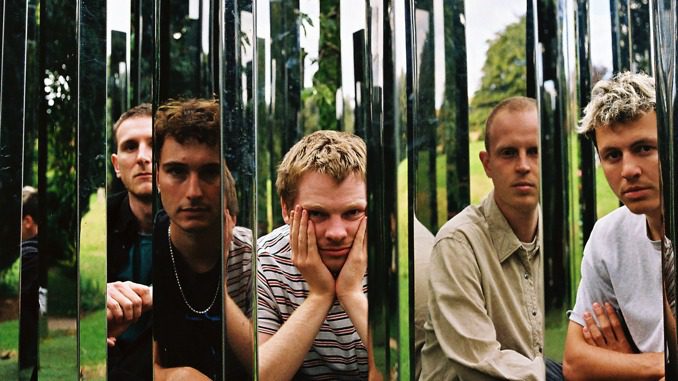
And for all the talk about guitar’s alleged obsolescence, the stuff that has made me most sure the instrument is still very much alive isn’t on those 1990s and 2000s albums—it’s in what my peers and near‑peers are making now. Take Geese, the Brooklyn band that has somehow managed to sound like half of New York rock history and still end up as themselves. They play with an unabashedly guitar‑first setup: multiple players, jagged riffs, parts that tangle and then lock in. Critics keep referencing Television, The Feelies, Radiohead, The Strokes, Parquet Courts—basically, a whole lineage of bands where the songs are built around twitchy, inventive guitar work. One of Geese’s guitarists, Emily Green, has talked about using a beat‑up mid‑’50s Silvertone Stratotone she found at RetroFret in Brooklyn, describing it as “like a baseball bat” that doesn’t play like any modern instrument, better suited to scuzzy, half‑broken‑up amps than pristine tones. That image—a young band in 2025 building their sound around a vintage oddball electric that fights back—feels like the opposite of death.
Zoom out and you get a whole little constellation of present‑day guitar bands. Acts like black midi, Black Country, New Road, Wednesday, and MJ Lenderman all take the instrument somewhere visceral and fresh instead of just reverently repeating old tricks. Squid’s Bright Green Field is full of nervous, flickering guitar parts that sound like they’re being played by someone whose fingers can’t keep up with their thoughts. Dry Cleaning’s records run deadpan spoken‑word vocals over wiry, post‑punk riffs, turning the guitars into a pressure system bubbling under this almost affectless voice. Add in the jangly, interlocking parts of bands like Rolling Blackouts Coastal Fever—three guitarists weaving lines together like they’re building a net in midair—and it becomes very hard to argue that guitar rock is gone; it’s just taken its weirdness and gone slightly sideways. Branched out, so to speak.
So when I tell the story of why I play guitar—why I keep picking up this unassuming acoustic in a world that keeps announcing the instrument’s demise—it’s never just about one band or one era. It’s a mesh. It’s my dad’s homemade songs and the Dead and the Clash, and it’s also Hop Along’s lurching crescendos and Courtney Barnett’s scorching riffs, and it’s also the knowledge that somewhere in Brooklyn a band like Geese is sweating under stage lights, dragging a temperamental Silvertone through another set, proving that guitar‑centered rock can still feel new. The instrument gave me a way to meet the music I loved halfway, to stop being just a listener and start being a so-so but earnest participant. The fact that I’ve mostly done that on a cheap acoustic, in an era supposedly defined by laptops, makes the “death of guitar” narrative feel even more abstract and, frankly, dumb.
My guitar is not particularly nice, nor am I particularly good at playing it. To be honest, it mostly lives on a stand in my room, waiting. But every time I sit down and start to strum, all those records move a little closer. The messy, oddly specific worlds that shaped my listening leak into my hands. And as long as there are kids forming bands around weird guitar shit, folk singer-songwriters fingerpicking arpeggios, and nervy post‑punk outfits writing songs that only really make sense when the right riff kicks in, it feels impossible to believe that the instrument that taught me how to listen, and then how to play, is anywhere near dead. To this day, whenever my fingers land on the right fret and the chord rings out, I still hear a faint echo of that toddler yelling “’GAIN, ’GAIN, ’GAIN”—and, well, what is a gal to do but oblige?
Casey Epstein-Gross is Associate Editor at Paste and is based in New York City. Follow her on X (@epsteingross) or email her at [email protected].