Listen to this article
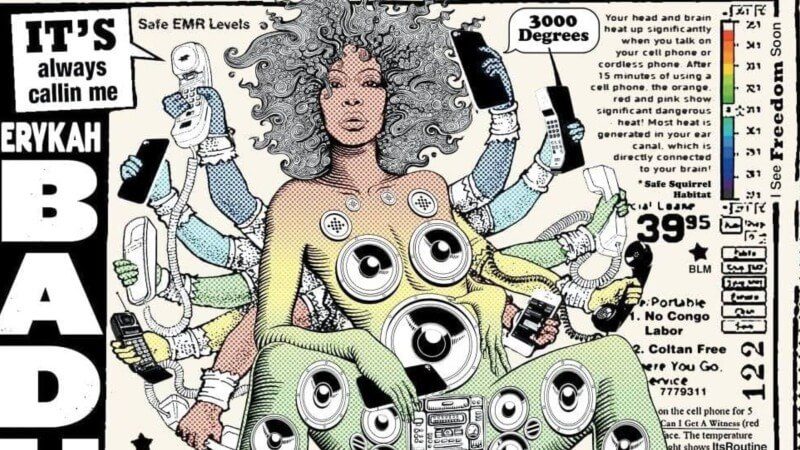
Erykah Badu didn’t play “Tyrone” at her 2018 show at San Francisco’s Warfield, but she did spoil the punchline. One of the best-loved products of her ‘90s head-wrap era, the epic breakup song climaxes with Badu imploring her mooching boyfriend to call his friend to help him pack up and move out—but “you can’t use my phone.” Laughter and cheers greet the funk goddess on the canonical version from 1997’s Live. At the Warfield though, the prevailing sound was discontented chatter, with that repeated line—but you can’t use my phone—echoing through the space on loop over the PA system. Badu fans learn to roll with her frequent lateness, but the more casual fans in the crowd were getting restless, especially because there’d been no word on an opener. When she finally showed up on stage, her slow and deliberate footfalls seemed like an elbow in the crowd’s ribs, a joke at the expense of her glacial way of doing things, as if to ask the crowd if another minute was really gonna kill them.
The track heard over the intercom was “Caint Use My Phone (Suite),” a “Tyrone”-sampling track that opens her 2015 mixtape But You Caint Use My Phone, which is, to date, her most recent release of substantial length. And if you thought her pace at live shows was frustratingly slow, consider that her last proper album was New Amerykah Part Two: Return of the Ankh, which came out 15 years ago. That’s longer than the gap between her peer D’Angelo’s Voodoo (which he worked on at the same time and with many of the same musicians as Badu’s Mama’s Gun) and his comeback/swan song Black Messiah. She’s been talking about a collaboration with the Alchemist for some time, which will hopefully come out soon—and hopefully not with the hideous anime-styled artwork she’s been teasing for it.
Why no ravenous demand for new Erykah Badu music? Maybe it’s a mutual understanding between artist and audience, the latter in unspoken agreement to let the former move at her own pace. Maybe it’s because she’s stayed in the public eye as a shaggy-dog media personality and frequent guest star, waxing mystical about her side gig as a doula and dropping in on sessions with everyone from DRAM to Damon Albarn. Maybe it’s because Badu’s best music is rarely her most serious, making it easy to take her less seriously than she should be taken. Maybe it’s because her pop culture image is, infuriatingly, that of a beguiling hippie chick who’ll have a man rocking dashikis a week after their first date rather than a brilliant and original artist—as the one-time partner of rap gods André 3000 and Jay Electronica, Badu has not escaped the scrutiny that attaches itself to talented women who shack up with talented men.
Or maybe it’s because her releases, infrequent as they are, feel so breezy and low-stakes. Even her most ambitious works, like Mama’s Gun and 2008’s New Amerykah Part One: 4th World War are driven more by her eccentricities and smoky muse than by the unapologetic desire to create masterpieces of the same caliber as her friends’, like Voodoo and Stankonia. Often, this is by design. Badu’s 2002 release Worldwide Underground is sometimes called her third album, but she called it an EP, and today she might call it a mixtape; despite the runtime lasting 50 minutes, it’s simply on a lower altitude than the albums that preceded and followed it, an artist chasing her own vibe like a dog chasing a squirrel.
It’s appropriate, then, that Badu would embrace the idea of the retail mixtape. One of the peculiar artifacts of the streaming era, the retail mixtape originated as a way for rappers like Future and Drake to make a buck off lower-stakes and more experimental releases while keeping audiences waiting for the proper “album.” Often, as with Drake’s defining If You’re Reading This It’s Too Late, these releases were really only distinct from “albums” by being shorter, looser, and weirder. But You Caint Use My Phone is more of a classic hip-hop mixtape in the sense that Badu’s putting her own spin on other people’s instrumentals, but its eventual vinyl release revealed how nebulous the term had become, and the retail-mixtape format must have appealed to her because it allowed her music to breathe without the weight of expectation.
[embedded content]
The tape’s tacit acceptance of Drake as the era’s pop king is what ties Caint Use My Phone most glaringly to its era. “Hotline Bling” had just gone from unassuming loosie to one of the biggest songs in the world during the peak of the now-disgraced Canadian’s pop dominance, and even Sufjan Stevens wanted a piece of the action. Badu, 44 when But You Caint Use My Phone came out, was old enough to be amused by this spring chicken turning Timmy Thomas’s Vietnam-era lament “Why Can’t We Live Together” into one of the goofiest memes in history. The drum pattern shared by those two songs appears throughout the tape’s 36 minutes, not least on a “Hotline Bling” cover called “Cell U Lar Device” that transcends the rocky legacy of gender-swapped pop songs through its opulently extended arrangement and our own awareness of her personal history (it’s funny to imagine that “you started getting dressed and going out more” might refer to André 3000’s ongoing quest as a flute-toting club-hopper).
The Timmy Thomas drums also appear on an epic cover of Todd Rundgren’s “Hello It’s Me,” featuring a guest turn from André himself, whose relationship with Erykah ended in 1999 but with whom she has seemingly remained not just friendly but flirty. Though Badu has said that the “squirrel” she refers to throughout the album is just a “good substitute for girl” that fits the rhythm better than “boy,” fans have speculated that it refers to the man she’s proudly introduced as her “baby daddy” onstage, and with whom she raised their son Seven long after their separation. (He’s not the only male interloper here; Badu recorded the tape with producer Zach Witness in 12 days after being pleased by his “Bag Lady” remix, and guest rapper ItsRoutine does passable dial-a-Drake on two songs, a useful skill in the mid-2010s). The most moving moment on the tape, and one of the most moving in Badu’s catalog, is the concluding refrain of “don’t ever change, squirrel.” Crucially, it fades out rather than having Badu hang up. She’s still on the line, it implies.
But because Caint Use My Phone is divided by such a long sea of silence on either side—the five years since New Amerykah Part Two on one, a decade and counting on the other—it’s hard to get a read on where or how it fits into her journey either as a person or as a musician. All the phone talk has the inadvertent effect of making it sound like a solitary transmission, an expression of isolation and longing even in spite of its communal origins. A phone call is an inherently lonely endeavor, because the other party isn’t actually there. Erykah doesn’t seem particularly happy here, least of all in contrast with the giddy love songs on New Amerykah Part Two, written during her relationship with Jay Electronica. The tone is tentative, with a lot of waiting and uncertainty; many of the calls made during the course of the tape either by Erykah or the prospective “caller” from the audience go unanswered.
And it’s hard to say if the tape’s slightness has more to do with its status as a mixtape in the classic, chatting-over-people’s-songs sense or a dearth of ideas on its creator’s part. On “Phone Down,” Badu repeats the mantra “I can make you put your phone down” vainly in the hopes it’ll somehow transcend itself; if you thought Solange’s exercises in repetition on When I Get Home were obnoxious, “Phone Down” will give you hives. With songwriting less of a factor than usual on these dreamy experiments, the tape relies heavily on Badu’s quirks of personality, like when she imitates the bird from Parliament’s Motor-Booty Affair on “U Don’t Have To Call,” or when she leaves a list of options for leaving a message before admitting she doesn’t check her voicemail. Her sense of humor is one of her biggest assets, and it goes a long way here.
Badu announced a mixtape not long after But You Caint Use My Phone. It never came. She announced another one after that. It never came. She’s slowly been working on her fifth album, or maybe it’s her sixth, which may or may not be the one with the Alchemist, I’m not sure. If she’d delivered on these promises, it’s worth wondering if Badu’s prolificacy would be welcomed or if she’d simply blend into the background, her mystique shattered in the absence of artificial scarcity. What would a theoretical Erykah Badu release from, say, 2017 even sound like? Would she dish about the Trump administration over XXXTentacion and Trippie Redd instrumentals, or return to the timeless funk and universal themes of New Amerykah? Were these tapes ever made? Will they ever come out? Only Badu knows the answers to these questions, but she’s chosen to let her answering machine just play.
[embedded content]
Daniel Bromfield is a writer, editor and musician from San Francisco, CA. He currently works as Calendar Editor at the Marin Independent Journal and is a prolific freelancer, with bylines at Pitchfork, Atlas Obscura, Resident Advisor and local media in the Bay Area. He runs the popular @RegionalUSFood Twitter account, highlighting obscure dishes from across the US. Find him on Twitter at @bromf3.