In Houston during the early ‘90s, DJ Screw pioneered what would come to be called the “chopped-and-screwed” sound. By slowing down his samples to a lethargic crawl, he warped them into such novel shapes that they sounded completely fresh, so much so that the original material would sometimes be difficult to discern at all. A chopped-and-screwed production style soon rose to dominance, spreading from its Southern U.S. origins to take root in cities across the nation and, eventually, the globe. These days, it’s a genre-agnostic stylization that continues to flourish online and has influenced everyone from Kendrick Lamar to Oneohtrix Point Never. Enter U.K. rapper and producer Tony Bontana, who posits the following question: What if chopped-and-screwed was more chopped and more screwed?
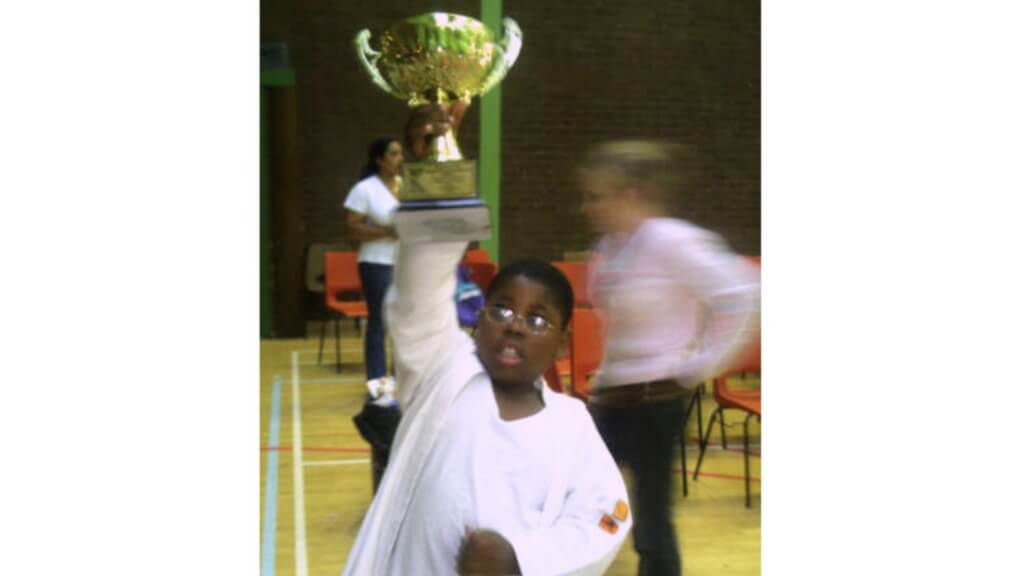
The result is what the Birmingham underground innovator refers to as his very own “splayed” sound. As Bontana himself has described it, the process involves lifting “a sample or a loop, and then processing it, degrading it to the point where it makes less sense.” Similar to how J Dilla approached production, the rhythms aren’t quantized or fixed to a standard grid. Rather, they’re fluid, like a canvas strewn with watercolors where diaphanous forms bleed into one another instead of adhering to strict contours. My Name, Bontana’s new album, is a showcase for his skills as an incisive emcee and imaginative beatmaker.
Someone as creative as Bontana understands the power of brevity, and he moves from one idea to the next at a rapid yet nonetheless smooth pace. Early highlight “Soft Dreams” offers a Midwest emo guitar backdrop for Bontana to excoriate those who remain grossly silent on the genocide against Palestinians, getting the point across in just two verses. “Time might run up so I gotta speak my mind, right? / Free Palestine, I could never turn a blind eye,” he raps, his voice loud and resonant over the gauzy instrumental. It transitions into the minute-long “John Osbourne,” a track built on cooing vocal samples, rhythmic synth stabs, and Bontana’s meditations on grief from his mother’s death. It shortly dissolves into “Absolution,” one of two tracks on My Name to breach the three-minute mark, whose ghostly chipmunk soul loops throughout the final minute or so before it filters into the brisk groove of the Leo Sierra-featuring “Recoup.” He covers a lot of ground in a small amount of time; its effect isn’t vertiginous so much as it is spellbinding.
As his vast, frankly overwhelming discography demonstrates, Bontana has a surfeit of ideas, both under his own name and via his many other projects, which includes everything from a hardcore band to a lo-fi-punk-meets-Parannoul endeavor. His production résumé includes high-profile names like Lil B and billy woods, and he was the only feature on last year’s excellent Nourished by Time album. For an artist that simply does not stop, it’s all the more impressive that Bontana has managed to craft something that stands apart from the pack rather than submits to the background. Many artists in the modern age bend genre to their liking, viewing it as a versatile ingredient as opposed to the final endpoint. Take a look at people like Jim Legxacy, 1010benja, or MIKE, all of whom Tony bears a resemblance to, occasionally at the same time: there’s the woozy, labyrinthine soundscape of “Microplastic,” the King Krule-core jazz and reverbed-to-death vocals of “About Face,” and the hyperkinetic, repeated drum fills of “Wherever I Go.” No matter the aural bedrock Bontana provides for himself, he easily finds a home in it.
Whether he’s behind the mic or the mixing board, Bontana proves an adept force. With such an extensive output, including four disparate full-lengths in 2025 alone, there’s little room for doubt that he puts his songs together fairly quickly. But that doesn’t make them feel any less considered. On his previous releases, he displayed the splayed sound, introducing his audience to its conceptual framework. My Name, by contrast, is not an introduction but an exhibition for those already familiar with his game. This is his apotheosis, the most fully realized project Bontana has released yet: a compelling portrait of an artist whose singular style refuses to be mistaken for anything else. [Everything Is Perfect]
Grant Sharples is a writer, journalist and critic. His work has also appeared in Interview, Uproxx, Pitchfork, Stereogum, The Ringer, NME, and other publications. He lives in Kansas City.