
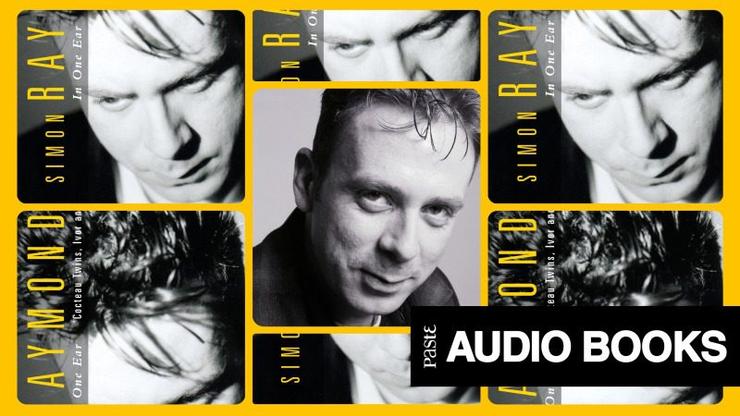
Audio Books is a column focused on the latest books about music. Every month, Grant Sharples sits down with authors, journalists, and poets to discuss the latest music memoirs, biographies, essay collections, and more.
Simon Raymonde has lived a storied life. From 1983 until Cocteau Twins’ breakup in 1997, he wrote for and performed on classic records like Treasure and Heaven or Las Vegas for the revered indie label 4AD. When his fellow bandmates Elizabeth Fraser and Robin Guthrie broke up in 1997, Cocteau Twins disbanded too, at which point Raymonde went on to found his own label, Bella Union, that same year, putting out records by Beach House, Fleet Foxes, Explosions in the Sky, Father John Misty, and more in a three-decade span.
With an imprint on indie music as both a dream-pop pioneer and band-breaking A&R man, Raymonde can reflect on his life with the sagacity of someone who’s seen many sides of the music industry. His memoir, In One Ear: Cocteau Twins, Ivor and Me, traces everything: his origins as a Joy Division- and Talking Heads-obsessed teenager; his extemporaneous induction into Cocteau Twins; his distant relationship with his father Ivor and releasing a compilation of his father’s arrangements on his label; Cocteau Twins’ poor reception opening for Metallica; going deaf in one ear; and a near-death experience while escaping a moving vehicle in Mexico City (you’ll just have to read the book for the details on that).
For the inaugural installment of Audio Books, I spoke with Simon Raymonde about revisiting his life by writing a memoir, how he got the initial idea to write this book, and learning more about his father’s musical journey and how that maps onto his own. This interview has been edited for length and clarity.
Paste Magazine: What gave you the initial idea to write this book?
Simon Raymonde: A mixture of things. I guess a lot of people were saying, “You should write a book,” because I’ve been around forever. With one career with Cocteau Twins and a musical life, and then the other career of running a record label, and then with my father and his whole life of music, people thought it would be interesting. I hadn’t come to that conclusion myself until much more recently. I didn’t really ever think of it as something I wanted to do.
But talking to Warren Ellis from the Bad Seeds and Dirty Three, who we’ve worked with on the label side of things for close to 30 years, he’d done a book called Nina Simone’s Gum, which had been really super successful, and he too had not really ever been interested in writing a book. But I talked to him a lot about it, and he just gave me some inspiration to write it. I came away from our meeting thinking maybe it is more interesting than I thought it could be. Never really thought it was something that I would have the patience to endure, because writing a book… It’s not like writing an article, which I have done many of. You’ve got to really go deep with it. I didn’t understand that until quite a way through the whole process.
I feel like writing an article is like a TV episode, and then writing a book is like a movie.
Yeah, exactly. I know friends who do movies and it can take nine or ten years before the thing gets made. I did think this could carry on forever. How do I get an agent? How do I get a publisher? I didn’t know any of the people that you need to know to be able to do it. But I was quite lucky. Maybe I didn’t realize the effects that being in Cocteau Twins had on people, and there were a lot of fans out there who wanted to be part of the story and part of the team, as it were. So actually, I was really super lucky with the people that I met who helped me along the way.
So when did you start working on the memoir?
It came out in the U.K. at the end of 2024. In the U.S., 2025—so I probably submitted the book at the back-end of 2023, because it usually takes a year to get a publishing date. So I would say I submitted it in the middle of 2023. I probably started it, with no idea what I was doing, around 2021 probably. And then I had a few false starts and thought I’d finished the book and realized that I absolutely was nowhere near finishing the book. I realized how many words you had to submit, and went back to the beginning, started all over again. I would say it probably took two years in total to go from not having anything much to having something that felt like a proper book with a beginning, a middle, and an end.
It was probably interesting to revisit all of these memories and formative experiences. How did you go about packaging all of that into a nice, tidy composite?
I went through a few phases with it. Ultimately, what I did was I got into the habit of writing every single day for about six, seven hours. I didn’t really do any editing at the beginning itself. I just wrote, got it out there. I would get to the end of the day, and then in the morning, I would check back what I wrote the day before and make a couple of little changes. For the most part, I wrote solidly for six months every day for six, seven hours. I didn’t really have mental blocks with it. I treated it a bit like going to work. I got up super early in the morning. I would go for a long walk in the morning before getting to a cafe, and I’d sit in a cafe with my headphones on. From about 8:00 in the morning until about 2:00 or 3:00 in the afternoon, I would write nonstop. It became almost like a kind of a regime, where you try to get fit for a marathon or something—where you do the same things every day, because you’re getting into this rhythm.
I’d read a little bit about how that is really one of the best ways to write a book, because if you’re just doing it every now and then, it is going to take forever. I’m quite a busy person. I’ve obviously got all these things in my life, as well as having dogs and a wife and kids and a granddaughter. I’ve got a lot going on, and if I’d have just treated it like, “Oh, it’s just a hobby. I’ll just get around to writing next week or find some time on the weekend,” it probably would have taken me forever. So I think creating that disciplined approach definitely worked for me, and it probably helped me get the book done a lot quicker.
The process started with discipline, and then, as far as tapping into the memory banks, which is something that I know a lot of people do really struggle with, I found that bit surprisingly easy. Not because I have a good memory. I have a terrible memory of things that aren’t very important. I have a really great memory of things that are important. How you decide what is and what isn’t is a different matter. But sometimes you don’t know if it’s important until much, much later on. Having a lot of memorabilia from the past really helped me. A tour book with the itinerary, with all the dates in it that you get at the start of a tour—I had kept all of those books for pretty much every tour [Cocteau Twins] ever went on. I don’t remember exactly all the dates on a tour—it would be impossible to do—but by having the book, I could go back, look at the thing, and then suddenly remember all these things that you were doing. Because I don’t remember things from 40 years ago. No one could, but by looking at a book, that opens the door a little bit into your memory banks. Once you’ve got your foot in the door, the door then is a little bit easier to push open. Other memories of other things come back.
Photography is another big one. Photographs from that era, or from the era that I was writing about, were definitely keys to opening up the memories—and speaking to a lot of my friends and getting them to send me photographs of things we did. I checked a couple of facts with a couple of mates pre-Cocteau Twins. When I was living in London with my friends, I would check the dates of certain things to be absolutely sure. When did I move into that flat? Who was I going out with at this time? I just found it really pleasurable to do, and it made me realize how lucky I am and what a really interesting life I have led. And I didn’t really realize that until I’d started writing the book and I’d be reading it back in the morning. That is actually really cool. What a great thing to have done.
I definitely didn’t find it a struggle. The only bits that were probably difficult were finishing it and having written way too much. I started off by writing not nearly enough, and then ended up writing way too much, and then having to obviously lose a bunch of stuff from the book. That was tough. But the editor, who’s also the publisher, was really brilliant to deal with. And I knew that whenever he said, “You should lose that bit; it’s not really very relevant,” I knew he wasn’t saying it because he was trying to piss me off. I knew he was saying it because he genuinely felt like it, as somebody who does this for their living, and I didn’t really argue with him more than maybe two, three times. He knows what makes the book work and what slows it down. So I had a lot of help on that side of things with the editing, because otherwise I would have probably just not changed anything. I would have left it super long. But I think he helped me make it a bit more concise. Other than that, it was guidance: I don’t know the first thing about writing a book, so having somebody that’s done it hundreds of times, and a literary agent who could help me with the contracts and finding the right publisher and stuff, I got very lucky.
You’re talking about going into the memory banks. But by writing this book, you’ve created a new artifact that you can refer back to and revisit your life and reflect.
Yeah, not only I can, but my kids can, and my granddaughter will be able to one day. And you know, it definitely feels like I put it all down on paper. This is my experience. Other people from that era, the other members of the band, will all have their own story, and I hope they, one day, will want to share that story too—because this is only my version of the events, and I think that’s the only way you can do a book like this. You can’t be worrying about what anyone else is going to think about it, or whether they’re going to be upset about this thing you said about them, or that thing you didn’t say about them. I just had to write it and not think too much about the consequences.
I don’t think I really threw anybody under the bus because that’s just not the kind of person that I am. That’s not that kind of a book either. It’s really more of a love letter to Cocteau Twins. Part of it, anyway. I thought, “Well, yes, I could talk about all the drug problems and how destructive that was. But does anybody care? Isn’t that obvious?” It’s blatantly obvious that that would be one of the reasons why we broke up—because of all this drama—and I don’t shy away from it. I do touch on it in the book, but I don’t go into great detail because I just think, “Boring! Rock and roll band has drug problems,” like, wow, tell me something I don’t know. I just didn’t think that was very interesting as a subject matter for the book. What’s far more interesting was the relationships, how we actually did things as a band, or how we didn’t do things as a band—because those are the questions we would all get asked, like, ‘Why does this music sound like this?” And whilst I didn’t come up with a definitive version of why it does, hopefully there’s enough pointers in there that people will find surprising and interesting as to how this music was made, because, as I say, it is only my perspective.
Like you said, a lot of things were cut, too. Were there any things that you really wish did make it into the book that didn’t make the final cut?
Not about that era, not about Cocteau Twins. Now, I think everything stayed in what I wrote. I think some of the things about Bella Union that I wrote were the things that mostly got cut because Pete [Selby], the editor, just felt that there was some stuff in there that was interesting to me, because I work with these people, but maybe not to a wider audience. They might not know who some of these bands were, and might not find it very interesting. They might find it self-indulgent, which I didn’t agree with, but I understood his perspective and the fact that I wrote 130,000 words and we could only have 100,000 meant I had to lose a third of a book. It wasn’t just a few paragraphs. It was really big chunks. So I knew that it was going to have to be butchered to a degree, but it didn’t bother me greatly, because I thought, “Well, this can be in another book.” If I eventually tell the Bella Union story, or whatever, I’ll just put it all in there—or I’ll use it on Substack. I didn’t think, “Oh no, what am I going to do?” There’s so many resources these days and places for one to do other writings. I didn’t think this was some amazing thing that I came up with that’s going to be lost to the world, if you could just stick it up on the internet somewhere. I didn’t have a big issue with there being things left out of the book. Maybe initially I did, because I didn’t really appreciate that I could do another book. I thought, “This is it. This is the only way to get this, so I have to have everything in there.” You fear that no one’s ever going to want you to do another book. But I have been asked several times to do another book, so I can use some of that stuff if I ever choose to.
If you were to do another book, what would you want to focus on?
Well, I don’t know at this moment in time. I haven’t thought that far about it, because a memoir is all these things that you’ve gone through, and that’s now done. I’m not going to go back there, but certainly the Bella Union story on its own, there is only a tiny bit about that in the book. There’s stuff about certain artists, like Father John Misty and John Grant. There’s a fair bit about those guys, but there’s an awful lot that isn’t in there. And because we’re getting to 30 years of the label now, in a year or so, that could be the time where I think this is a story that I could tell: the Bella Union story. It would be a very independent release, and I’m sure it wouldn’t get the kind of nationwide and global interest that this book did—because of the Cocteau Twins part of it, which was obviously a huge band—but that’s a story I definitely could tell without any issue at all, because I’ve been there for the full 30 years.
You mentioned earlier that you really wanted to hone in on the relationships and the processes of the band itself. What else were you really intent on getting across to the reader when you were first sitting down to write this book?
I wasn’t thinking about the reader at all. I was just thinking about telling the story from my perspective. I certainly was very confused about my dad and how I would fit his story in—because those of you that haven’t read the book yet who will read this, my dad was a famous writer and a musician and arranger in the ‘50s and ‘60s. When I was having my career in music, initially, for the longest time I just didn’t pay very much attention to what he’d done. It’s not that I wasn’t impressed by who he was, but to the point where I needed to get on with my own life and not be thinking back to what my dad did or didn’t do. That was another time that I’m just not interested in. Right now, I need to be doing my thing.
So I almost forgot about his life and his achievements until I was probably in my mid-40s or early 50s. It was only at that point that I was like, “I didn’t know this guy at all. Who was he?” He died relatively young, and I didn’t have much of a relationship with him. It wasn’t a bad relationship; in that era, you weren’t friends with your parents, whereas I’m friends with my kids. I think this generation, there’s much more communication. That wasn’t the case when I was growing up, so I needed to get the Ivor Raymonde part out, and I didn’t really understand how I was going to do that until I was writing the book. And, all of a sudden, all these connections that I have in music, they all seem to be following a very similar path to my father’s. I never thought that before. I always put him up there and me somewhere over there, you know?
I didn’t even think that we were in the same business at times. He was classically trained. He was working with string arrangements and orchestras, and I’m not, and I just didn’t put the connection there. But I think, by the time I got to the end of the book, I was like, “Oh, we actually did very similar things in so many ways, and we were much closer musically than I realized.” We even worked with some similar people, with the Scott Walker story. The book was very self-revelatory to me. It helped me make some sense of my relationship with my father that I hadn’t really hitherto appreciated. So from that perspective, it was really, really good.
On top of your revelations about your relationship with your father, were there other things that you were looking back on, and as you were writing, you had a realization about?
Perhaps, I think with Cocteau Twins. When you see it written down on paper, sometimes you don’t know where the words are coming from. They’re just coming out on paper, and they’re not thoughts you’ve had before; they’re just thoughts you’re having now. And they may be subconscious ones from before that are now conscious ones. I did find that interesting, looking at how I thought about the band because the band ended not great, you know? And the last few years were obviously a bit of a struggle with all the issues going on between Robin and Elizabeth and the breakup and the drugs. It was quite a dramatic band to be in, even though, publicly, people just listen to our music. And no one was really writing about this other stuff too much, which is how it should be. But I obviously was quite hurt by a lot of things during that period. As soon as Bella Union came along, I shut the door on Cocteau Twins. I could sit around moping about it and mourning the fact that I don’t have this cool band anymore—oh, woe is me. Or, I could just get up in the morning and get on with shit and do something else interesting. That’s how I dealt with the loss of the band but also the development of the record label.
Writing the book also helped me not have such a negative thought process when I went as far as the band went. I did have some incredibly positive memories and thoughts about the band that outweighed any annoyances I had over this or that. That’s what happens with bands. Bands are quite complex, and very easily you can get yourself in a negative state of mind—usually over money, or petty stupid shit that you don’t need to be bogging yourself down with. I talk to anyone about anything, because I feel like I’ve exorcised all those demons and they don’t annoy me anymore. I’m super grateful that I was in the band and that I got to experience those things with two incredibly talented people. Of course, there was shit to deal with, but isn’t there in everybody’s life? There’s drama in our lives every single day, and what I realized writing the book was that our drama was in no way any more significant than anyone else’s.
In the grand scheme of things, I’d much rather write about things that are super inspiring and that you can hold on to forever. The good stuff about Cocteau Twins is what I tried to write about, mostly because there’s so much of it, and mostly that’s to do with the music-making and the extraordinary way that we did create this thing. Because it’s odd: I know all these other bands that I’ve worked with for 30-odd years, and nobody writes music in the way that we did. Very few people do. It’s nice to be able to think about that and think, “Huh, that was really strange how we did that band.”
What were some of the most enjoyable parts for you to write about?
Some of the anecdotes are fun. I really enjoyed writing about the Lollapalooza episode, because it is hilarious that my band would have been invited to play on a bill with Metallica, Soundgarden, Rancid, and the Ramones, to name four. It’s not a bill anyone would have come up with. If you were thinking of naming five bands that should play on a bill with Cocteau Twins, the other four would not be names that were thought of. I enjoyed telling the Metallica story. I had written about it before. I wrote a piece for The Guardian about it just after it happened. But I completely changed the way I wrote about it in the book. It’s quite funny: these things at the time seem like, “Oh my God, what horrible things to have to go through.” But 30 years later, you can look back on it and think it’s hilarious. Why would we have even done that? They wanted us to do the whole tour, but to agree to do one show and then have that show be in Kansas City? It’s funny. It’s the last place we should have played to have made Cocteau Twins go down well, you know? So that was fun to write about.
Obviously, the Mexico incidents were fun to write about. My dad’s story was the most fun because that isn’t my life. That was writing about somebody else’s life, and my mom left me these audio tapes when she died of conversations that she’d recorded with my dad before he died about his life, and I hadn’t heard any of them. She died in 2017, so it was only after that I had these tapes. Thinking about how they would fit into this book, how I would use them, and whether I would use them as my version of his version, or actually let his words do the talking… In some circumstances, that was the best way to do it. But I really enjoyed that part, because it made me understand his life better. I didn’t know any of this stuff until the last five or six years, but he’s been dead since 1990. That’s pretty much half of my life. I’ve not known any of the stuff that’s in the book, so it’s all still quite new to me. Like, wow, he did this, and he did that, and this was his background, and this is how he got started in music: by busking. It’s fascinating, because it’s not a story I grew up knowing.
What are you most proud of with this book, now having written it?
Well, the fact that it’s authentic. I told the story as it was. There’s nothing in there that never happened. Some people have said to me that the Mexico story couldn’t possibly be true. A few people have said I definitely exaggerated. But I 100% didn’t. I couldn’t, even if I tried. Thankfully, with the Mexico stories, about ten people were there and know everything that happened was true. [I’m most proud of] telling my own story in my own words and feeling proud that I could write a book. I’ve written plenty of 1,500-word essays and articles for magazines like Pitchfork and The Guardian or whatever, and I always enjoyed that, but I never thought of myself as a writer of a book. I still don’t, but having done the audio book in my own voice, and having written this book and have it come out in paperback and on hardback, I was like, “Yeah, I did that book, and I’m very proud of what I wrote.” It feels authentic. It’s something I spent a lot of time on. Maybe five years ago, if you’d have asked me if I could do it, I would have probably said, “No chance.” So the fact that I’ve done it, and it’s out, and it got published by a nice publishing company, and that you’re sitting here talking to me about it, it shows that it must have had some impact. People have been saying lovely things about it, so that makes me happy. If people can get to learn a little bit about my old band, or about my dad’s music, or about some of the bands on Bella Union, and then go and buy some music and listen to some more things that they didn’t know about, then that’s only a good thing, right?
I felt like I learned quite a bit about your dad and his fairly prolific musical output, which I had no idea about.
And why would you? There’s so much in there that I didn’t even know about until recently! Discovering this about my dad, it was an incredible thing to be doing late in life. But also, there’ll be things from that chapter about 1979 which is, as I say in the book, my favorite year in music. I was 17. When you’re 17, you love the music from that era because it’s when your mind is expanding and you’re going out with your friends to gigs. A lot of people have reacted well to that chapter because they say they stopped the audio book, or they stopped reading the book and listened to those records to have a little flavor of what I was listening to during that year. That’s really lovely, the fact that people can discover things that they didn’t know about, that I might have given them a tip off about. That’s how I discovered a lot of music.
Grant Sharples is a writer, journalist and critic. His work has also appeared in Interview, Uproxx, Pitchfork, Stereogum, The Ringer, Los Angeles Review of Books, and other publications. He lives in Kansas City.