
“Don’t believe the hype,” a teenage Alex Turner says in the music video for “I Bet You Look Good on the Dancefloor.” Immediately after that statement, Turner and the rest of his bandmates in Arctic Monkeys—drummer Matt Helders, guitarist Jamie Cook, and former bassist Andy Nicholson—make that a hard command to follow. Helders counts everyone in with four quick stick clicks, and a jolt of pure adrenaline kickstarts the song. Guitar harmonics interlock with Helders’ rapid-fire snare-and-hi-hat pattern. Turner’s fingers scale the fretboard in a brief but fiery garage-punk solo, and the quartet settles into a steady groove before Turner delivers another indelible manifesto: “Stop making the eyes at me, and I’ll stop making the eyes at you.” For 20 years and running, no one has averted their gaze.
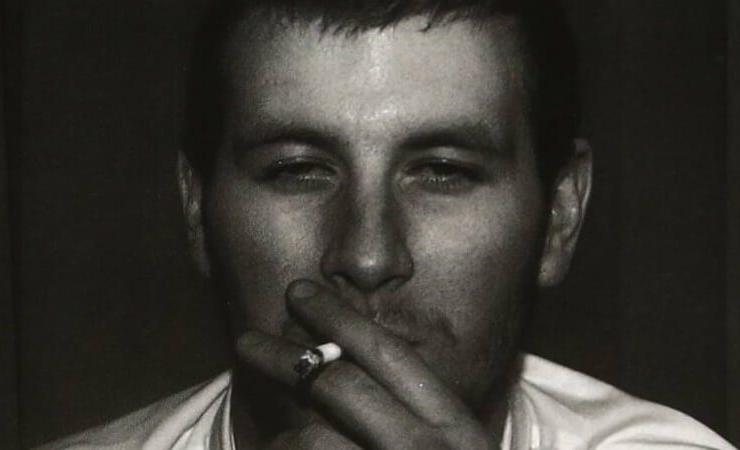
When it came to Arctic Monkeys—whose debut album, Whatever People Say I Am, That’s What I’m Not, released twenty years ago today—it was hard not to believe the hype. After all, the hype was built into the band’s mythology, a palpable force from even their most nascent beginnings. At their earliest shows, the Sheffield rockers handed out free copies of 2004’s Beneath the Boardwalk, a collection of 18 demos that garnered so much buzz that it eventually leaked online through file-sharing services. Many of those songs, including “A Certain Romance,” “Riot Van,” and “Still Take You Home,” would make it onto their debut proper. It was presumably because of those leaks that Domino released the album a week earlier than planned. The label has never officially stated as such, but the exact same scenario unfolded with Franz Ferdinand, whose self-titled debut, released two years prior, also came out a week early after internet leaks, so people put two and two together. It doesn’t matter, though; Whatever People Say… quickly became one of the fastest-selling debut albums of all time.
Yet even with all the attention Arctic Monkeys generated, there’s still a scrappiness present on Whatever People Say…, a roguish punk throughline that they would go on to completely sever just a few years later. At this point, the writing was on the wall. They knew they were on the brink of becoming the Next Big Thing, but they still resembled four teenagers playing loud, fast music in a garage, largely because they were four teenagers playing loud, fast music in a garage. It’s a fun trajectory to think about, given that they’re now one of the biggest rock bands of the century. Before they delved into desert-rock on Humbug, arena anthems on AM, and lounge jazz on Tranquility Base Hotel + Casino, they wrote infectious bangers that were simple yet no less sophisticated. There’s the rumbling toms of “Dancing Shoes,” the frenetic starts and stops of “From the Ritz to the Rubble,” the full-band explosion of “When the Sun Goes Down.” Across its 13 tracks, the band plays with an unrivaled verve that’s become rare in indie rock as of late, even within the Monkeys’ own catalog.
From the performances to the lyrical material, youth is the common ground here. Turner has mentioned that the record’s overarching narrative follows Sheffield’s nightlife. Think a British After Hours, but less feverish and bizarre than hedonistic and debaucherous. “Riot Van,” featuring longtime collaborator James Ford on electric piano and organ, portrays a group of teenagers who get caught for underage drinking; “From the Ritz to the Rubble” depicts a “totalitarian” bouncer who makes “examples of you” by throwing inebriated, overly confident patrons to the pavement; “Fake Tales of San Francisco” finds its protagonist watching a mediocre bar band who are, for lack of a better term, total posers. This is a 41-minute aural document of a night on the town, framed through the eyes of someone who’s equal parts neutral witness and active participant.
Turner’s magnetism as a performer was there from the start, even as his style shifted over the years into that of a slicked-back crooner style, a persona better suited to the labyrinthine, interstellar music of their two most recent records. Here, though, he fully leans into the bratty, rambunctious delivery the loud, brash instrumentation around him is begging for. In the chorus of “I Bet You Look Good on the Dancefloor,” his voice sharpens into a yelp, breaking the melody to shout the final few lyrics instead. On “Mardy Bum,” one of a small handful of the album’s midtempo moments, his singing assumes a quieter, subdued affect to mirror the romantic conflict at hand. His voice is laced with a light rasp, a far cry from how we hear him now.
For all of Turner’s charisma, though, you cannot ignore the band’s secret weapon that is Matt Helders. The propulsion of Arctic Monkeys’ early years is largely indebted to his drumming, right down to the preliminary fill that launches opening track “The View From the Afternoon” and, by extension, the entire album itself. He injects a burst of momentum following the guitar-and-vocals intro of “When the Sun Goes Down.” In “From the Ritz to the Rubble,” he alternates his pattern every two bars in the chorus, maintaining a kinetic flow and high-octane thrill, like a rollercoaster that never coasts into a staid taxi. We’d get glimpses of this version of Helders on later songs, namely “Brianstorm,” “Pretty Visitors,” and “Library Pictures,” but they’re few and far between. Arctic Monkeys, if you’re reading this, consider this a formal request to let that man rip again.
These days, it can be hard to remember that Arctic Monkeys used to sound like this. They’ve only retreated farther into their own eccentric orbit on albums like 2018’s Tranquility Base Hotel + Casino and 2022’s The Car, and it’s a delight to hear these once-boisterous garage-punk revivalists indulge their most outré inclinations. But this is a band that also excels at simpler pleasures; they were part of a UK response to what had been happening in NYC at the turn of the new millennium. Across the pond, there were the Strokes, Yeah Yeah Yeahs, and Interpol—so the UK, about two years later, had Bloc Party, Franz Ferdinand, and, of course, Arctic Monkeys. Before they went on to sell out arenas and reach streaming numbers in the billions, they were just a crew of kids making fast, loud, and catchy music. Alex Turner was wrong. You should’ve believed the hype.
Grant Sharples is a writer, journalist and critic. His work has also appeared in Interview, Uproxx, Pitchfork, Stereogum, The Ringer, Los Angeles Review of Books, and other publications. He lives in Kansas City.