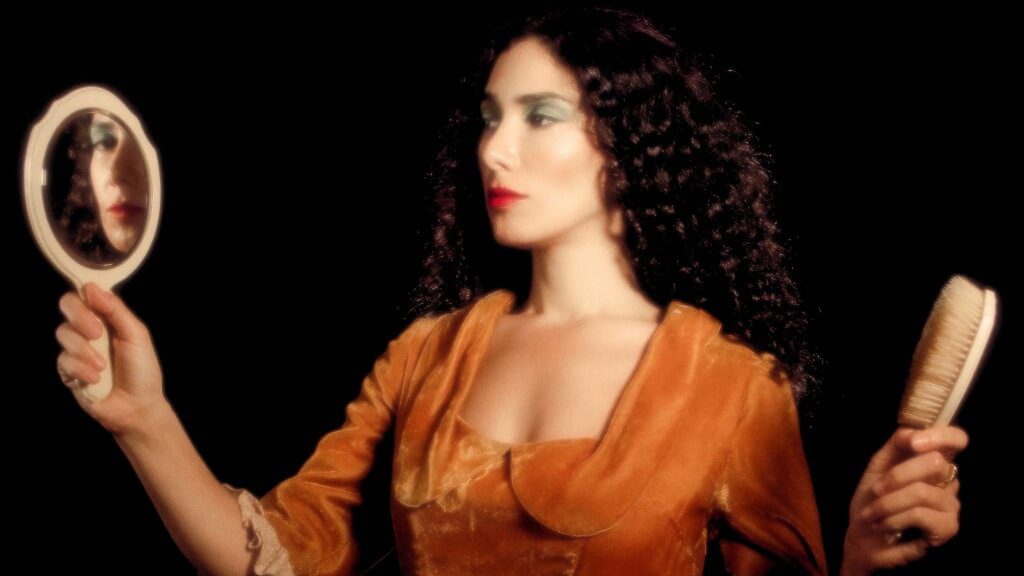
The word bedouin, the gallicized version of the Arabic badawī, translates roughly to “desert-dweller.” The Bedouins, a nomadic group in the Middle East, have been thrust from place to place throughout their eight-hundred-year history. To maintain an identity in such circumstances is no small feat. It requires a special care for the stories you hear, the mythology, and the family secrets murmured in passing. When the Syria-born, LA-based musician Azniv Korkejian adopted the name Bedouine, she was bound to bring those ghosts along with her.
A New Direction in Songwriting
Bedouine has long been a beloved voice in the folk scene, known for her measured intentionality and a voice that has drawn comparisons to legends like Karen Carpenter and Nico. However, on her new record, Neon Summer Skin, she pivots toward a more visceral source of inspiration: her own family history. With the help of her partner and long-time collaborator Guy Syffert, as well as Michael and Brian D’Addario of the Lemon Twigs and producer Jonathan Rado, she has crafted her most personal work to date.
Born in Aleppo, Syria, in 1985, Korkejian spent her early childhood in Saudi Arabia before her family moved to the United States via the Green Card lottery. After years of nomadic living—a lifestyle she describes as “restless”—she eventually settled in Los Angeles. Yet, as the political climate in the Middle East shifted and her parents moved to Armenia, the singer found herself grappling with a profound sense of displacement. “I felt like I no longer belonged to a family,” she explains. “There’s no anchor. It feels too light.”
The Weight of Memory
Neon Summer Skin serves as an ode to a version of her family that no longer exists. While her previous work was characterized by a clear-eyed serenity, this album is searching and needy. The track “On My Own” acts as the record’s galvanizing force, capturing the heavy heart she felt after a final, transformative trip to Saudi Arabia. She describes her lyrical approach as “bloated” in the best sense—packing words with so much meaning that they create a distinct texture and emotional weight.
The album’s centerpiece, “Canopies,” recounts her mother’s childhood in a Lebanese orphanage. It is a heart-rending exploration of the gaps in family history, whether those gaps were left for convenience or protection. This leads into the Armenian-language track “Deghma Cheega,” a song that confronts the immigrant experience with a stark, inevitable truth: “I lived, there was nowhere to go.”
Defining Home
The struggle to define “home” remains a central theme throughout the record. On “White Patent Leather,” written while on tour with Father John Misty, she explores the cultural rituals of her youth, such as the sacrificial lamb ceremonies common in Syrian weddings. It is a song about observing one’s own culture from the outside, trying to find a place within it while simultaneously rejecting its darker elements.
Ultimately, Neon Summer Skin is a quest for normalcy and the feeling of safety that comes with a stable home. As Bedouine sings on the title track, she is reaching back to a childhood that was once protected, hoping to pass that sense of security on to her own daughter. In doing so, she has found a way to return to the places she can no longer physically visit, proving that while home may be inaccessible, it can still be preserved through song.
Neon Summer Skin is out June 5 on Thirty Tigers.