Sam Rosenberg’s monthly column CineMusic highlights newly released film scores, soundtracks, and the composers/curators behind them.
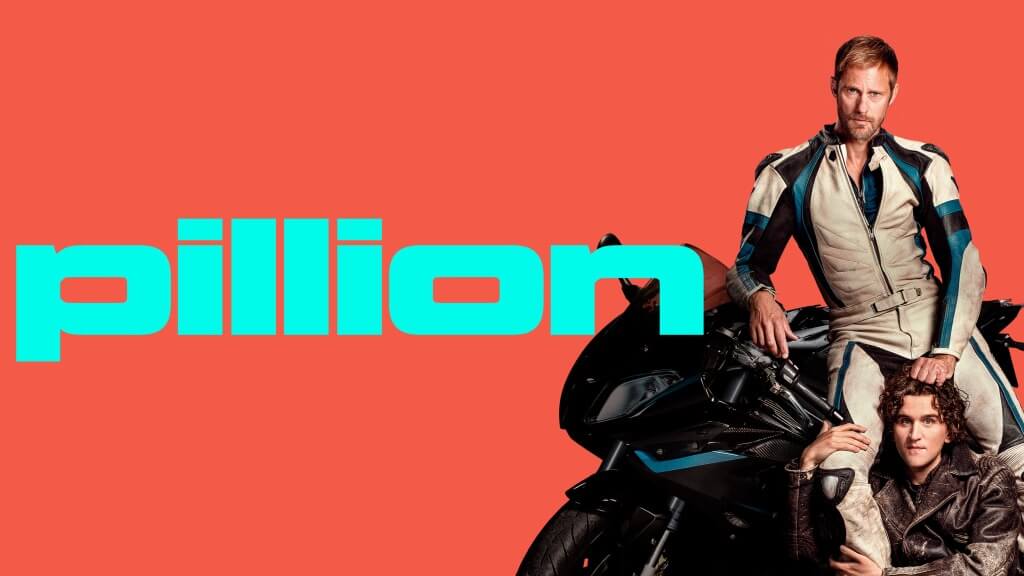
When thinking about a film that depicts BDSM culture, one might expect it to have a score made up of heavy, sinister, clubby synths. Not so in Harry Lighton’s dom-com/coming-of-kink feature debut Pillion, which follows the timid and lonely Colin (Harry Melling) who becomes a submissive for laconic motorcyclist Ray (Alexander Skarsgård). Though its sex scenes are explicit and rough, Pillion (named after a motorcycle’s passenger seat) is surprisingly sensitive in its exploration of gay male intimacy, showing how the power dynamic of such a rigidly defined arrangement can be both carnally hot and emotionally difficult. Composer Oliver Coates translates that tension beautifully through the film’s melancholic score, using subdued piano melodies and romantic strings to capture the tender heart beating underneath Colin and Ray’s relationship.
Such a compelling output from the London-born, Glasgow-based musician isn’t a surprise, given the tremendous resumé under his belt. Since graduating from the Royal Academy of Music, Coates has collaborated with a list of notable electronic indie bands, ranging from Sigúr Ros to Massive Attack. He contributed work to Jonny Greenwood’s scores for 2012’s The Master and 2017’s Phantom Thread, as well as Mica Levi’s score for 2014’s Under the Skin. Along with putting out his own solo work and assisting avant-pop artist Joanne Robertson on her 2025 record Blurrr, Coates has written and created music for a series of other recent projects, including Charlotte Wells’ acclaimed 2022 drama Aftersun, Steve McQueen’s sprawling 2023 documentary Occupied City, and the period piece miniseries Mary & George.
Over Zoom, I spoke with Coates about his score for Pillion, reworking a classic Satie song, the influence of synth-pop pioneer Gary Numan, and collaborating with opera singers and ML Burch. This interview has been edited for length and clarity.
******
Paste Magazine: How did you first get connected with director Harry Lighton? What was your experience like working with him and the process of making the score?
Oliver Coates: I met Harry for a dinner a year and a half before I got the Pillion script. He was working on another project and I was doing a TV show, a period drama, and I met him. I don’t know what stage he was at, actually. I didn’t really know anything about what he was working on. We were just gently talking about various projects. There was another director at the table as well and it was more about this other project, so I gently got an idea that Harry was a writer and was thinking about his first film. When I got that script, I think I got the tagline: “BDSM comedy, something, something, Skarsgård, something.” But then, I read it. I read it on a day that I was flying from here, which is Glasgow, Scotland, down to London to attend the premiere of [Mary & George]. I read it on the plane and I found it so funny. It hit these jangly nerve endings in my body in a particular way.
I left these really irritating voice messages for Harry just articulating all the ways that script was powerful to me. Because, yes, it’s about what it’s about, but in a way, I thought the pillion thing and the idea of rules and submission could be an allegory for all of our relationships. In so many ways, we’re often in grey areas. We often don’t know where we stand with friendships, boss relationships, dynamics. Often, people get a bit uncomfortable. Are you my friend? Where are we on stuff? In this film, they name it. They call it “pillion,” and it’s very clear, and they get to be together under this circumstance. I thought it was really interesting. Also, I remember on the plane, there was a guy who was getting some snacks from the stewardess and they were having a weird, awkward thing where he was grinning her about what the snacks were. He was trying to be charismatic and larger-than-life and she wasn’t playing along and she was just holding it out and he chose a kiddie snack by mistake.
To start with, I made recordings of sounds that were leathery and time-stretched using cellos and dark synthesizers and things that kind of rumbled and squeezed and stretched. From the script alone, I got a far more experimental feeling. A lot of that actually is there in the end, low in the mix: bass rumbles, using the cello to imitate motorcycle stuff, sexy leathery stuff. But [Harry] was really looking for a particular kind of melancholic, romantic thing that took me a long time, about two or three months, to find a melody—or two melodies, in fact—that had a bittersweet lightness. The film is marketed as a certain thing, but it’s actually a very subtle, tender film. In the end, these piano pieces and delicate articulations of a type of melancholy that also was a bit funny, that was beautiful but not spiritually beautiful but on the earth, secular beautiful so we could feel sympathy for Colin (Harry Melling)—it took a while. I sent him lots of drafts of different bits and pieces for us to fix on a couple of themes that we then spread throughout.
Just to clarify: Did Harry [Lighton] already envision the score being more ambient and piano-driven, or did that idea emerge through a conversation with him?
I don’t think we ever really know. I think you might have strong conversations going into a thing, but, actually, the work itself over time starts to tell you what’s sticking and what’s not sticking. You do a lot of testing. Harry could really feel emotionally all the corners of these characters and how they intersect and any sound that felt outside. So for example, in some of the early drafts, I had sounds that were a bit too cathedral, a bit too beautiful in the forests, and a bit too almost spiritual, and he helped encourage me to bring it down from being serious and earnest to a slightly more laconic, humorous type of beautiful. So it’s a slow thing of, I’m sending him suggestions and offerings and we work it out together. At one point, he said, “I think we should use the accordion,” so I went and sampled accordions and played a few different instruments, but we binned it all because the color of it was drawing too much attention. So in the end, I used a mixture of different types of voices, pianos, and keys. And then, just at the very end, it hits a certain point where the full flood of sentiment, like 12 cellos, comes flooding out to hit a certain breakup moment where we just let it pour out. We had all this experimental stuff bubbling under the surface that we could use in the toolbox, but then, there were these lighter themes.
I’m curious if there were any outside inspirations in creating the score. To me, parts of it have a vague hint of Aphex Twin.
Well, that’s definitely music I’ve grown up with in my wheelhouse. I guess my ears, my sensitivities, go that way. But over time, what happens with a director like Harry is you learn his sensitivities and you learn what frequencies, textures, and transparencies he can bear. It really is a collaboration. He came up to Glasgow and we went through all the cues by note to really make sure that we didn’t go too bittersweet too soon, that we were radiant with these relationships being normalized, that we shouldn’t go too complex and dark until we need to. He was really funny about the character Ray (Alexander Skarsgård) because he said, “This is what we want him to be. He’s kind of inscrutable. We don’t know where he’s come from. We can’t place him. But he wants to play the piano.” I showed Harry this Satie song “Gymnopedie,” which he didn’t know before and he loved it. He stuck it in there and got Skarsgard to learn piano for a couple of weeks. That was brilliant. Then, we did an electronic version of that track, almost an absurd synth arpeggiation version. I’ve been listening to Aphex all my life, so it does make sense that certain kinds of synthesizers and tone or even harmony are central to that.
Skarsgard playing “Gymnopedie” was definitely a standout moment, and then we hear your electronic reworking of it. Can you go more in-depth about your approach in reinterpreting that specific song?
Do you know Gary Numan? There’s a Gary Numan electronic version of that same piece and that was in the temp. They basically had that and loved it. I had suggested “Gymnopedie” as a piano piece. [Lighton] said, “What would be a piano piece that Ray could be learning in his house as an amateur pianist?” I was quite interested in amateurism all the way through the film, not like being a consummate performer or a mega-talented anything. Colin too makes music as part of his life. He sings in the local pub. It’s part of his family. So Ray’s there. We picked that piece. Then, we found the Gary Numan synthetic version. So, my version is basically me doing a cover of a cover: finding my synths, tuning my synths, and then also putting this cello in there to play the melody and harp. I used a harp in almost a comedy way. When they were driving down these country roads towards the forest escapades that they have, the “Gymnopedie”—it’s a precious piece of music, that one. It’s really canon. Satie was such a beautiful eccentric in history. Just exploding another version of the “Gymnopedie,” which has got nothing to do with the original but had all the weird and wonderful colors of Pillion, was really good. It came out of copyright—that track, that piece of music, whatever—70 years after his death. Like, in the year Pillion came out, it was completely appropriate that we were able to use the Satie and do whatever we wanted with it. It coincided with the copyright elapsing.
What is your personal relationship to the themes and story in the script? Did that shape the sound and mood of the score at all?
I’m less interested in myself. I want experiences that dissolve my ego. I’m interested in letting go of any buildup of any ego that I have over the years of musical strong taste. Actually, with every project I do, I quite like it if I find myself way, way outside of things that I would’ve expected doing. Some of this Pillion music, I can’t really believe it happened. The “Sex & Bonfire” track and a few other tracks in there—I would’ve never have imagined making that. That’s entirely Harry’s script, vision, and articulation of the emotions that resulted in this kind of music.
There was one thing, though, which was using the voices. I used ML Buch’s voice at one point. She’s a wonderful singer from Copenhagen. Also some Scottish singers and my friend Nick in Australia. We were doing things with high and low and different registers and different types of singing, but we had this one wonderful opera singer who’s singing really high, like beautiful high, and just the right amount of wobble in the sound. But dragging it down digitally into a quasi-androgynous zone, like slightly masking the male-female, resulted in this beautiful tone that I never discovered before. Some people said to me they thought this tone was like a string instrument, like a Mongolian horsehead fiddle or something, but it’s a voice that’s shunted down digitally and the artifact of the sound comes with it. It results in this really curious, haunting, slightly funny, but very moving, almost mournful opera sound that we use in a few places that I love and I want to use again and again. That was a Pillion discovery for me.
That’s very cool that ML Buch contributed to this sea of voices.
She did two tracks in particular. She did these melodic hooks. She was here in Glasgow. We were doing some other stuff and she was very kind to give her time to some of these hooks.
You’ve worked with other composers before, like Jonny Greenwood and Mica Levi. I’m curious what those experiences were like and if those specific collaborations have informed your approach to making scores.
Definitely. I had a past life in a way when I lived in London and was a session musician, running around to survive with my cello. For their scores, that was my early introduction to film work. I didn’t do the There Will Be Blood score—I did the live version of that—but I did The Master and Phantom Thread and The Power of the Dog. I did a whole bunch for Jonny and that was great. He’s a friend. Lots of lovely session work. You turn up and just give it your all, but thank goodness, you stop at 5 pm and play the notes on the page and you also think of alternative solutions for that composer. Mica’s an old, old friend. Mica doing Under the Skin was just brilliant because it was a discovery for them. That was their first film. There were nine string players and again, I was just a session musician helping out and giving my all and Mica plays viola as well, so I was replacing, I think, some of the viola bits. There were some magnificent people on that. But that was my first experience seeing what it was like for the composer to be working with substantive pieces of music that they wrote that were then going to be chopped and edited and experimented with and cut up and what the relationship is between writing away from the picture versus writing specifically to the picture. You have to attack these things in a variety of ways. I never thought at that point that I would be doing it myself, but somehow, I had fallen into doing it myself as well.
Are there any film scores that you have affection for, or any film composers who have influenced you in some way, not just with this project, but in general?
In a zen way, I like to think about Thomas Newman. He represents a kind of psychological clarity and humbleness. I love his attitude and I love the sound of his work and the transparencies of his scores. I love 1917, which is a darker and thicker one. I love American Beauty because American Beauty is one of those magical things. There were Indian instruments like tabla in a dark comedy in suburban America. Everyone knows and loves the famous piano theme, but the Indian instruments, no one knew that would be the right fit and I love that. I love things that don’t make logical sense, but they just totally work. That’s what I’m always looking for. Logic flies out the window when you just test. When I’m stressed or not sure how to adjust or how to make the change, I think about him.
That’s so funny you say that because I interviewed Daniel Lopatin for the Marty Supreme score a couple months ago and he also said that Thomas Newman is a huge influence for him.
Oh, really? That’s cool. The sound of his work is beautiful. That is an interesting Trojan Horse. His actual music is very exploratory. He does all kinds of interesting progressions and colors and stuff, but of course, there’s this beautiful polish to his music. It doesn’t scream for attention. It’s not grabbing you, but once you dig in, you’re like, “There’s all kinds of evocative harmonies and techniques going on under the surface.”
Sam Rosenberg is a filmmaker and freelance entertainment writer from Los Angeles with bylines in The Daily Beast, Consequence, AltPress and Metacritic. You can find him on Twitter @samiamrosenberg.