Listen to this article
Sam Rosenberg’s monthly column CineMusic highlights newly released film scores, soundtracks, and the composers/curators behind them.
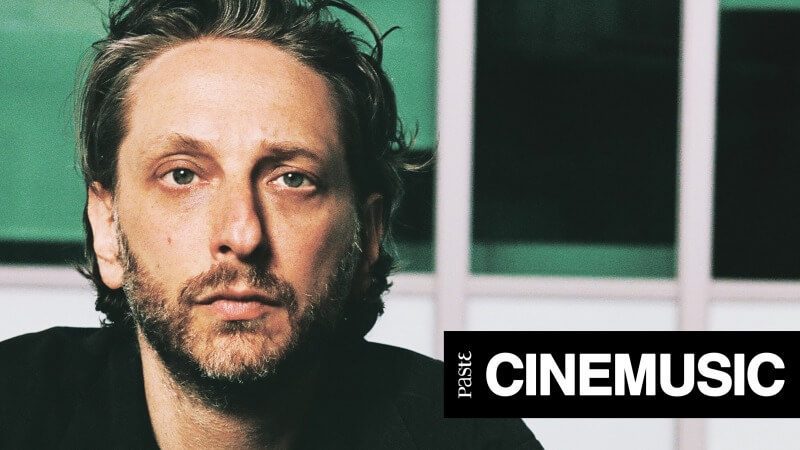
Despite being set in 1952 New York, Josh Safdie’s Marty Supreme isn’t your typical period piece film. The sports drama follows the trials and tribulations of Marty Mauser, a young and stubborn ping-pong maestro played by Timothée Chalamet, whose single-minded pursuit of greatness is soundtracked by a series of ‘80s needle drops and a riveting, cosmic score by Daniel Lopatin, best known by his stage name Oneohtrix Point Never. The movie marks the third collaboration between Lopatin and Safdie, but it might just be their most emotionally epic one yet.
Much like his OPN records and scores for Safdie’s other pictures, 2017’s Good Time and 2019’s Uncut Gems, Lopatin’s work on Marty Supreme draws heavily from the shimmering electronic sounds of ‘80s new wave. All the trademarks are there: propulsive percussion, operatic choirs, fluttery flutes, sci-fi/horror-adjacent synths and organs. The sonic anachronisms might catch people off-guard—the Peter Gabriel, Alphaville, and Public Image Ltd. needle drops certainly did for me—but it’s a mostly effective (and definitely entertaining) method that captures the friction between Marty’s eager ambition to be the best and the many existential, professional, and financial obstacles he’s up against in doing so.
Over Zoom, I spoke with Lopatin about his score, how Tears for Fears served as major inspiration, his longtime collaborative relationship with Josh Safdie, his favorite pieces from Marty Supreme, and his love for composer Thomas Newman. This interview has been edited for length and clarity.
Paste Magazine: To start, I would love to hear about how you first conceptualized the score. What were some of the inspirations? Correct me if I’m wrong, but you mentioned in the Q&A after a screening I attended that you were influenced by the Tangerine Dream score for Risky Business and the John Williams score for E.T.
Daniel Lopatin: Those were touchstones, but they didn’t inspire the score initially. The real inspiration for the score was the script. The original ending in the script that was altered—and that you don’t see in the film—has Marty Mauser at a Tears for Fears concert in ‘84 or ‘85 with his kids. There’s some indication, at least from the way I interpreted reading the script, that he might be reflecting on how he arrived at that point in his life and that’s what you’ve been watching on screen.
The idea that the music runs concurrently with this memory interested me a lot, in the sense that when you’re trying to do two things at once, it doesn’t really work out that well. So, sometimes, things take a backseat. I kind of imagined Tears for Fears as an abstraction that takes on a life of its own in the form of a score in [Marty’s] memories of his life. I gave myself artistic license to think of the score as an abstraction of this Tears for Fears concert. That really unlocked it for me.
But the other thing that unlocked it for me was just sitting in my first spotting session with Josh [Safdie], closing my eyes for the second viewing, and listening to the sport of table tennis itself and linking that to Marty Mauser’s essence in his buoyancy, his excitement, his aggression, his speed, and getting into sounds that have a formal register that speaks to the game itself. And then, beyond that, realizing that there’s a lot of interesting mallet strikes in the ‘80s new wave music—they were so into sampling real, organic instruments, because it was the first time they could. So everything came together in this crazy cyclone of ideas that were really perfectly linked with one another in a way that made scoring it really fun and really easy.
I’m curious if there were any reservations about doing something that was a bit more anachronistic, or if that was kind of always the plan.
It was pretty much always the plan to have those needle drops. That opened the gates for the score to follow suit. It is really ‘80s, but there’s also Laraaji playing zither and percussion. There’s Weyes Blood singing. There’s a 32-piece choir and an orchestra. There’s flutes and saxophones and fretless bass. There’s lots of different things. I think it’s a little bit of a blend of wanting to work with a concept that I was speaking to earlier. You could say that we might have more reservations about doing things “the correct way” and honoring the period than we would have reservations about doing something the interesting way, which is how we did it. To me, it would be just another boring period piece.
[embedded content]
You’ve worked with Josh before on Good Time and Uncut Gems. How would you characterize your collaboration? What draws you to working with him? Were there any big differences in scoring this film versus the others or have the processes working on each film all been relatively similar?
Ten years is a long chunk of life. You don’t really know what you don’t know. When we met each other, we were Marty Mausers trying to teach each other about how we were defining music departments on films for ourselves. He had made a few and I had some experience scoring a couple, but we were both really ambitiously—and excitedly—looking to one another. It’s like an art project: How are we going to define our working relationship and how are we gonna make something that is us? We didn’t really know. We were just inventing this kind of language as we went. Time is the secret ingredient of life. That’s where wisdom is located. You’ve just arrived at this moment and you don’t even really know how you’ve gotten there while you’ve gotten there through time. I don’t think I could sum it up in any way, but I think when you’re in the soup with somebody artistically, in the foxhole working on projects together over a long period of time, you develop a shorthand. You get better at what you’re trying to say. You learn a lot about how to deal with soundtrack or sound on a technical level. You learn a lot from mix engineers. You learn a lot from other films. You talk a lot. You fight a lot. You just go through life together. It’s been one of the greatest gifts of my life to have a long-term artistic collaboration.
Josh helped out with the score as well. What were his contributions?
He just can’t help but get involved in all aspects of his film. That’s what makes these films so wonderfully focused and unique at the same time. You’re just like, “These are Josh Safdie pictures.” He’s in there conducting, basically. He’s wildly gesticulating, showing me where he wants to hit a beat. He’s showing me with his body like a conductor what’s up. He’s very brave that way, actually. He has just a lot of courage and belief in his instincts. No matter how little or how much he knows about a particular musical challenge that we’re facing, he finds a way to describe it to me, often with his arms.
Do you have a personal relationship to or philosophy around the themes explored in Marty Supreme? Did that shape the sound of the score at all?
I don’t know how it shaped it, but it helped me understand the film and once you understand the film, I think you’re just in a better psychological position to make good work. Anyone who has dealt with ideas around integrity in their line of work, or the idea of a calling or the idea of your vocation versus your calling or these types of ideas, I think they’ll get something from this film. That’s one of the subtextual things about this film. It’s about artistic integrity, or integrity more broadly, but we’re aware of artists, so I guess we’re thinking about things that way. When do you stick your neck out? What are your principles? Where is the line? How do you negotiate work and art and life and all of those types of things?
Also, just the idea of a young Jewish guy for whom his community doesn’t really want much more than the next guy. That’s something I understand. It’s a factor of growing up in a largely immigrant background, where so much is at stake and so much is centered around the ideas of survival and in a way conformity. There’s reasons for that conformity. There’s good reasons for that conformity. But as often as young people find themselves at that point in life, why would we listen to a bunch of old people telling us what we should be? We want to be something new. We don’t want to be something that’s established. I’m bored with that idea and I want something else. That’s what Marty Supreme’s about. It’s so easy for me to sink my teeth into this one. Something like Uncut Gems was a little bit more of an analytical approach, where this one was just a little more like, yeah, this is in my blood.
[embedded content]
Is there a particular part of the score that you loved composing? Were there any scenes that were challenging to score? Or did it all flow once you nailed the concept?
It was all a blur and a flow. A summer-long blur and a flow. I loved working on this score. I don’t know how to single out any of my little babies, although I think there’s some cues that are pretty dazzling. I love “The Apple.” That’s where you hear some of my John Williams affection, particularly in the second half [of the song]. But I also like “Force of Life.” I like the final cue there. Very proud of that one. And I like “I Love You, Tokyo,” which is, at its core, almost a very simple European melody that my dad would play all the time at home on piano. It was interesting to see how much of his musical language was passed down to me. I like that one, too.
One of the standout tracks from the score, to me, is “Holocaust Honey.”
That piece of music is our arrangement of a Constance Demby piece. She was a pretty incredible New Age composer. She worked primarily in the ‘70s and ‘80s, making these New Age records, but they were so much more than just New Age records. She was classically trained and had a love of baroque music, so the piece is an arrangement that we put together of one of her pieces. Primarily, the drivers of it are electronic and arpeggio and that organ. It’s an interesting piece because, when it really starts ramping up, it’s Marty and Kay (Gwyneth Paltrow) circling each other and sizing each other up for the sex scene. There’s a kind of glorious pushing and pulling between these two elements in the score, the strings being Kay and the arpeggio being Marty. It’s a cool piece.
You also put out a great album this past year, Tranquilizer. Were you working on that while doing Marty Supreme, or did you get a chance to work on them with enough separation?
It was back to back. I started doing research on Marty towards the end of Tranquilizer. They were right up against each other, spring and summer.
How do you manage separating your work as a film composer versus as a solo artist? I figure it’s a slightly different experience, in the sense that you’re making something for someone else as a composer and something for yourself as a solo artist, but I’m curious if there’s any overlap between the two, in terms of your approach.
I think I borrowed some of the more logistical aspects of scoring films over to my own stuff because, without some self-imposed restrictions and deadlines, you can really get into this megalomaniacal state of mind with your own music—where it just goes on and on and you keep tinkering and you say, “Who is it for?” Maybe I’ve improved on that anyway, but I think knowing Marty was around the corner put the fire under my butt to be like, “You gotta set some really firm deadlines here and commit to some stuff.” I really love that about Tranquilizer, that there’s this kind of incredible urgency to it. It was also just really fun to make and once I unlocked the process of Tranquilizer, it didn’t feel like a job or anything. I think I probably would just tinker forever if I could.
Everything for any project, whether it’s for other people or for me, locks into place once I know why I’m making the thing, what the soul of the thing is. The “why” always has to do with the soul, and the soul is always this enigmatic thing that’s about feeling and inner-purpose and a message and point of view. And without the point of view, I don’t have anything and no deadline can help me. I got really, really lucky this year with Tranquilizer and Marty, because both projects were coming from that place. It’s insanely hard work, but it’s easy because you have a point of view. You have a reason for doing this stuff.
Any film scores or composers you love that have inspired or influenced you in some way—not just with this project, but in general?
I talk a lot about Thomas Newman, because he was someone I had a vague awareness of but got really, really into last winter when I watched Angels in America for the first time. My girlfriend showed me Angels in America and I was basically sobbing for two days straight. I got obsessed with Thomas Newman after that. I know his brother David because we worked briefly together. I texted him, “Oh my gosh! Tell me everything.” And he’s like, “All right, you gotta go check out the Desperately Seeking Susan score.” You gotta do this, you gotta do that. I got really, really into him. He’s been a big influence over the last year or so.
I think he’s also an unheralded genius of film score. The way I like to put it about Thomas Newman is that no composer has singlehandedly nailed the vibe of wonder or curiosity or the gentle intrigue about what the hell is going on around you. I love that about his music. It’s just intoxicating question marks everywhere. I think he’s a kind of total genius. His brother David too, who doesn’t get a lot of airtime in the conversations about great film composers. I like them. I like Carter Burwell, the longtime Coen Brothers composer. I like melody-forward composers who have something to say, who have a point of view, who can be gentle but can also be propulsive. I like composers who are playful and use clichés and quote things and homage things that are generally post-modern in their attitude.
[embedded content]
Sam Rosenberg is a filmmaker and freelance entertainment writer from Los Angeles with bylines in The Daily Beast, Consequence, AltPress and Metacritic. You can find him on Twitter @samiamrosenberg.