
Listen to this article
Time Capsule is a weekly feature series where Paste writers revisit albums that came out before the magazine was founded in July 2002 and reassess their cultural or personal importance.
When I was nine, I wrote my Tropicana Speech—a Florida education requirement that makes elementary schoolers craft and perform some sort of personal soliloquy—on how much I hated the patriarchy (unfortunately for me and my pride, a video of this now-incredibly-embarrassing display still exists on YouTube). When I was 13, my Instagram bio (cringingly) read “5% sugar, 5% spice, 90% bitter feminism.” When I was 16, I wrote my college essay about boys angrily throwing Frito Lays at me in AP World History because I argued with my God-fearing, Trump-loving, Bible Belt classmates until they deemed me a “fucking feminazi cunt.” I walked to classes whipping up verbal lashings-to-be in my head with a sneer on my face and Live Through This or Exile in Guyville blaring tinnily through my cheap earbuds. I was abrasive, assertive, and unafraid; an annoying feminist killjoy (to steal Sara Ahmed’s term) who refused to let things lie. That was the whole point of me.
Then I went to a party my first week of college and discovered that, while that version of myself held up well in theory, it did not always in practice. I would be shown this again and again as I left teenagerdom and entered my early twenties: in a darkly lit bar I don’t remember, in a bedroom that wasn’t my own, in the backseat of a car I didn’t plan on getting into. As time went on, it became harder to listen to Liz Phair grin around “I take full advantage of every man I meet,” or to hear Courtney Love’s scorched-earth howl rip through anthems of righteous rage. Did I even deserve to? What good was my anger if I couldn’t use it when it mattered?
There is a lie that gets sold alongside empowerment, especially the version of feminism that prizes sharp elbows and sharper tongues: if you believe hard enough in your own strength, you can will it into existence. It’s a comforting fantasy, one that lets the world stay exactly as violent as it is while shifting responsibility onto women to be brave enough, angry enough, prepared enough. But when it comes face to face with reality—more specifically, when it comes face to face with a man who is bigger or stronger or in a position of authority and wants something from you that you do not want to give—it collapses quietly, privately, and with an astonishing amount of shame. How do you square the identity you’ve built with the cold truth of your own powerlessness, the same powerlessness you’ve crafted your life around rejecting?
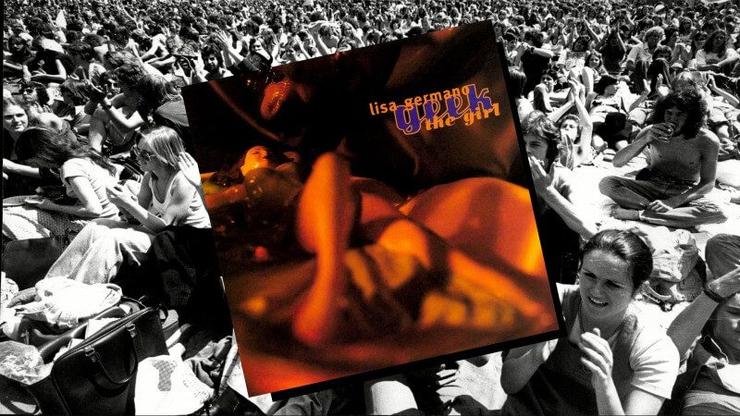
In 1994—one year after Exile in Guyville and months after Live Through This—violinist-turned-singer-songwriter Lisa Germano released Geek the Girl. In theory, it should have entered the same ’90s feminist-rock canon as its peers. Instead, it has lingered in the margins: a cult object rather than a pillar. It’s impossible to say exactly why, but I suspect part of the answer lies in the weakness of the album’s central woman. Where so much feminist music of the era offered sneering catharsis or righteous fury, Geek the Girl centers powerlessness—and not as a flaw to be overcome, but as a lived condition.
To be frank: Geek the Girl is not an album about fighting back. It’s an album about wanting to fight back and not knowing how; about trying to be cool or sexual or normal enough to be safe, being terrible at it, then discovering too late that none of it was viable armor in the first place. Where Liz Phair and Courtney Love sang for the woman I wanted to be, Germano sang for the woman I was: the one who knew all the right things to say and still didn’t say them when she needed to, who believed in her own strength more than any God and still found herself paralyzed when it mattered. Who found herself utterly lost in the aftermath, fallen down a pit of cognitive dissonance she didn’t know how to get out of. Listening to Geek the Girl for the first time felt less like revelation than like being caught—seen in a way that was almost accusatory, almost unbearable.
Lisa Germano did not come up through the mythology we tend to grant women like her in retrospect. For years, she was best known as someone else’s musician: a violinist in John Mellencamp’s band, an auxiliary emotional texture behind men’s songs about American masculinity and Rust Belt malaise. Her presence was essential and invisible. Despite her love for and gratitude to Mellencamp, she grew to resent the way his long shadow loomed over her solo career. As she later put it in an interview bluntly titled “Mellencamp must die!”: “My past work with Mellencamp is a complete, 100% total drawback… Everybody seems to have to mention that, as if to justify that I exist.”
Her early records hinted at what would come—an interest in vulnerability so unvarnished it bordered on embarrassing, a fixation on fear that felt lived-in rather than metaphorical. But it wasn’t until she landed at 4AD in 1994, newly freed from a destructive relationship with Capitol, that she made the record she had been circling all along. Geek the Girl was not a bid for crossover success or feminist anthemhood. It was a document of being stuck, of knowing just enough about the world to understand how dangerous it is, and still not knowing how to survive it.
THE ALBUM SOUNDS THE WAY it feels to be alone with your thoughts at night: grainy, echoing, uncomfortably intimate. Much of it was recorded in Germano’s Bloomington, Indiana, home on a four-track with her playing nearly every instrument herself, and that isolation is audible everywhere. Violin lines waver between nervous and harrowing; guitars hum and scrape; percussion arrives sparingly, like an afterthought.
Inarguably the most unique element of the record’s structure and sound, though, is the absurd repeated leitmotif of a sproingy, upbeat ditty credited only as a “Sicilian folk tune” titled “Frascilita.” This is made particularly bizarre by the fact that this so-called “traditional” song appears to have arrived via immaculate conception upon Geek the Girl’s release. Prior to 1994, the track had no digital footprint whatsoever (at least not one that I—or the good people at r/lostmedia—could uncover). Sonically, it sounds like the score to a silent-era knee-slapper, something that would play while a pack of Italian mobsters in clown shoes pile out of a comedically small car. And yet it opens the album, recurs between songs, and returns when you least want your footing disturbed, feeling in those moments like nothing so much as a horror movie jack-in-the-box jumpscare. Why include it at all? Because Germano felt bad for the darkness of the album and decided it needed a “comic relief” mood lifter—as if the times when “Frascilita” barges in aren’t some of the most deeply unsettling moments of the album.
At its core, Geek the Girl is a bildungsroman, to the point of loosely flirting with being a concept album. It’s not triumphant—there’s no neat arc towards self-actualization or empowerment, although there is a glint of hope at its end—but rather, a slow, nauseating education in how the world actually works. Germano sketches her painfully non-heroic protagonist as naïve in the way many young women are: informed, perceptive, self-conscious, vulnerable, and dangerously hopeful. After nearly a minute of “Frascilita,” the record begins—truly begins—in confusion: about power, about faith, about why what feels wrong is treated as inevitable. Opener “My Secret Reason” is deliberately underbuilt, cycling a simple progression beneath Germano’s half-whispered vocal. Every claim is first hedged by a nervous assertion of Geek’s own naïvety: “Dumb as I am, I know this” she sings, “In power rules the world and it’s people who die, ache.” There is no solution embedded in the observation, only fear and a vague sense of wrong.
As the album unfolds, Geek tries on versions of herself the way you might try on clothes in a dressing room you suspect has cameras behind the mirrors. She experiments with desire, with passivity, with being agreeable enough to get by. She wants to be wanted and fears what that wanting will cost her. In “Trouble,” affection feels dangerous; in “Geek the Girl,” coolness becomes something to be performed and concealed at once. Sonically, both songs reinforce that instability. “Trouble” adds more moving parts—piano, bass, a shaker, something that almost sounds like a harmonica—but retains a nursery-rhyme simplicity that makes its fearfulness feel childlike rather than coy. “Geek the Girl,” by contrast, is eerily controlled: a low, humming synth that Germano mirrors exactly with her voice, doll-like and precise, the arrangement slowly blooming only to collapse back in on itself. Both songs hover between curiosity and dread, adulthood and retreat.
By the album’s harrowing middle trilogy, these strategies have undoubtedly failed her, and now she is beginning to reap the dire consequences. It is at this point that Geek the Girl stops being merely uncomfortable and starts feeling genuinely unclassifiable; its music no longer something to passively listen to but something to actively brace yourself to endure. Each song strips away another layer of plausible deniability until what remains is naked, brutal fear.
“Cry Wolf” arrives deceptively gently, its ghostly feather-light arrangement masking something far crueler. The lines blur: where does desire end and coercion begin? When is acquiescence given freely and when is it forced by fear? The script flows easily: She didn’t know. She didn’t want it. She says she’ll give it. She changes her mind. The refrain comes down like a verdict, one the protagonist seems to believe: “They say she got just what she wanted.” Germano doesn’t editorialize any of it; just lets it hang there, circular and cruel, repeating until it hardens into fact. By the time the song dissolves into its refrain of “cry, cry wolf,” the dust has settled and so has the blame.
But then “…A Psychopath” happens, and everything that came before suddenly feels distant and small. To be blunt: there is no other song like this. There never has been, and there never will be. Musically, it is almost nothing: a low, funereal guitar line; a thin wash of synth; Germano’s violin crying in long, sickening arcs. It doesn’t fit into a genre so much as a horror movie soundtrack. Her voice is breathy, eerie, almost childlike, cataloguing fear in plain objects rather than emotions: a baseball bat beside my bed, a can of mace, a creak in the floor. The lyrics here are taken straight from Germano’s own long-term suffering at the hands of a stalker—her paranoia, her inability to function, her terror, and her disbelief that no one, least of all the police, would deign to help her.
ALL OF THIS WOULD BE HAUNTING enough on its own, but everything pales in comparison to the centerpiece of the song: a real-life recording of a 911 call, taken (with permission) from a rape center. It is not reenacted, not fictionalized. It is a woman named Karen begging a monotone police officer for help he does not seem inclined to give as an intruder advances on her. It is Karen choking through sobs as she shakily warns the man who broke into her house that she has the police on the phone, as she desperately asks “Who are you? Why are you here? Why?” It is Karen’s final bloodcurdling scream of “Why?!” dissolving into a wordless vocalization of terror and hurt. It is the call going dead. You are left sitting in silence, forced to finish the story yourself—because you already know how it ends. Help does not arrive in time. She is raped and murdered.
Germano nearly left the call out, saying that recording the song left her unable to sleep, but she felt it was too important to cut. “…A Psychopath” takes trauma out of the abstract, and forces it into the harsh daylight of the visceral. You feel that raw animal fear, a powerlessness that can’t be processed. You experience the precise moment when empowerment rhetoric comes to a screeching halt and starts feeling actively cruel. Belief, preparation, and self-conception all collapse when faced with the brute force of a rape culture society still hasn’t seen fit to alter. “A lot of people, when you’re being stalked or you’re being harassed by a man, they don’t take it seriously,” Germano once explained. “You’re not scared that he’s just going to hang around your house; you’re afraid that he’s going to get in your house and you’re going to get raped like she got raped at the end of that call. Her voice is so hysterical, and I want people to know: that’s what the fear is.”
There’s a beat of silence following Karen’s last cry. But then, in a move so deranged it almost feels like a prank played on the listener, “Frascilita” suddenly chirps to life. It is perhaps one of the most insane choices I have ever heard an artist make—I mean, we just heard a woman get raped in real life, and before we’re granted even two seconds to process it, we’re sent straight into the Italian equivalent of a farcical Charlie Chaplin soundtrack—and it is also, arguably, one of the most effective. The impact is immediate and terrifying. After all, it’s an accurate representation of the aftermath to assault: the world cheerfully resumes its tune, as if nothing occurred and nothing ever will. The old adage comes to mind: if a tree falls and no one cares to hear it, does it even make a sound? Well, if it does, it gets immediately drowned out by whatever stupid little song the world was already humming.
“Sexy Little Girl Princess” follows as a representation of the shift in mindset that so often follows that kind of brutality. Here, submission stops looking like a failure of will and starts looking like a survival strategy. If the world is going to keep playing its sprightly jingle no matter what happens to you, you learn to move to the rhythm. You learn to perform desire, to say the right words. You learn how to make what happened sound like something else. The song is breathy and cruel, Germano’s voice soaked in reverb as she repeats commands that sound less like desire than training—”Go on, get it done / Say you want it, say you love it / Run away, little girl, run to mommy”—over shrill violin stabs and brittle plucked strings. Then, finally, you’re granted a moment to breathe and process with the instrumental track “Phantom Love,” although the space it creates is not a comforting one; it’s haunting and eerie, reinforcing the fear already there.
The only thing more stomach-turning than those songs is how eager some of the men who reviewed Geek the Girl were to personify the worst of them. In a 2001 article for Hot Press, one male writer described Germano’s vocals as “seductive in the extreme” (concerning, considering other reviewers frequently note the “childish tenor” in which she sometimes sings) before adding, without irony: “I find it hard to believe that someone whose voice can only be described as aural sex has really endured the pain about which she sings in the songs.” The claim here is almost elegant in its cruelty: desire—not even the female victim’s, but a male bystander’s—is disqualifying. The body, once labeled appealing by an onlooker, forfeits credibility.
Horrifyingly, a glowing 2017 review on the discussion site Sputnik Music goes even further, staging the album as a “female fantasy” and insisting that “Cry Wolf” and “Sexy Little Girl Princess” are “sexy songs”—and that they have to be, otherwise “it wouldn’t work.” The listener, a commenter argues, is encouraged to ask themselves: “Aren’t you getting a little turned on by these encounters and Lisa’s innocent voice?” (Short answer: No. Long answer: Jesus fucking Christ, no.) The commenter concludes, triumphantly, that the album is about a girl who is “really scared of that big cock but she knows she should take it and she might even like it. Then she goes mad.” The slide is seamless: fear into fantasy, listening into entitlement, violation into pornographic invitation. What Germano offers as documentation of terror and collapse is received here as erotically instructional material. These readings aren’t merely accidental or anomalous; they are the point of impact. The album does not ask to be believed. It shows you, in advance, what happens when it isn’t.
What these reactions demonstrate, in miniature, is the same philosophy the album has been tracing internally: if your suffering can’t be framed the right way, it will be rewritten for you. It’s only fitting, then, that when Geek emerges from the stupor of that three-song wreckage, she falls into a sinkhole of depression—“I’m not trying hard / I’m not getting well / I’m not improving / I won’t do anything”—and even wishes desperately that she had “cancer of everything.” Part of what she’s reaching for here is legibility, validity: when you have cancer, no one says you’re too pretty for chemotherapy or jeers that you’re secretly enjoying the tumor inside you. Illness gets you attention, and the right kind. Your suffering becomes tangible. You are allowed to hurt.
“Cancer of Everything” itself is vicious, bleak, and darkly funny, its grinding mid-tempo crawl underscored by Germano’s flat, cynical delivery—a far cry from the plaintive naivety with which the album began. There are a lot of songs about depression, but few that name its most humiliating and selfish reasoning so brazenly. You could not torture the admission of wishing for a terminal illness out of most people. It’s too ugly, too self-indicting, too nakedly transactional: I want to be sick so I’m allowed to stop trying. And yet, if you’ve ever sunk deep enough into that pit—deep enough that effort itself starts to feel like a moral failure—the song doesn’t shock so much as indict you by recognition. If I’m visibly ruined, maybe no one will ask me to perform recovery. If I’m dying, at least my suffering will finally count.
THIS IS WHERE ANGER FINALLY enters the album explicitly—not as spectacle or catharsis, but as something sour and belated and impossible to use. In the mid-’90s, female rage in rock was often loud, theatrical, and righteous; it came with distortion pedals and slogans and forward motion. Germano offers none of that. Anger exists here, yes, but it has nowhere to go. It seeps through and turns inward, manifesting as self-disgust, paralysis, and the longing for a socially sanctioned kind of pain. In the blunt, stripped-down “A Guy Like You,” it arrives as exhaustion: “This should be easier,” Germano sings, still cynical but now quiet, pained. “But I’ll just get angrier / And close my eyes and wish away / Hide it inside / Nobody knows.” Germano lets it sit, ugly and unresolved, refusing to redeem it with revenge fantasies or tidy healing. When Geek the Girl finally walks away from the man the song speaks of, it doesn’t feel victorious. It feels necessary, provisional, and long overdue.
But then, after all of that—after naivety curdles into self-surveillance, and self-surveillance curdles into bargaining, and bargaining curdles into fear, and fear curdles into depression, and depression finally curdles into anger—Lisa Germano loosens her grip. The record doesn’t resolve, but it does exhale. Where everything prior had been claustrophobic and inward-facing, the final stretch widens its frame almost imperceptibly, like the camera pulling back at the end of a film you didn’t realize was shot in a single room.
“…Of Love and Colors” feels like the album looking at itself from a distance for the first time. Not with forgiveness exactly, but with a weary clarity. Germano inventories the damage—“people / all us fucked-up people”—without drama or spectacle. It’s a plaintive statement of fact that couldn’t have been made at the album’s start. Pain, now, has become ambient, shared, dull with repetition. Threaded through that fatigue is memory—of a time when people felt unique, when trust and beauty didn’t feel naïve. The song doesn’t insist such a world is possible, only that it was once imaginable, and that something was lost when we stopped imagining it. Crucially, buried inside that recognition is the smallest possible mercy: “You just fucked up for a moment.” It’s not absolution, but it’s something arguably more usable—a way to keep living without having to re-litigate your own credibility every day.
And then “Stars,” the song everyone calls hopeful, arrives and immediately tells on itself. Stars aren’t comforting because they’re reachable; they’re comforting because they’re far away and safe to look at. “Far away from here” repeats until it sounds less like a destination than an incantation, something you say so your body doesn’t fold into itself. When Germano admits that “great excuses make it easier to forget that awful feeling,” it’s not framed as a moral failure but a survival tactic: forgetting as triage, fantasy as first aid, smiling “real big” and dreaming dream of an unreachable kinder world brought to you by an imagined kinder man as a kind of primitive spell. If the earlier songs are about losing your voice, the last song is about learning a new one—flimsier, maybe delusional, but yours. A new secret reason, after the previous song’s admission that the old one was lost. Geek the Girl doesn’t end on a cure. It ends on the only thing that feels honest after undergoing the ultimate violation: a compromise with being alive. There’s a kind of hope in that, too. A measured one, but hope nonetheless.
Lisa Germano never capitalized on Geek the Girl in the way the industry likes its women to do—no victory lap, no trauma-to-triumph rebrand, no tidy second act where the darkness becomes “resilience” and therefore sellable. Instead her career reads like a series of vanishings and returns: new records (all of which are good, although I have a special fondness for 1998’s Slide), label turbulence, being dropped, quitting the business, resurfacing anyway. After her final album in 2013, the trail runs somewhat dry: she worked at a Whole Foods, or maybe an independent bookstore, or maybe moved back to Indiana to help her mother, or maybe all of the above.
The present-day details are stranger still. After years of radio silence, Germano reappeared onstage in 2018 (and again in 2023) playing violin with Mellencamp once more—after years spent resenting how hard it was to be seen as anything other than his violinist—before promptly receding back out of the public eye. Even her online presence feels corrupted: bizarrely, lisagermano.com reads like it’s been overtaken by AI slurry (featuring blog posts like “Women’s kimono jackets for your concerts and festivals” and “Relaxation music, a genre dedicated to sleep,” the latter of which is written entirely in French for some reason), while the only site that reliably documents her work is fan-run. It’s hard not to see the rhyme. Geek the Girl is an album about how easily women’s reality gets overwritten; the afterlife of Lisa Germano is, in its own smaller way, a version of that, too: an artist turned rumor, a body of work kept alive mostly by the people who needed it and couldn’t find it anywhere else.
I think now, finally, that what Geek the Girl gave me wasn’t permission to stop being angry, or proof that my anger had been misguided all along. It was permission to stop treating anger as a moral credential—something you earn or prove, something that retroactively determines whether you deserved what happened to you. The girl who wrote the Tropicana Speech and the girl who froze years later are not contradictions; they are the same person living under different conditions. Lisa Germano understood that long before I did. Geek the Girl doesn’t argue that women are strong, or brave, or empowered, nor does it argue against that. It just shows what happens when strength fails, when bravery is unavailable, when empowerment turns out to be a story you were told to make the world’s violence feel fairer. 30 years on, that refusal still feels radical, precisely because it insists that your worth, your politics, your selfhood, do not hinge on how well you performed them under threat. Some truths don’t exist to make you better. They exist so you don’t have to disappear trying to be.
Casey Epstein-Gross is Associate Editor at Paste and is based in New York City. Follow her on X (@epsteingross) or email her at [email protected].