
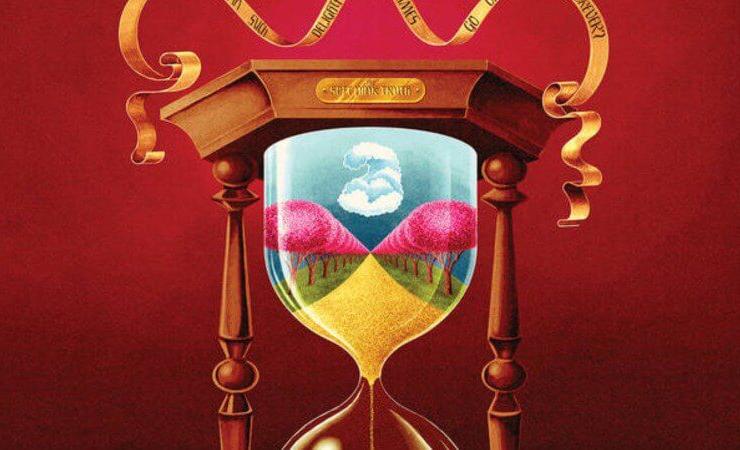
Every album from the Soft Pink Truth hinges on a question, and that question provides a new canvas for Drew Daniel to explore a different sound. His 2002 debut under the alias, Do You Party?, was born out of a dare from Matthew Herbert to make house music. 2014’s Why Do the Heathen Rage? filtered his IDM roots in Matmos through songs by black metal bands, resulting in gleeful, industrial detritus. 2020’s Shall We Go on Sinning So That Grace May Increase? pared everything down to meditative, ambient minimalism, only to revert back to full-fledged house on 2022’s Is It Going to Get Any Deeper Than This?. For his latest record, Can Such Delightful Times Go on Forever?, Daniel whisks us from the dancefloor for a date at the concert hall.
The Baltimore-based electronic artist’s foray into the symphony was inspired by the forces of gradual change that feel so fundamental to the human experience, particularly how those slow shifts often go unnoticed amid the hectic day-to-day tasks of modern life. In press materials for this new album, Daniel says that he “wanted music for that overlay” of a “longer, slower process playing itself out, cell by cell, structure by structure: birth, growth, life, aging, death.” Yet even with an overarching concept befitting of his day job as an English professor at Johns Hopkins University, Can Such Delightful Times Go on Forever? never feels academic. Thanks to its orchestral setting, it just sounds exceedingly pretty.
Daniel begins the record with “Mere Survival Is Not Enough,” which builds from total silence into a swelling string arrangement, incorporating glissando harps from Neleta Oritz and piano from Koye Berry and Daniel’s husband and Matmos partner, M.C. Schmidt. Daniel litters jittery synths throughout the mix and concludes the piece with piercing analog resonance, as if to signify that this is “still an electronic album” despite the classical flair. For “And By And By a Cloud Takes All Away,” Daniel changes his focus to a chamber choir, or at least what sounds like a choir, given that it’s the voice of a lone singer, Helen Spencer-Wallace. Andrew Bernstein’s saxophone punctuates the dreamscape with staccato breaths, subtly foreshadowing the dense totality of the 10-minute epic “Phrygian Ganymede,” a dual tribute to both the ancient kingdom in Anatolia and the minor musical mode from which it gets its name.
Can Such Delightful Times Go on Forever? has its lighter moments, too. “L’esprit de L’escalier” highlights sprightly xylophones and vibraphones played by Daniel himself, accentuated by the pizzicato jaunt, courtesy of the Peabody Institute’s Ebu String Quartet. Daniel also recruits improvisatory guitarist Bill Orcutt for the penultimate “Orchard,” whose acoustic flourishes flicker between Felipe Sosa’s oboe and Daniel’s glockenspiel like candlelight in a dark room.
Daniel’s take on the conservatory successfully charts the non-linear path of temporality, how time itself takes twists and turns that can’t be charted by conventional means. What once started as a project to fulfill a tossed-off dare has since bloomed into a full-fledged artistic endeavor that reckons with human existence. At first, Daniel just wanted to know if you partied. Now he’s asking where the line between the finite and the infinite is drawn. Surrounded by a coterie of collaborators, he may not give us a concrete answer, but their investigation sure sounds like a delightful time. [Thrill Jockey]
Grant Sharples is a writer, journalist and critic. His work has also appeared in Interview, Uproxx, Pitchfork, Stereogum, The Ringer, Los Angeles Review of Books, and other publications. He lives in Kansas City.