
Of the litany of early, shameful lessons marked on the map of the soul, there are few as damning and intense as early crushes. Immense feelings that emerge from unknown corners of the heart to steer the body directly into the maw of tantalizing danger. These early crushes develop slowly over time, like taking on water in open sea, and threaten to drag you down to all dark and hollow places below the surface, leaving the body desperate for some hint of savior. Crushes develop early, without warning, and at different times for everyone, and mine first emerged during working hours at the grocery store.
I’m not all together sure who my first crush was on, I only know that my first crush was on everybody. For a while, everyone was new to me, and their newness was a special little thing I kept catalogued in my heart. As we spent time together in our recursive days of monotonous labor, we bonded over all the shared nothings that eat away at the clock. We laughed at the customers who wanted groceries packed in paper bags within a plastic one, made loose plans to smoke cigarettes out back in the alley between our store and the Canadian Freightways loading dock, and gently teased each other about our clothes and hair and the shifting changes in ourselves. We sang along to beloved songs that came on the radio if we knew the words, and mocked them when we didn’t, and together we built a life.
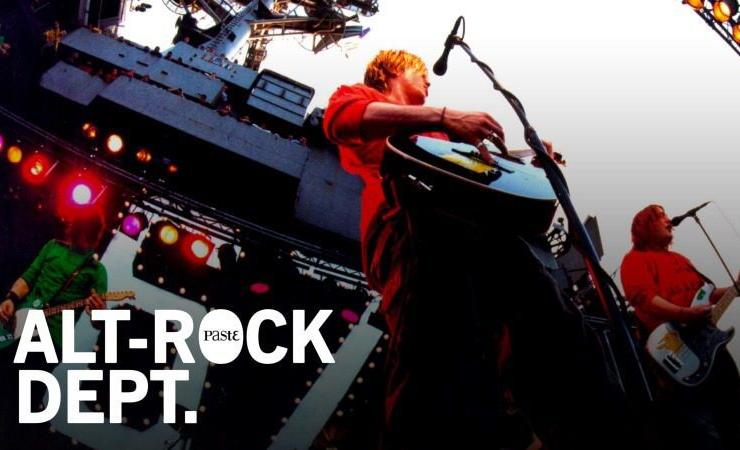
It is impossible then, to talk about the radio that built and sheltered our lives without talking about the inescapable presence of Goo Goo Dolls. This was the band that wrote “Name,” and “Iris”—yearning and tender love songs steeped in punk rock, jangle pop, and alt-rock that served as inescapable masterworks of drive time pop charts. We did not use this term so liberally then, and it is sacrilege to do so now, but there are shades of emo in them too, a movement that grew in dominant popularity as an evolution of hardcore and punk rock built on a foundation of mankind’s painful yearning. Bandsplain host Yasi Salek has included Goo Goo Dolls in her personal emo canon for years, and it is easy to see why—if your heart is bold enough to remain open to the endless possibilities of the spectrum of overwhelming emotions. There is also a Goo Goo Dolls that came before the charts: a younger band all scrappy and headstrong, who were a traced outline of the Replacements; young men trying to discover who they might become if they emulated the desires of those who came before them long enough to find themselves.
This is another lesson learned early, how to peacock and pretend until you find your own way. I learned who I was by copying all the people I was not, as if I was made of rice paper and placed gently over them, carefully outlining a new idea of a body based on the theory of those that I assumed had arrived complete with shading and definition. I watched as others laughed, and sang: how they stood so tall, how they reacted in anger, and how they fell in love. This was how I learned to have a voice, carefully following the lines that might end at a personality, and seeing how it fit on the idea of myself.
I was withdrawn and awkward to a fault in my youth, and I’m sure it’s to the eternal frustration of everyone who ever had me bagging groceries at the end of the till, placing cans and fruit and things in bags with chilling silence. No one wants an awkwardly quiet bag person when there are questions and demands to be made on the order of things. Paper or plastic, and whether meat should be in a separate bag, or do you want to carry your candy/cigarettes with you. You want confidence at the end of the line, and while I held none of it within me, I was eager and desperate to learn. I pretended until I could become real, and that is how the first of my crushes became ingrained in me, by learning who I was below the artifice of it all.
There are many bands that tried to be the Replacements—because who would not want to be the Replacements—but there are few who succeeded. It would be hard, borderline impossible, to recreate what the ‘Mats had: this scrappy charm, this vibrant and destructive spirit that leaves indelible pop songs in the crater of its impact. But let it be known that Goo Goo Dolls tried their hand at being the Replacements, and it’s to our great benefit that they didn’t quite succeed.
“Name,” from 1995’s A Boy Named Goo, was the initial breakout hit for Goo Goo Dolls. A ballad that is tender and destructive all at once, achingly holding onto a memory swiftly fading from its photograph, all told through an irregularly tuned guitar and Johnny Rzeznik’s raspy, desperate voice. “Iris” followed closely in the same formula, equally raw and painfully aching, with orchestral movements that arrive boldly when called for, only to retreat when it is best to be calm. But “Slide,” from 1998’s Dizzy Up The Girl, was the song that could change the course of the day when it broke through the tedium.
I had a crush on a girl who worked in the deli department, whose name is a secret to everyone but me, and I did not know what to do with myself because of it. It was as if the bones of me had been melted then frozen and reformed into something that resembled a body but not quite. When I ordered lunch from her, I did so with a voice that was not my own—an adopted tone that played at a confidence I did not have—that betrayed the truth of me. I had a crush on a boy that worked with me stocking shelves and pushing carts: his wild unkept hair, his expertly mumbled drawl, and his disdain for the job that manifested in joyful chaos to kill time, although I did not fully understand the idea of this crush yet, same as any of them. I lacked the language to describe a complex relationship to the desires of my heart. I had a crush on these people and countless more, who existed in this one perfect place, and rarely would I see them outside of it, which made them all the more formative. It is easy to crush on someone you will never have to know, who will in turn never have to know you. It’s a trial run at learning what words belong to the immense sentence of yearning.
There is something so elegantly simple in the line I just want to wake up where you are on “Slide.” It feels too easy somehow, to have mastered all of these complex feelings and arrived at this moment of placid desires. As a contrast to “Iris” and “Name,” “Slide” plays with hints of what life had come before the biggest hits of Goo Goo Dolls career and teases out its wild years. A bit louder in the opening moments, a bit brash, with a playful guitar that clatters clear and sharp against the wall of the heart. A good and perfect radio song has seconds at the beginning that announce its arrival to promise sanctuary and absolution. “Slide,” like all perfect crushes, is all blood and energy. It is big and loud and tender and sad all at once, and it is everything.
This is not to say that it is any less suffocated by desperate emotions. Johnny Rzeznik has said that the song is about a young romance that results in a young pregnancy—two lovers in a small, isolated town that have to make decisions about what to do with each other, and the life they have built together. Do they want to run away, or get married, or both? Who are they to each other, and who are they to all the people that have judgements to rain down upon them? “Slide” is a lush and tender song that is no less frantic and wild than the punk rock of Goo Goo Dolls’ younger days. It is, in fact, the wild energy of it that makes the song so perfect, so frantic and hurried, as if a song can stumble over its feet as it races breakneck down a hill towards uncertain freedom. If there has ever been a song about how a crush presses down on the heart, it has been written already by Goo Goo Dolls, and all we have to do is turn what dial conjures them and hear it once more.
Confidence came to me slowly, inching forward like a cautious bird approaching a discarded pizza crust on a busy sidewalk. And, as it neared, the boldness of it became enticing and tantalizing. When songs on the radio taught me about love and lust and desire I catalogued them within me, filing each lesson away. Slowly, it built me into someone new—someone beyond the trace outlines of a life. I asked out the girl at the deli counter, and felt the sting when she said no. I felt how swiftly the weight of rejection will drag your heart into the pit of yourself. Little pieces of the nothing that fall, Rzeznik sings on “Slide,” and a song about love becomes something new in the light of rejection.
There were more crushes in all the endless days that followed. Some requited and some not, and all of them were real until they weren’t. The beauty of early crushes is their impermanence, kept safely behind sliding glass doors and checkout counters. There is a training ground for all things, and the safest place to fall in and out love was a grocery store—where all of us who worked together existed out of time for a few hours a day, where we learned who we were, and who we might be, all copies and traced outlines of those who came before us. Those crushes, and the words that built my understanding of them, were invaluable to what love would find me later in life. Beyond the doors of this place I could feel so clearly all the joyous heartache heard in Goo Goo Dolls songs that live within me, their lessons etched into the bones and outlines of my body: all that I learned by hearing them, and how they have allowed me to be here in fond remembrance of them.
Niko Stratis is a former smoker and an award-losing (and winning) writer. She is the author of the critically-acclaimed book The Dad Rock That Made Me a Woman, and the newsletter Anxiety Shark. She once came 2nd in a Chicken McNugget eating competition, but that was a long time ago. She is a cancer, and she lives in Toronto.
Read previous editions of Alt-Rock Dept. here.