
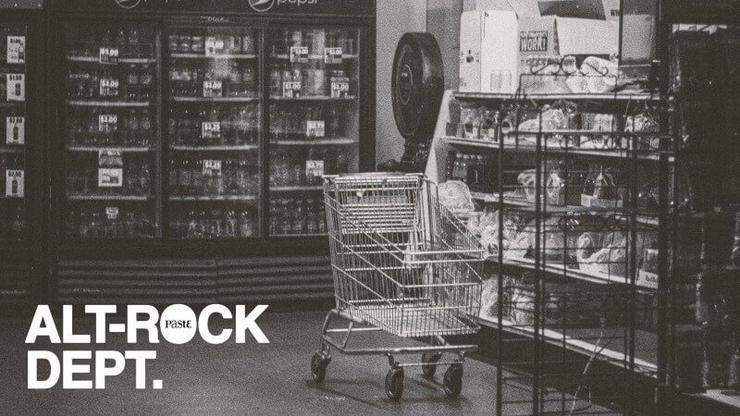
The radio, like electricity or God explained to a child, is best when the legends of it become lavishly ambiguous—when the stories told about and through it transcend belief into some other realm of being. The radio as a box on the counter is a nothing thing talking to no one, but cut into the drop ceiling of a grocery store, unseen and only heard, it becomes a presence. A force that moves the world and all the feet upon it in steady, ceaseless increments and tells the stories of them.
In 1995, when I was 13, I got a job at a family-owned grocery store in Whitehorse, Yukon, Canada. The store, Food Fair, lingered at the end of an open parking lot that would eventually host a strip mall populated by a Chinese takeout place that stayed open until 4:00 a.m., the liquor store, and the first Subway restaurant that opened in the northern territories of Canada. As I get older, there are many signifiers of age, but few more painful than the memory of being excited at the prospect of a Subway. When I was young, any capitalist enterprise in our town was a signal received from the world beyond our isolation, and sometimes a 6-inch pizza sub is a sign that you belong to the world.
The radio played this role too, signals received from the heavens and turned into an AM frequency, dialed into the store’s PA system. The radio was nothing for the first few days and weeks of working there, as everything was. I was a teenager, barely grown and hardly alive, working partially just to bring some extra cash home. I was overwhelmed with everything at first: how to stock shelves properly; how to gather carts abandoned in the parking lot and herd them back into the store like wayward sheep; and how to bag groceries the right way based on the individual taste of the customer. I learned quickly that there is a right and wrong way to do so many things that were once so easily taken for granted.
Slowly, all of these actions became second nature, became reactions, became muscle memory and nothing, and when they did my mind opened to the hum of the world beyond all the anxieties of learning new skills. Wandering thoughts that finally caught the radio and the songs played in regular rotation on the one station—CKRW 610 AM—we played endlessly in the store. The Yukon didn’t receive a reliable FM signal until the early 2000s, around the time the territory banned smoking inside, when people in cities apart from ours began to flirt with the idea of streaming radio via broadband internet. We were connected the same as anyone, albeit tenuously, and we moved to shared rhythms despite our lack of fidelity.
If there is a golden age for every artistic era, I believe we should nominate the mid-to-late 1990s as the hallmark of the daytime radio stations played in grocery stores movement: a mercurial blend of inescapable titans and bizarre oddities that could not hope to survive harsher climates; “How Bizarre” by OMC, like a child in an iron lung, unable to breathe what air the Stone Temple Pilots enjoy so freely. At home, in its ecosystem—played through speakers with a blown-out, low-end cut into a drop ceiling—these delicate oddities thrived and multiplied. All of them worked as one to build the soundtrack of lives bustling behind sliding glass doors and checkout counters.
There is a language to it, how the songs become part of the body. They become shared speech patterns and vocal tics. Choruses to songs I had only heard within the walls of that store became hymnals emerging from the weary lungs that knew them. All of them cherished favorites, even the songs I hated—because even the songs I hated were proof that I was still alive, that the day was still moving ahead and would eventually end. Songs were textures on time, marking where it had been and where it was yet to go.
There was a moment, as there were so many before it, where songs became secrets and riddles on the radio. Lyrics heard through crackling speakers and cut between calls on the PA for bag boys and cleanups. “Possum Kingdom,” the second single from Toadies’ 1994 debut Rubberneck, was the source of endless debate and speculation. Like many songs before it, I’m not even sure of the first time I encountered it. One day it just existed, as if it always had. The crunch of its persistent guitar, louder than anything the speakers in our ceiling could handle. Vaden Todd Lewis, Toadies guitarist and vocalist, howling about blushing brides and pleading with Jesus behind it. In the future, this song will become a centerpiece of Guitar Hero 2, and many who had only ever known it as that song about God and sex and death at the grocery store will wonder at the desperate darkness of it all. They will recreate chords and shifting time signatures on a plastic guitar while Lewis’ voice emerges as an ethereal and vengeful spirit, only to howl at paradise when rebuked.
We spoke about these songs in the break room, around crumbling folding tables covered in Cosmopolitan magazines—their quizzes half-completed—and styrofoam coffee cups that held cigarette butts in the lingering dredge at the bottom no one dared drink. We shared theories about what we thought “Possum Kingdom” was about, some of us not even knowing the name of the song or the band that played it. Some of us referred to it as that “do you want to die” song. Some of us claimed it was inappropriate to play during the day, and fiddled nervously at gold chains with gold-plated crosses dangling tightly from them.
The theory I always believed was that it was about vampires, or some offering of eternal life—the narrator in Lewis’ voice promising to be a gentleman behind the boathouse, where he will share his dark secret, promising he can make her beautiful forever. Her dark hair. Her soft skin. His blushing bride. His voice soft at first, wavering and fading into the song, like a spirit of the night who arrives as mist that hardens and sharpens the teeth that hold cravings in their hollows. This theory was laid out for me and others in the room by a giant man who proclaimed all songs sung by women as “chick bullshit,” who played air guitar with a jerking off motion when the whammy bar part kicked, and we smiled all polite and nervous until he left the room. We all agreed we liked his theory a lot more than we liked anything else about him, and it slowly became the truth in our hearts.
A song like this, built of stories and theories and wild conjecture, means everything to those who hear it day after day. It becomes part of you, part of your stories. It speaks to you in words only you can hear, that means more than anything. The truth of its secrets mattering less than how it bonds eager lives together. Those that need distractions from the monotony and the terrible men. A song I never heard kids at school talk about, that felt like it only existed for those of us at work that needed it. As if the radio was ours, making us eternal with its dark secrets.
As I grew comfortable in the job, I became complacent and self-assured. I bagged groceries with a flurry, and rode flat-top stock carts like a skateboard down the store room hallway, crashing wildly into crates of paper towels or old pumpkins. I stacked stock-carts impossibly high just to show that I could, even though the boxes held glass jars of beets and pickles and other acrid things. I pushed the cart through the swinging doors that separated employees only from the common man and out into the store. I turned it sharply into aisle six and felt the boxes teeter where I had so confidently and lackadaisically stacked them. The familiar rhythm of “Possum Kingdom” churned somewhere unseen up above me.
I watched the boxes lose their place in this world and fall to the floor, heard them smash and split apart as they collided with the cracked tile at my feet. Laughter, off in the distance, of those who already knew what had happened and those learning in real time. Then a PA call for a cleanup in my aisle interrupted the song, before it faded back in time for the bridge, as Lewis snarls do you wanna die over and over and over again. And I do, as the smell of vinegar blends with the dirt and the newly wet cardboard—as beet juice runs red like blood around my feet. Do you wanna die? he asks again, and I laugh because right now I do, and give in to his promise to instead make me live forever in this moment.
That afternoon, in the break room, over cigarettes and terrible coffee, someone will enter the room and break into laughter upon seeing me. They will ask me to tell the story, and I will, every detail, even and especially those that paint my arrogance so clearly. They will laugh again, and I will announce the best part, how “Possum Kingdom” played while this was all happening, and the perfect timing of the do you wanna die of it all. I will say that I did when the boxes crashed, and I did when I was picking shards of glass in beet and pickle juice up with my bare hands. We will share in uproarious laughter, and I will still feel the acid of the vinegar in my nose taint the familiar aroma of coffee turning lukewarm in my hands. I will see the stain of blood-red water on my fingers, tainted by beets and arrogance, and tap a simmering cigarette into an empty 7UP bottle.
It doesn’t matter, really, what “Possum Kingdom” is truly about, though the truth of it has been revealed in the intervening years between then and now. It’s about cults and death and eternal life, steeped in Texan folklore centered around Possum Kingdom Lake, a real place near Forth Worth. This is the truth of a story that matters less to me than how it felt when the song belonged to me and my disastrous confidence, when “Possum Kingdom” and others on the radio were about the half-truths and legends woven into their words. How they built the stories of us, with chords and verses crackling through shitty speakers, how they cling to our bones as we age, and mark the days with their absence.
Niko Stratis is a former smoker and an award-losing (and winning) writer. She is the author of the critically-acclaimed book The Dad Rock That Made Me a Woman, and the newsletter Anxiety Shark. She once came 2nd in a Chicken McNugget eating competition, but that was a long time ago. She is a cancer, and she lives in Toronto.