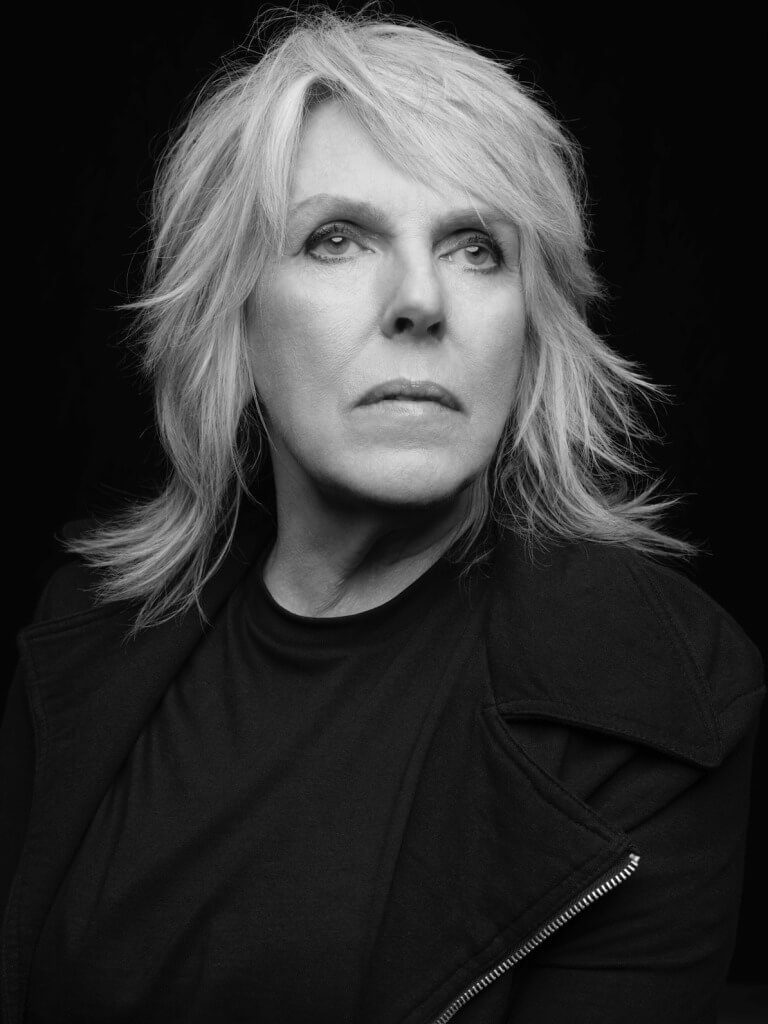
We can’t find Lucinda Williams. She’s somewhere on the other side of the phone, and her husband Tom Overby’s gone to find her. Two voices clatter distantly, until it’s finally her in my ear. The holidays are coming up, so PR thought it’d be good to get this call in before everybody closes their laptops for a couple of weeks. Williams seems happy to be chatting; I’ve been on a “Fruits of My Labor” kick for days. “I love Paste Magazine,” she tells me, gleefully. “I’m glad y’all are still around, fighting the good fight.” Williams is still fighting the good fight too, on her 16th studio album, World’s Gone Wrong. Following one of her dad’s cardinal rules of creative writing—-“never censor yourself”—she used songwriting to respond to the tyrannical forces that overwhelm the country she calls home. Like Good Souls Better Angels, This Sweet Old World, and The Ghosts of Highway 20 before it, Williams streaks again down the same level-headed, raised-fisted path. “Urgent” is a word getting tossed around.
She found inspiration for the album’s title in a Mississippi Sheiks song called “The World Is Going Wrong,” (which Bob Dylan himself reinterpreted on World Gone Wrong in 1993, along with “Blood in My Eyes”). In between the sleeves is a topical, robust collection of songs that react and resist. Williams is subtle yet direct, paraphrasing Bible scripture like her preacher grandfathers and sowing seeds of contempt for Donald Trump’s dividing, oppressive line. But World’s Gone Wrong isn’t some feel-good set of bonafides from an aging storyteller. Williams doesn’t drape a light over the exit, nor does it assume that hope is the strongest medicine. Instead, she tells it like she sees it and sings songs about the people in this world who’ve fought hard for a piece of the American Dream. “Music is a powerful weapon,” Williams said last year, and World’s Gone Wrong proves that her most powerful weapon is whatever song she’s currently singing.
Paste has kept up steadily with Williams this decade. In 2020, just months after releasing Good Souls Better Angels, she suffered a stroke—a blood clot on the right hemisphere of her brain that debilitated her motor skills on the opposite side of her body. Through rehab, she relearned how to walk and react. She couldn’t play the guitar too well anymore but she mustered up the stones to go on stage, in a wheelchair, and sing some songs at a Jason Isbell show at Red Rocks. By 2023 she’d made a record with some of the best musicians that good faith could buy anyone: Angel Olsen, Bruce Springsteen and Patti Scialfa, Margo Price, Buddy Miller, Tommy Stinson. Her bandmates, especially Travis Stephens, pitched in on the guitar in all the places Williams couldn’t, and Stories from a Rock n Roll Heart breathed new life into her career.
World’s Gone Wrong puts Williams’ smoky vocal behind common tales about common people—working-class, salt of the earth folk on the outs because humanity’s been ravaged by political malevolence and fence-sitting ambivalence. She draws a line in ink between her and her oppressors on “Something’s Gotta Give,” “Black Tears,” and “How Much Did You Get for Your Soul.” Williams and her band rally around human dignity by playing the blues and sniffing out a groove. World’s Gone Wrong is loud and it’s punchy. It’s Lucinda Williams all the way.
Williams and I spoke at length about her new album World’s Gone Wrong, and, along the way, we touched on her duties as a songwriter, her changing relationship with the guitar, and writing political music that lives up to Bob Dylan’s. If you need to brush up on the record, I recommend reading Matt Melis’ great review of it. The following interview has been edited for clarity.
******
Paste Magazine: You felt a sense of urgency making World’s Gone Wrong. Why was that?
Lucinda Williams: The nature of the songs, and the nature of the beast—what’s been going on in the country and you-know-who in the White House; the day after day after day after day insane chaos and craziness—was right in our face. You couldn’t get away from it, you couldn’t escape it. It was on the news on TV, it was in the paper there. I remember, at a certain point, it was a daily thing where you’d get up and there’d be some story for that day that had happened—something that [Trump] had said or done that was just completely off the wall. I’ve been wanting to write some songs like this for a while, but they were kind of challenging. It’s harder for me to write a topical song than a love song—because, if I was going to write one, I wanted it to be on the level of Bob Dylan’s “Masters of War,” or something like that.
You were working on a different record, but then you pivoted to World’s Gone Wrong.
Whenever I make a record, it’s always just a hodgepodge of songs. This and that. I don’t ever sit down and think of a theme for a record and then write the songs to match. I just have songs. I’m always working on songs, so it depends on what I have ready to go in and record. Sometimes you don’t know exactly what’s going to make up a record until you have a bunch of songs. Then you start to see which ones fit together as a group. That’s what becomes the record, or the album—I still say “album.”
When this album got announced, before I even listened to any of it, I thought of Dylan’s album from ‘93, World Gone Wrong.
We talked about that! World’s Gone Wrong, not to be confused with Bob Dylan’s World Gone Wrong. Yeah, one is singular. One has an apostrophe. I was concerned about that, because I didn’t want Bob to get mad or anything [laughs]. But we decided, because it’s World’s Gone Wrong, as opposed to World [Gone Wrong], that it would be OK. I hope it’s OK. I didn’t want to be a copycat. I didn’t pay as much attention to that particular album as some of the other ones.
I think I can confidently say you’re not the only one who didn’t pay a great deal of attention to that record. There’s a line on your album that really stood out to me: “Did God forget the punchline?” I thought to myself, what a tuned-in thing to say at a time like this. You’ve probably written thousands of songs. Do you ever get taken aback by some of the things you come up with nowadays? Does the language that comes out surprise you?
Sometimes I get excited if I come up with a really good slant rhyme—words that don’t run perfectly but rhyme enough to be able to use them in the song. That was in the song “Jukebox.” I was talking about having a handful of quarters to go play the jukebox, and I said “listening to Patsy Cline and Muddy Waters,” so I was able to rhyme “waters” with “quarters.” I felt good about that. I know it doesn’t sound that big of a deal when I tell you. That’s not a line that Bob Dylan would write, but it’s an example of what makes me happy when I’m writing.
At some point everybody wants to be Dylan, but I don’t know if anyone thinks that way their whole life. I’m pretty happy that you’re Lucinda.
You’re so sweet. Thank you.
I was reading about Good Souls Better Angels, and someone said it was your “angriest” album ever. I don’t know. If the gloves were off for that album, then the gloves don’t even exist on World’s Gone Wrong. Do you think about how frustrated you are in the songs that you write?
I don’t really think about that. Actually, I probably do think about it to some extent. That’s just part of writing a song—I have to try to stand back from it and listen to myself and pretend I’m the listener, that sort of thing.
[embedded content]
How necessary does political writing feel to you now compared to, say, 1998?
I had to learn how to write those kinds of songs. I was wanting to do it more, but because Bob Dylan set the standard for me—which is the topical songs he’d written—I shied away from it for a while. You don’t want to date it too much. You don’t want it to be too flowery or a sugary, “come on, brothers and sisters” thing. I just stuck to love songs.
There’s still love in the songs you write, even if they’re not love songs. I’ve always found that to critique something shows that you care for it. I think that’s love.
I’m glad you recognize that. I did an interview with [someone from] Australia last night, and the woman said, “Well, these songs are a far-cry from some of your earlier songs, like ‘Passionate Kisses.’” She kept pointing that out. But even the title song, “World’s Gone Wrong,” talks about an everyday couple, man and wife. He sells cars, she’s a nurse. They’re trying to make sense of all the craziness, barely making ends meet.
Stories from a Rock n Roll Heart was such a personal album for you. But “World’s Gone Wrong” goes beyond you. What do you learn most about yourself as a writer when you’re reaching out past yourself? What does doing that teach you about the way that you’re interpeeting the world?
What I’ve realized is I like to write from the perspective of just a regular person. A lot of times, instead of it being about me, it’s easier for me to make it another person speaking. Part of it is that I just want people to be able to relate to what I’m writing. I want to make it accessible to different kinds of people and put stuff in the song that somebody can hear and say, “Oh, I know how that is,” or “I’ve felt that way before.” It’s gonna work differently to the listener if you say “he was in his old, rusty pickup truck,” as opposed to “he was driving his Camaro.” I like those details. Certain descriptions of things are going to be familiar to one person and maybe not another.
The details say a lot about the story you’re trying to tell. The words, and how you say ‘em, do matter. Otherwise it’s all the same story.
That reminds me of Neil Young. “It’s all the same song, man.”
Thinking about writing about people and writing about people that, when you’re hearing these songs, you can relate to them, I imagine… Well, I don’t know. The world is so bad sometimes, and when I say “sometimes,” I mean most of the time—
That’s why I wrote these songs!
We’re surrounded by tragedy and we’re surrounded by corruption and genocide and meanness. And I find that mortality is something that’s on the mind more than ever. I imagine that having a stroke was a wake-up call for you. When you go through that, does it color what else is going on in the world differently for you?
I look at things differently, but I think some of that’s probably on a subconscious level. I’m not consciously walking around thinking all the time about how I could have died. I didn’t realize that for a long time. I wasn’t even sure what a stroke was. I would hear about older people usually having one—your grandparents, or something—when I was a kid. When I had one, people were calling me and texting me. They would say, “Oh, my God, you’re OK. You’re still alive.” And I couldn’t figure out why they were expressing that, until I learned that some people have strokes and die. I didn’t look at it as an ending. It was just what happened. Then I learned what recovering from the stroke was all about, which is the pits. It’s a blood clot in your brain and I guess the reason someone would die from it would be if the blood cot moved around and got into your heart, or something.
You can’t walk right. Your brain short-circuits. All the stuff that you used to do without thinking about it don’t work anymore, because your brain forgets. When we walk, we’re not thinking about anything. We’re just walking. But, technically, your brain is telling your legs what to do. Everything starts in the brain and goes from there. So I’ve learned all of this stuff about physiology. It’s fascinating to me.
Are you still unable to play the guitar?
I’m not playing right now. It hurts when I try even just pressing down the strings. That might be a case of my calluses being gone from not having played enough, but I’m still looking at that as a temporary setback, because there are other things that I haven’t been able to do. At first, I couldn’t even walk across a room without falling down. Now, I can walk. Not very well, but I can walk. I don’t have to use one of those walker things that you see old people with. “You kids get out of my yard!” [Laughs]
I’m fighting that tooth and nail. I decided I’m not gonna end up in a wheelchair. I got into physical therapy right away. When I was in the hospital, they started me on it. When I got home, they came to the house and I would do it there. That’s been a major difference. They give you exercises to train your brain—repetitive moments that you do until, eventually, you don’t think about it anymore. And you get back to before, when you weren’t thinking about moving your leg up and down. You just move your leg. It’s a fascinating subject matter, the whole neurological thing. It makes me wish I studied it at school. Almost.
Why choose music?
I took music theory and failed the class. [Laughs] I had trouble grasping a lot of it, because it’s so mathematical. I ended up just teaching myself and learning by ear.
Learning to play instruments is like algebra to me. Doesn’t quite make any sense. I decided that I’d just write about it. If I can’t play it, I’ll tell people about somebody who can.
That’s a wonderful place to be. You’re a journalist—I would have wanted to do that. That would have been one of my choice options as a career.
I think, as a songwriter, you are doing a type of journalism.
Thank you. Some of my best friends have been music journalists, which makes sense, because it’s that combination of music and writing.
Who have you bonded it with over the years?
I just love Alan Light. I talked to him yesterday. The first time I talked to him, he was writing for a Chicago or Detroit paper. Real sharp, really nice person. Then, when I was living in Austin, Texas, I got to be really good friends with Margare Moser, who wrote for the Austin Chronicle. She was real fun and spirited. Fun to hangout with, went out and saw bands all the time. She introduced me to different kinds of music.
She passed away, didn’t she?
Yeah, she did. She was great.
Going back to guitar playing… How has that been for you, passing that part of yourself off to somebody like Marc Ford or Doug Pettibone?
It’s, in a word, extremely difficult—or two words. It’s challenging and difficult, not being able to play. Everything I’m used to—establishing the vibe, the groove, and the cadence, and tempo of the song—is set up with my guitar. The guys play around me, or with me. Not being able to do that has really been hard. It’s hard that I have to depend on one of those guys. Nobody’s going to play exactly like you do.
And that makes it hard in the studio when you’re recording. It makes it harder when you’re playing live. Sometimes we have to rehearse the songs more because of that. But once we get past that hurdle, and the guys feel comfortable with the song, then they just go to town on it and it’s great. We can go out and do shows because we’re able to do that. I just get up and sing. It hasn’t affected my voice at all. In fact, people have been saying they think I’m singing better now than before my stroke—which is surprising, and kind of funny. And nobody really knows why! It’s a mystery. Some people say it could be that, because I lost the ability to play guitar that my voice grew stronger. You have one weakness but then something else becomes stronger.
I have a friend who plays drums and sings, and I find that his singing is stronger when he’s not drumming. Maybe even subconsciously, now that you’re not singing and playing guitar, your voice can do more.
I think it is that. At first, I was kind of nervous about not playing guitar on stage, because it gives me something to do with my hands. If I’m nervous on stage, it helps with that. But then I realized that it felt so liberating to just stand up at the mic and do nothing but sing. It really gave me a lot of freedom, vocally. I agree with you about that.
Speaking of the band on World’s Gone Wrong, I think these are some of the sharpest accompaniments you’ve put behind you in a long time. I know it’s hard passing the guitar off, because, like you said, no one plays the way you play, but how validating is it working with players like David Sutton and Brady Blade and Brittney Spencer and Rob Burger—people who can just bring these songs to life?
It’s really validating. It’s wonderful. I love having Marc and Doug playing. They play off each other, and Marc is a great blues guy. He brings that to the table. He was in the Black Crowes, so he’s a great addition. Dave is on bass, and he’s been with me for a while. Brady is somewhat new to the band. He replaced Butch Norton on drums, because Butch just needed a break. They all work really well together. And everybody likes each other, too. That’s a big part of it.
You co-wrote “Low Life” with Big Thief. How did that connection come about?
We did a couple of shows with them in California, and they reached out about doing something with me—just hooking up and getting together. They came to my show at Red Rocks and came backstage. They were really cool, and I like their vibe. They do this real lo-fi thing. And I’ve been opening my mind a little bit more to working with other artists. “Co-writing,” as they say. I wasn’t really big on it that much. But, when I first came to Nashville, I started getting all these requests to write with people. I’ve done some of it, with different people. Some of it works differently, depending, of course, on who you’re working with.
But that lyric you mentioned earlier—“Did God forget the punchline?”—I have to give credit where credit’s due. That line came from my husband/manager Tom Overby. We’ve started working together on songs, believe it or not. I never thought I’d see the day. [Laughs] I was working on a song and he came up and said, “I’ve got these lyrics here. I wanted to show them you, see what you think.” And at first, I thought, Oh, no, what if I don’t like them? Then I read through them and thought, wow, these are pretty good. I took the lyrics and went over them, did some editing and came up with the melody and tempo. I molded it into something. Tom came up with that idea, “Did God forget the punchline?,” and I wrote the music. We made a pretty good songwriting team. We see things in a similar way, as far as what’s going on in the world.
The one song that I keep coming back to is the one with Norah Jones, “We’ve Come Too Far to Turn Around.” That song feels important to you. There’s a lot of very necessary writing on World’s Gone Wrong, but how much room for hope did you have when you were writing these songs?
I think “We’ve Come Too Far to Turn Around” is a reflection of that. Someone else said not too long ago, “Most of the songs are dismal and dark, but, once we get to ‘We’ve Come Too Far to Turn Around,’ there was some light at the end of the tunnel.” That made me feel good, because I don’t want people to get suicidal over this. It’s just… things are crappy and shitty right now. So, I wrote some songs about it. I have to admit: I do like pushing people’s buttons. I want to wake them up. People need to get mad and say, “Come on, let’s do something!” There’s always some decision you can make—something you can do to make a difference.
“How Much Did You Get for Your Soul” sounds like the perfect Lucinda Williams song, because I know that punk rock has always held a special place in your heart. Can you tell me about that song and being a punk at 72, making country songs about how fucked up the world’s gotten?
You get it. Nobody else has said it like that. Joey Ramone was a big fan of mine, and David Byrne was a fan. At first, I was surprised. I thought, well, our music’s so different. But then somebody said “not really.”
There’s a cover of Bob Marley’s “So Much Trouble in the World,” and Mavis Staples sings on it. What made you gravitate toward that Marley song, in particular?
I’ve always loved it. It’s so relevant still, and I love songs like that—songs that stand the test of time. At first, I was a little hesitant, because I thought, It’s already been done as well as it’s ever going to be done, by the man who wrote it. But then, we started doing it live and people really liked it. The band plays their ass off on it. Mavis has become a friend, really, over the yearrs. We’ve done a handful of shows together, and we talked about trying to get her in the studio and on some background vocal stuff. She was ready, and willing, and she came in and did her thing. We didn’t tell her what to do. Just go in there and sing. That’s my story and I’m sticking to it.
I’ve always wanted to ask you about courage, because I find that a lot of these songs are courageous. How do you feel about being a courageous musician?
I was talking to a guy from Ireland the other day, and he said, “Are you ever concerned about speaking out about these things that are going on in your country?” He brought up this recent story about Trump putting down Bruce Springsteen for whatever reason, because Bruce had been speaking out against Trump. So, of course, Trump had to come back with his bullying. So the Irish guy asked, “Well, are you concerned about that happening to you?” I told him, I just don’t think about it. It’s hard to imagine something like that happening, but I guess it could. Sure. I said, I would be more concerned about some guy in the audience, who is some Republican guy with a gun, getting pissed off and rushing up onto the stage. I guess I’m gonna piss some people off, but that’s OK. As long as they don’t physically harm me.
I can’t be going on stage or walking around with that in my mind. I’d be terrified! I wouldn’t be able to get on stage anymore. Yes, Trump could get pissed off and call me all kinds of names. What do you even say to something like that? There’s nothing to say, because it’s just so blown out of proportion and weird. It’s so ignorant. When I was a kid, looking up at the President of the United States, I always thought, Oh, this is a person who’s formally educated, reads all the right books, speaks intelligently, is sophisticated. That’s what I thought a president was supposed to be—dignified, refined, and all of that. Now, we’ve got this schoolyard bully. It’s just beyond the pale. What do you say?
That’s why I wrote these songs. I loathe apathy. There’s just no place for that in my world. Who are you going to vote for? I don’t know. I don’t even know if I’m going to vote. What difference does it make? I’m not watching the news anymore because I don’t want to know about it. I just want to be comfortably numb. I prefer to be active, as in the word “activist.” I started doing that when I was a teenager, in the “swinging ‘60s.” I’d go to the demonstrations and stand with everybody and hold hands and sing “We Shall Overcome.” I did all that stuff and, instead of the world getting better, it seemed like things started getting worse. I thought, well, I need to go back and look at this and try to get some of these songs written like the songs I used to sing back then and can play for people to help them process this stuff.
[embedded content]
Matt Mitchell is the editor of Paste. They live in Los Angeles.