
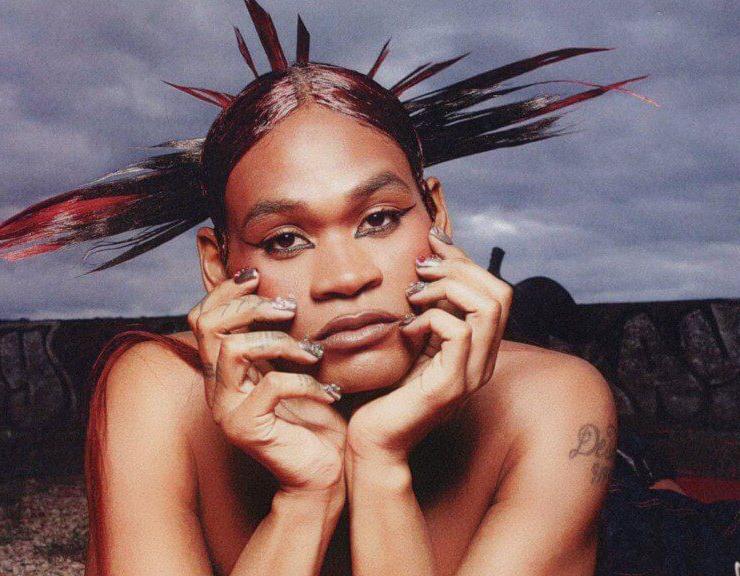
Infinite Coles is dealing with a little stardom fatigue. The day before I spoke with him, he taught his middle-school-aged dance students at a local Staten Island school, rode the Ferry to Manhattan to grab some clothes for a Fang NYC fashion show he attended the day after our talk. He excitedly tells me that it’s the first time a designer invited him to a show. That breakthrough moment follows his first headlining performance at the release event for his Sweetface Killah album, released in December on Don’t Sleep Records. “I don’t even think words can describe it, but it was beautiful,” he reflects on the set at Brooklyn’s Elsewhere. “I’ve been working on myself and my music for a really long time, so to finally just be heard and seen, it feels surreal.”
The project is true to his first name, melding house, dance, R&B, and hip-hop influences in myriad fashion. Coles’ current musical chapter is a byproduct of a period spent in solitude, examining what self-love and self-acceptance meant to him. He’s wanted to sing all his life professionally, but self-doubt and qualms about the potential reaction from his family, including his estranged father, Ghostface Killah, and uncle RZA, stopped him. But he pushed those misgivings aside and found his voice as an artist. He realized he could rap, too.
So did the rest of the world when he dropped “Sweetface Killah,” a brash track that went viral last year. He accidentally sent the song to his label when emailing them a folder of songs. “They were like, ‘What’s this one Infinite, we never heard this?’ I said, ‘Oh, I’m sorry. I didn’t mean to send that.’ And they were like, ‘No, this is the one.’ I’m like, ‘What are you talking about? Everybody’s gonna think it’s a diss record, I’m not putting this out.’” But he was convinced to drop it, and the song went viral not just because of celebrity proximity, but also Coles’ charisma and lyricism.
He saw some hardcore rap fans react sensationally to the song, but he paid more attention to those who identified with lyrics like, “Is it me? Am I not your cup of tea? / Are my pants not low like your self-esteem?” such as a fan who stopped him in the street to tell him about his own traumatic parental relationship. Some hip-hop heads may first identify Infinite Coles as the son of a legendary rapper, but his story is vaster than that.
It starts in Staten Island, where he grew up singing alongside his cousins, realizing his musical inclination from an early age. RZA was the first adult who affirmed his talent, after he and his cousins sang a Christmas carol in front of the family at 14. They wowed the room and compelled RZA to tell them that he was going to get them in a studio when they were 18. “We were excited,” Cole remembers.
His family shaped his early musical tastes, as he gravitated toward their sessions playing Aretha Franklin, Whitney Houston, and other vocalists, but was more averse to hip-hop. He began making his own foray into music as a singer, though he occasionally grappled with insecurities that would take him off course. In 2015, at 22 years old, he had a role in Clayton Vomero’s Gang, a short film which Dazed called, “a day in the manic lives of Infinite, Mela and Denasia” as “the three rail against their psychological confinement through the malls from the streets of Staten Island.” Coles also worked on the Gang soundtrack, coalescing his two creative passions: music and acting.
Producer XXXChange, who curated the Gang soundtrack, had just signed with the vaunted London label XL Recordings, and connected Coles with label co-founder Richard Russell. Coles soon found himself across the pond to record with Russell. “I was turnt boots,” he raves about his first time in London, two weeks of celebrating Gang’s release while recording for Russell’s star-studded Everything Is Recorded project. Their studio sessions were so prolific that Coles was able to use the outtakes for his debut Destiny EP in 2021. The project reflects Coles’ early aspirations for traditional R&B, with slower-paced, heartrending tracks like “Spiders” and the eponymous track with Wiki. In hindsight, Coles told Galore Mag, “I’m not a fan of this project at all! I was living in a shelter when I was offered the opportunity by Dean at Don’t Sleep Records to release this project. My mind, body and soul was not in the right space.”
He faced housing instability for 11 months, working in Staten Island, then traveling to a shelter by JFK Airport on a daily basis—one of the longest journeys a New Yorker could take. He notes that he’s always been his “own therapist,” which made that extended trek a daily chance for self-examination. “In the beginning, I was really depressed by it,” he admits. “But I’ve learned to embrace those ferry and train rides during that time, because I was able to get into me and figure out what I needed to do with myself.” He realized that the very people he was wary of unsettling with his music weren’t even there for him at a time of need. “I [would be] like, my dad’s gonna hear this, my uncles are gonna hear this. After the shelter, I was like, ‘I really don’t care what nobody thinks.’”
With a new sense of confidence, Coles linked with Zach Witness, a Dallas producer whom he met online. He says their Virgo synergy and shared musical tastes made them natural collaborators. During their first time working on what would become Sweetface Killah, they made 11 songs in 13 days. Coles locked into a flow state; he wasn’t sure what kind of album he was working towards, but knew to just keep going. “Everything was working out on its own. I didn’t have no plan. I didn’t know what I was going to talk about. It’s all came out on its own.” Within that period, Coles confronted one of his deepest creative qualms: rapping. He says he always wanted to rap, but felt like he wasn’t “allowed” in such a “gritty, rough” field. “It felt like I had to be like that if I wanted to rap.” But then, “I let everything go. Like, fuck what they gonna think. And my first rap is the reason why things are happening.”
“Sweetface Killah” begins the album with a bang, with Coles belting, ‘Batty boy SweetFace Killah Nasty on the beat, bang bang go gorilla.” The bold affirmation was meant to orient listeners in what to expect from the rest of the project: “You’re not about to get some regular R&B heterosexual vibe. I’m letting you know right now, the next song is going to be something.” And the rest of the project follows that cue. One of the chants on “DM” is “I do what I want,” part of a chorus that comes after he’s singing, and before a breakdown that leads into Coles rapping. The summery “Mama Strong” follows up on “Body Strong’s crooning, but then he breaks into rapping, “I am my ancestor’s dreams, look at me beam, I am the American dream!” Those phrases are so often uttered in relation to capitalistic success. But Coles and Sweetface Killah embody what should be everyone’s northstar: the unbridled confidence to be your full self.
“I’m a rapper now,” he affirms. “I’m working on new music. Sometimes I’m singing, and sometimes I’m rapping, and sometimes I’m doing both on one track. It feels really, really good.” He says right now he’s fixated on keeping the momentum of his career going. Along with his newfound musical acclaim, Coles is a model with a distinct fashion sense intent on “barrier breaking,” often mixing “masculine with feminine” styles.
Coles says he doesn’t consider himself a member of the ballroom scene, but vies to highlight the influential queer community as the cultural progenitors they are. “A lot of people from the industry that are bigger love to take and never give life to where it came from,” he says. “You see everybody doing ‘clock it,’ but everybody’s doing it the wrong way. Everybody’s saying ‘Yes,’ [or] ‘What’s it giving’…they hate us, but they also want to take [what] we create. I want to be that one like, ‘This is where it came from. This is where it originated.’ Sweetface Killah asserts the historical links between hip-hop and house scenes.
His devotion to self-discovery has resulted in a debut album that he can be proud of, that’s now shaping the course of his future. With his debut album, Infinite represents hip-hop’s recent push toward rekindled house and hip-hop relations and a new generation of an extraordinarily talented music family. Through it all, he’s grateful. “I’m always like, ‘God, thank you for my growth. Thank you for allowing me to open up a new gift that was already inside of me that I was hiding.’”
Subscribe to the andre gee newlsetter here.
Andre Gee is an award-winning culture, politics, and music journalist living in Brooklyn by way of Washington DC. He’s been crafting profiles, breaking stories, and exploring cultural analysis for over ten years.