Gabriel Jacoby’s music makes the room spin. His language is a blend of Bayou second-line, Florida blues, and swamp footwork under a raspy baritone and a veneer of Hollywood funk. The songs are so good that even splashes of harmonica sound hot, hot, hot. Last autumn he put out his debut EP, gutta child, and earned comparisons to Prince and D’Angelo, neither of which I’m compelled to dispute. The guy sounds like a throwback, fluent in idiom and Southern heritage—but Jacoby didn’t even know who D’Angelo was until a year and a half ago, when his manager put him on to the late musician’s work. “I was like, ‘Oh, wow.’ It was crazy, because everybody, before I knew about him, was like, ‘You got this D’Angelo vibe,’ and I would always say, ‘I don’t know who that is, but I appreciate it.’” But when Jacoby started spending time with Voodoo, he started to pick out the similarities—not in voice or rhythm, but in intention. “I was like, ‘Yeah, he’s definitely a perfectionist like me,’ and I love that. That’s a dope human being.”
Jacoby’s perfectionism manifests in every facet of gutta child. The dude is a multidisciplinarian without hesitation. He writes, sings, dances, directs every visual, and mixes and masters each track—and he’s self-taught in all of it. The impulse to do it on his own comes naturally, he says, because he doesn’t like being subconsciously influenced by other people’s creative processes. “If it’s something technical, I might go on YouTube to try to find the easiest way to do something in Logic Pro,” Jacoby elaborates, “but when I picked up a guitar, I didn’t take lessons or anything. I’m still learning, but I had to figure it out myself.” He’s been “touching instruments” since he was a year old. “I don’t really remember not thinking or talking or dreaming about music,” he reveals. “Music itself wasn’t even a career, it’s always been second nature to me.” Around high school, when all of his friends and counselors started talking about college, Jacoby couldn’t envision himself anywhere else but on the mic. He started beatboxing and memorizing melodies, writing obsessively. “I thought, ‘I don’t want to do anything else,’” he says. “It’s inevitable that whatever I’m doing is going to involve music. I found myself in a space where I needed to perfect my craft and find my voice as I got older, and develop something that was personable to me.”
The now-LA-based Jacoby was born in South Carolina and lived there until 2007, when his mother moved him and his six siblings south to Tampa, a place with a musical history scattered across generations. There was Cannonball Adderley in the mid-century, after the Blue Note became a major stop on the Chitlin’ Circuit. Doechii, who became just the third woman to win a Best Rap Album Grammy, grew up near the Hillsborough River. Most native Tampa music was big in the 2000s, but people are slowly returning to their roots. That’s how you get some primo Nelly rhythms on gutta child. “You have to really pay attention to realize that a lot of [Tampa music] is blues-based, African-based,” Jacoby says. “It’s very fast-paced. It’s very much like reality, nothing fancy or polished.”
“Were you surrounded by creative people growing up?” I ask Jacoby. “No,” he says. “My mother, she’s a visual artist—a photographer—and she loves to direct and shoot videos. My dad can also do visual things. He loves to paint, but nothing to the degree of how passionate I was about music. I always felt pretty lonely in that space. But it’s okay. I like that I’m the only one.” Jacoby learned a lot about passion from his mom. She couldn’t teach him about music, but she used to sing and dance when she was his age. Visuals are, as he puts it, “half of the full message,” and he has her to thank for that.
[embedded content]
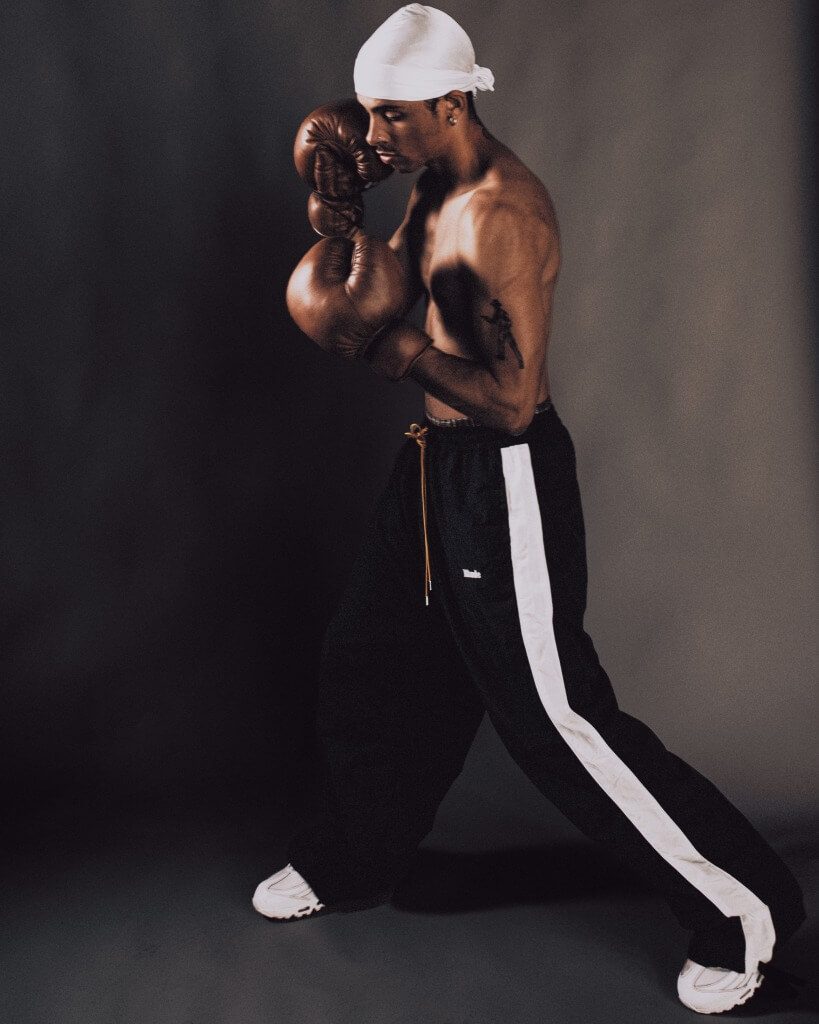
Fighting plays an extensive role in gutta child’s visual identity. Images of Jacoby wearing boxing gloves make a callback to his childhood, when he and his brothers would spar with and wrestle each other at home. “That’s just how it was, growing up in the country,” he admits. “But I think it’s a very honorable sport. I grew up fighting things that kids shouldn’t have to fight, and there are still a lot of children around the world who do [have to fight]. They should be able to just be children and be protected and feel safe. Me having gone through what I went though, the gloves, to me, represent fighting through life. Each song, even though they love songs, the love part of it is more for bringing the audience in. But the deeper message is the ‘gutta child,’ the child having to survive until he can take the gloves off and be free.”
gutta child is 20 minutes of old-school Florida krank music, or what other places may label “jook” music. Memphis has its own strain of it, but Tampa’s krank is very specific to the way that locals move. “You can’t krank to any other type of music,” Jacoby explains. “It just don’t make any sense.” There’s a song on the EP, “bootleg,” that’s a love letter to the 813’s footwork. He tells me that only people who’ve been a part of the city’s club scene will know “how to create what I created, or even understand what I created.” But exclusivity isn’t in Jacoby’s vocabulary, even when he’s at TECO energy paying a bill, chasing his friends’ ghosts through Robles Park, or finding Palmetto bugs in the toilet. “I wanted to make something that everybody around the world could feel and understand and not be excluded from just because it’s a Tampa thing.” He called on Tom G to assist him with “bootleg” (and drop a great bar about Jet2Holidays), because the Tampa OG has “been around forever. Everybody knows him in Florida. He’s one of the original krank music creators, and I feel like he’ll always be around.”
From the top down, gutta child is a Gulf Coast party built out of soul, reggae, rap, and a deep pocket of respect for blues music, which has filled every home Jacoby’s lived in. “It’s all I know,” he says. “It’s all intertwined, because blues is damn near the original sauce. Whether it came from Africa or the Deep South, it’s the foundation of what everybody’s doing today.” If Jacoby was going to be one of the greatest musicians of all time, he knew he needed to go as far back as he could, take something that already existed, and make it into something new. “When you say the word ‘blues,’ people try to put a timeframe to that, or a generation. There is music that has time on it, but I love the idea of timeless music. I want to be able to put respect on the blues and show the world that it can be something cool.” Jacoby is always experimenting, because it’s the only way to “create something out of thin air.”
He doesn’t buy into the argument that “nothing is original,” arguing that, “if I think about a song by Michael Jackson or 2Pac, I don’t know if I could go find something that sounded like that before they made it.” So Jacoby tried doing the same thing, though it’s never been about mimicry. Love is what powers the downhome bounce of gutta child, in the falsetto melting through “baby” and the damp, devoted attraction of “the one,” a song so warm it’s lit from the inside. “At the end of the day,” Jacoby gestures, “if I’m creating something that has to do with love, I’m all right with that.” And other people have started catching on. He’s been in the studio building tracks with Justin Bieber, he nabbed a co-writer credit on Shaboozey’s “Chrome,” and he’s about to link up with Kehlani.
Love manifests in unlikely shapes in Jacoby’s songwriting. After witnessing poverty’s ugliness firsthand growing up in the ghetto, he wanted to practice guidance and wisdom, passing greatness on to whomever’s coming up through those conditions now. “How can you escape that without running away from it?” he wonders aloud. “I think, instead of running away from it, I embraced it in a way where it’s like, ‘No, I don’t want to be poor. I don’t want to have the poor mentality. I don’t want my family to live like this, or anybody for that matter.’ But, with anything, I’ve always been one to go on the front line and embrace it because it’s who I am, regardless if I like it or not.” Jacoby doesn’t want poverty to be a negative in his art, or anyone’s. “Even though I might have been going through stuff, there’s other people that are going through much worse and they’re able to keep a smile on their face. I knew there was some possibility of trying to take something positive, or bring it to light.” His mission is to have every song parallel his own authenticity, to heal people through liberating, radical music. He’s a provider in every sense of the word. “Though not everybody’s from where I’m from, I still want to show who I am and have people connect in their own way. It’d be selfish to just make it about me. I try my best to include everybody’s perspectives as much as I can.”
Inclusivity, he reckons, is among his greatest strengths as a storyteller, so he quotes Bob Marley, OutKast, and Nina Simone often—artists who took to their stages with a purpose, whose intentions laid out a future for him. “They’re fearless in what they do,” he tells me. “And, no matter who I’m working with or who I’m around, I let everybody know from the jump: whether I’m in the studio or I’m on stage, I’m going to be me. I’m going to give my message.” The people who don’t operate in service to love, he says, are full of fear. “I’m doing what I’m doing for the people who need that, who need somebody to lead or somebody to hear them out, or somebody to give them something that has sustenance. Bob Marley didn’t do anything but sing about love and revolutionary things. Same thing with Michael Jackson. Same thing with Nina, or Prince, or James Brown, or Kendrick Lamar.” Jacoby seems destined to enter that conversation.
[embedded content]
Matt Mitchell is the editor of Paste. They live in Los Angeles.