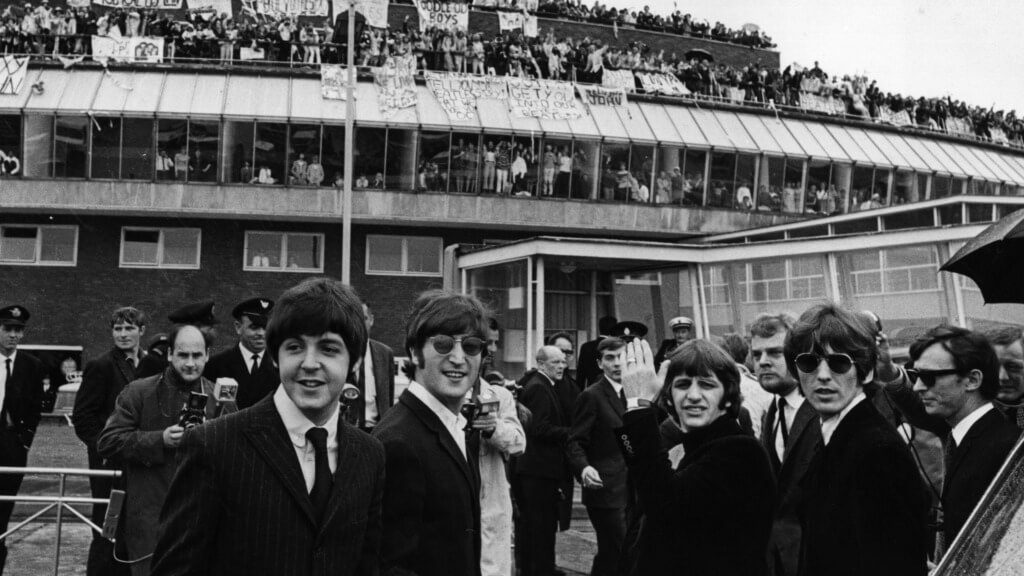
Serious thinkers, journalists, and academics have been writing about the Beatles for years. There are books about books about them. I’m not at all qualified to write a scholarly piece about the Beatles, but in the spirit of the across-the-board appeal that was one of their superpowers—they spoke to everyone from musicologists and filmmakers to the “everyperson” and “everykid”—maybe there’s room for all perspectives.
I wanted to climb into the speakers of our home stereo ever since I was old enough to reach the controls. At age six, I was entranced by the sound coming out of a green apple spinning on a record player on the floor of my best friend’s house. At age twelve, when I only owned the Red and Blue albums, a family friend showed me his complete Beatles collection on 8-track and I remember a physical feeling of almost hysterical excitement. How could all that magic fit on one shelf? We played them for the entire visit.
Not unlike David Foster Wallace’s story about the young fish who didn’t know what water was, it can be difficult for an adult to hear The Beatles’ music as anything but background. One of the great joys of parenthood is re-experiencing the too-well-known as brand new again. My six-year-old’s YouTube algorithm offered him the “Yellow Submarine” short-form video. I told him about the movie, but said it might be too long or strange for him to enjoy. Three hours later, he’d watched it twice, totally transfixed. Within days, he was deep into their catalog. A year later, we were in our seats at the O2 in London waiting for Sir Paul McCartney to come onstage. When he did, our son nearly exploded with glee, clapping his hands together faster than anyone has ever clapped.
I’ve never been much of a ranker—at least fifty albums must be tied for first place—but Revolver is in a heady place all its own. Both wildly popular and indisputably sublime, it has gathered an ever-thicker patina of association—our own histories of listening to it, but also the imagined histories of the millions of other times and places it was listened to. How easy it is to imagine a group of Vietnam War protest marchers recovering in their shared house to the sound of it, a teenager dancing in their room, a senior moved by “Eleanor Rigby” on their car radio. The artifact can take on an intoxicating emotional size. These songs have been everywhere. What it must have felt like to hear it at the time… Though, as my wife’s father told it, you wouldn’t put a Beatles album on at a party in the sixties, because everyone would stop talking, waiting to hear what would happen next.
Suspecting they were starting to soundtrack entire inner worlds must have freed the Beatles from the restrictions of party-starting best practices. Who could have argued for side one of Revolver opening with a banger but then going straight to poignant chamber pop, a sleepy number about sleeping, an Indian classical music–influenced song, a pastoral ballad, and then a submarine-themed sing-along, all before getting to the next rocker?
As a lifelong music fan, I live for the thrill of finding a perfect moment (or song) that I want to hear again and again. As a music maker, those moments are touchstones and ideals. Revolver has an outsized share: the guitar break in “Got to Get You into My Life,” the drop-in of “Love To You,” the snaky lead and off-kilter arrangement of “She Said She Said,” the opening riff and guitar tone of “Paperback Writer” (even though it was a non-LP single, it was recorded during the album sessions, so it and “Rain” have always felt to me like they’re of a piece with the full-length).
On tour in Germany in 2012, I splurged on an original UK mono copy of Revolver for 110 euros. My eldest son and I started a tradition of listening to it at the end of a particularly good day, as if it were a holy totem only to be brought out at special ceremonial times. I would often mention that the mono mix was the one the Beatles stayed in the studio for (they weren’t generally present for the stereo mixes, which were sometimes done days later)—this was how they heard it, the “real, actual sound.”
So much has been said about John and Paul’s genius, and George’s, and it’s all deserved and true. But what’s really struck me while preparing to write this is the fact that Ringo may be the best “drum composer” of all time. To sit in that hot seat, in the world’s most important band, knowing you’re making albums that will be listened to for a very long time, and come up with those incredible parts on the spot, again and again—parts that you can hardly imagine being any other way—seems like an almost impossible achievement. On Revolver, he is at the height of his innovation, with at least two radically rule-breaking performances. On the drone masterpiece “Tomorrow Never Knows,” he commits to extreme subtraction, playing a monastically unchanging part with hypnotic momentum and absolutely zero decoration, while on “She Said, She Said” he does the almost total opposite: he constantly removes the backbeat, but never stops implying it through the phrasing and accents of his almost non-stop fills.
What also struck me is how George’s absorption of Indian music is the defining element of the album, permeating almost every corner. In addition to “Love To You” and George and John’s guitar-playing that so often evokes the sitar’s winding phrasing and the tampura’s chiming and ringing, there’s Paul’s guitar solo on “Taxman” and his melismatic exploration in the outro of “I Want To Tell You.” And of course “Tomorrow Never Knows” distills and expands so well the feeling of droning sympathetic strings (the strings on a sitar that ring out without being plucked, animated only by the vibration of the whole instrument).
In 1998, Quasi and Elliott Smith opened for Nada Surf for nine shows in France. I was an enormous fan of both and knew very well that we belonged at the bottom of that bill. We had one night off and stayed in an Irish bar until the wee hours singing along to the jukebox, which we’d programmed to be almost entirely Kinks, with a few exceptions. It was a joyous evening, lots of Guinness, lots of laughter. The clearest memory for me is Elliott shouting his personal mondegreen “abbot, abbot!” at 1:46 of “Yellow Submarine.” Before one of the last shows, he came into our backstage area and asked me if he could borrow my acoustic guitar to warm up his voice. He sat down and played “I’m Only Sleeping.” Looking back, I can hardly believe that happened. I can still hear it. And I’ll always be able to hear Revolver, whether it’s playing or not.