A Decade of Human Performance
When I told my dad I was writing an anniversary piece about Parquet Courts’s Human Performance, which turned ten years old yesterday, he immediately scoffed. “That album came out yesterday,” he said, his voice tinny over the speakerphone. “It hasn’t aged at all. It’s way too soon to write an anniversary piece on it. Nothing has changed!”
On some level, he’s not wrong. The Brooklyn band’s third proper album sounds like it could’ve come out last week. In the grand scheme of things, ten years is nothing at all, hardly a blink of the eye. But this decade, I’d argue, feels more distinct than most. At the time of Human Performance’s release, the world was a different place—before the political shifts of the late 2010s and the global upheaval that followed. In the past ten years, the world has ended and put itself back together again a half-dozen times.
The Evolution of a Brooklyn Staple
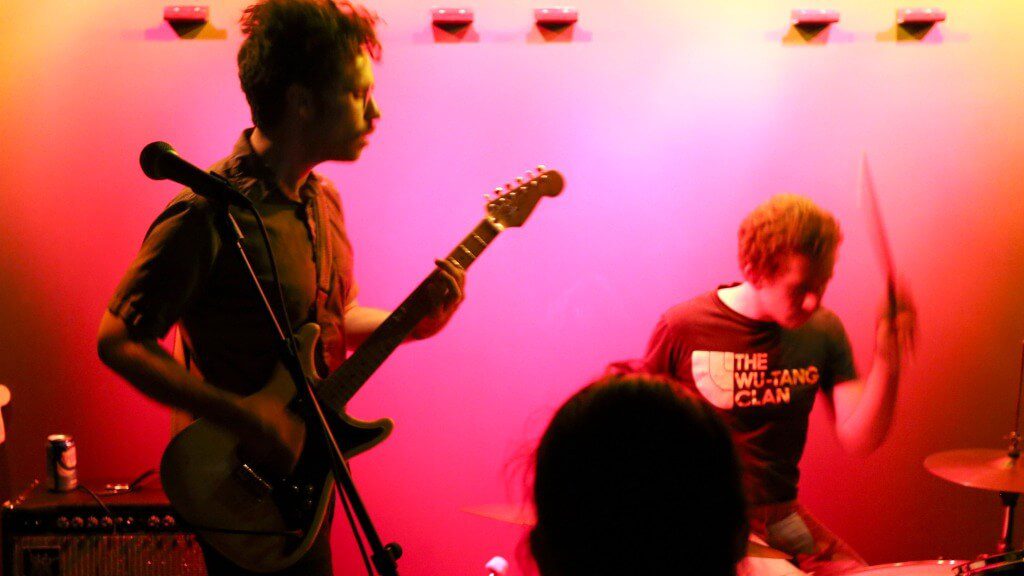
Although Parquet Courts released Sympathy for Life just five years ago, it’s hard not to view them as a thoroughly 2010s band. Frontman A. Savage was a DIY kid from the word go, hopping from band to band in his hometown of Denton before meeting fellow vocalist and guitarist Austin Brown at the University of North Texas. When the pair moved to Brooklyn, they were joined by drummer Max Savage and bassist Sean Yeaton, and Parquet Courts was off to the races.
Following the breakthrough of Light Up Gold and the twitchy, literate Sunbathing Animal, the band faced the challenge of being pigeonholed as a mere revivalist act. Their 2015 instrumental EP, Monastic Living, was a deliberate, “aggressively ambient” pivot that drew a line in the sand between fair-weather fans and those who understood the band’s deeper, more experimental impulses. It was a crucial moment of redefinition that cleared the path for Human Performance.
A New Sonic Horizon
The band underwent their own redefinition process throughout the making of the album. In a sharp contrast to the breakneck pace of their previous records, Human Performance took a full year of work across three different studios. The band wrote around 30 songs, but only 13 were chosen for the record. As Austin Brown noted, they wanted to take time to gain perspective on their sound and their lives.
The resulting record was their most hi-fi work yet, yet it remained deeply personal. Tracks like “Dust,” “Captive of the Sun,” and the vulnerable “Steady On My Mind” showcased a band willing to risk their established “tough” persona for something more emotionally resonant. Brown’s admission that he had previously hidden behind lyrical cleverness to avoid real feeling marks Human Performance as a pivotal moment of character growth for the group.
The City as a Character
New York City is all over this record, not as a backdrop but as a character in its own right—a place that keeps remaking itself faster than anyone living in it can process. From the vertigo of returning to a familiar block only to find it gutted and rebuilt, to the sensory assault of the J train, the album captures the particular strain of loneliness that comes from being surrounded by millions of people yet feeling invisible.
Human Performance remains the rare album that sounds like what’s going on inside your head—not a statement about the human condition, but the actual chaotic, contradictory, and devastating experience of it. Ten years later, it stands as the moment Parquet Courts figured out exactly what kind of band they were: something bigger, stranger, and more emotionally complex than anyone had believed possible.