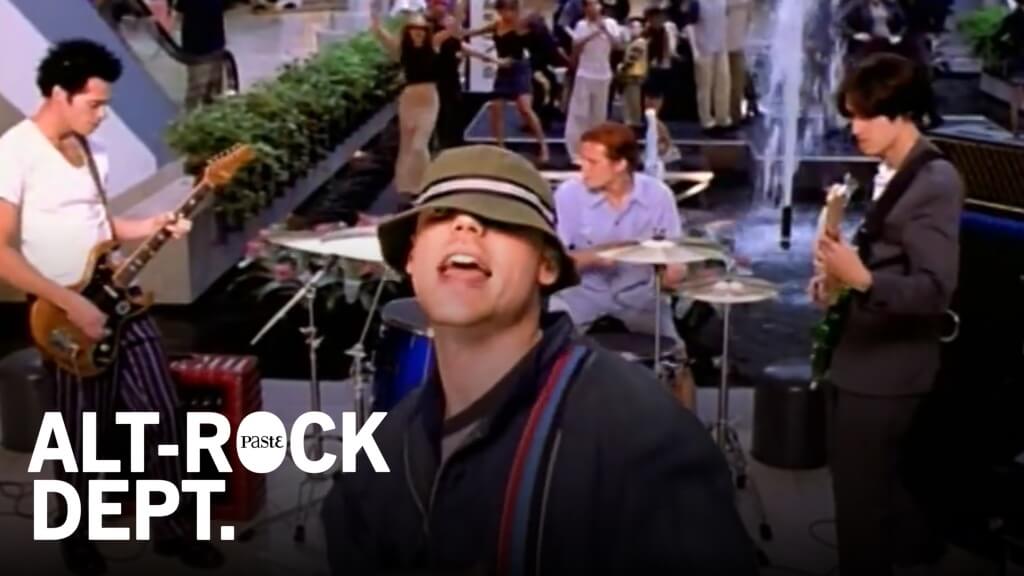
Alt-Rock Dept. is author Niko Stratis’ essay series about working at a grocery store in the mid-‘90s and the radio songs that filled every aisle and stockroom
YOU CAN BE LOVED and find love anywhere, and you can, and you will, be saved by the love of a thousand things that emerge from a thousand places. Not the least of which is a radio, where we got “You Get What You Give” by the New Radicals. In 1998, it emerged as the thesis on the value of it all—it is the atom that destroys when split, that rebuilds only once properly studied and understood. Like a perfect first job, it is easily bristled against, and it’s easy to mock its earnest value, which only reinforces it as a perfect kind of song. It has to mark you with questions about its place in your life so you can think about it forever before you can learn to love it.
I don’t believe it’s important for your first job to be good, as if there might be some perfect kind of charming labor that teaches valuable life lessons while building sturdy character. I would argue it’s more significant that whatever your first job is, it should be some Pantone code of total shit. It should wear you down a smidge, weigh heavy on the spirit in benign and harmless ways to inspire rebellion against the monotony of life’s tedious little battles. As an introductory course to the lessons of the world, a good and terrible first job is an ideal opportunity to see just how much weight the branches of your sturdy frame can hold before they break.
This is not to say a bad job will be good, nor the inverse, but that a terrible job is important. It’s paramount you know how to salvage your wits in a crushing environment. Not by the virtue of the work or the customers, but by your need to survive, and the lessons learned in these places are often more valuable than anything taught in any school you can name. As author Rax King once said, in an interview with Dirt Media on Instagram, “there ought to be a draft in America, and when you’re 18 you’re entered into this draft… it’s not for military service: it’s for food service, or it’s for retail.”
Public-facing jobs are important, if only to teach you the inherent danger of working in service of an ungrateful public. Customers that are eager to burden you with their lavish demands and desperate needs. This is different in all jobs, but at my first—the grocery store—it was the locations of unknown ingredients, or the precise order of things into a bag, or anger expressed at the cost of broccoli, as if the finer decisions of commerce were left to the awkwardly shy 13-year-old closeted queers of the world. There were countless terrible things about the job, but there was always a saving grace, and that was the radio and the people who loved it.
The breakaway single from the New Radicals debut (and only) album Maybe You’ve Been Brainwashed Too, “You Get What You Give” is a power pop masterwork that is as big and bright and bold as its sunburst yellow album cover would have you believe. If a song could be presented in technicolor, the synesthesia of its promise would easily challenge the limits of whatever cheap speakers presented it. It is also unimaginably earnest, with an opening call to arms to rally all who carry the dreamers’ disease, a song that leads to inspirational posturing about just what is achievable once you know you have the music in you. It is a song that is easily hated by bitter hearts, because it is easy to hate the things that want to love us the most. It was, like many songs heard daily on the radio, protested against by the voices that were always the loudest and most desperate to be heard. People who would bemoan how fucking cheesy the whole thing is before they harmonized perfectly with every soaring syllable.
I loathed working in the grocery store at first, because it was never going to love me, and this is the best lesson I took away from the job: how to find joy in all the things I did not imagine could contain any at all. A shitty job is only ever going to be what you make of it. It’s up to you to build it into something of value, and slowly I searched for anything in the erosive grind of the day that might be a catalyst for pleasure.
In searching and wanting something more in the endless repeating days, I found comrades in wasting away the hours. Together, we took the white styrofoam platters intended for meat packaging and built a sofa set above the dairy freezer in the stockroom, where we could sit and hide away, pretending that our makeshift furniture was some transcendental pleasure of our own design. We got high in the alley out back, then returned to fill the pockets of our dirty blue smocks with fuzzy peaches before climbing into the drop ceiling to throw errant candies at innocent enough customers. The job became second to the adventure, discovering what was possible when anything became imaginable. It’s only that there was friction with a management class that did not appreciate the creative endeavours of inspiration, the ideas with which we muddled away each minimum wage-earning hour.
Gregg Alexander, the primary songwriter and creative vision of the New Radicals, wrote “You Get What You Give” after a dream where he encountered Joni Mitchell in a strange house listening to music, who instructed him to have a seat upon meeting. The song opens with an infectious and undeniable melody; drums, guitars, and pianos so bright and impossibly cheerful they could have been lifted from an in-house educational film about the wonders of targeted marketing found in a Gap storeroom. It’s Alexander’s lyrics that shatter whatever misconceptions the instruments might inspire, his voice dancing between wild falsetto and gritty drawl, that bristle against the facade of a fading dream. That whatever life we’ve been promised is not really true, that it has always been a lie, and that it is upon us to create joy in a world that would rob you of it. Joni Mitchell, when asked years later, would say of the song that it “rose from the swamp of ‘McMusic’ like a flower of hope,” and that is perhaps the best response you can hope for from a legend who gave inspiration when first met in a dream.
Looking back at this moment of success in 2024, Alexander revealed that at the same time he dreamt of “You Get What You Give,” he wrote the hook and melody for “Murder On the Dancefloor” on an acoustic guitar in the back of a mustang, and briefly considered it as the single. While the song was never recorded by the New Radicals, it would go on to be co-written and released on the debut record of English singer Sophie Ellis-Bextor in 2001, becoming a major pop single in the UK, and finding new life in 2024 when it was used in a breakout scene in Emerald Fennell’s Saltburn.
I HAD AN IDEA, a plan that I knew was the misguided dream of someone who had given up on all pretense of care. I knew the rules and boundaries of my grocery store job, and all that was left was to see where they might bend and where they might break. At work, we were guaranteed three rests: a 15-minute coffee break, a one-hour lunch break, followed by a second and final 15-minute coffee break, all carefully spaced out to break up the day, written in pencil on a schedule that hung in the office. Each of our names laid out carefully in order, instructing us when we could stop, and when the simple grace of rest was afforded us. These windows of time could be, and often were, traded among us like baseball cards and secrets—time shifting so people could spend it together, or further apart if it was an enemy or an object of awkwardly unrequited affection. I didn’t want to return to the tedium and toil of the working floor. I had been there for years, I knew all that it offered, and it left me uninspired and dulled. My spirit, a nub of its former self, like a #2 pencil worn down to the brass barrier of the eraser. Waiting to be cast off as the functionally useless detritus of a formerly valued vessel.
After my initial 15 minutes lapsed, I lingered in the coffee room, wandering to the steel carafe to refill my white styrofoam cup once more. New people came in for their scheduled breaks, and we delighted in unexpectedly crossing paths. They asked how long I was going to stay up there, sitting on an uncomfortable bench behind a reinforced folding table accented by discarded cellophane and half-unfinished Cosmopolitan quizzes. I responded that, for the first time, I had no idea how far I could take an idea.
I don’t know if I ever thought of “You Get What You Give” as a good song in the years that I worked with it, acting as the soundtrack to my days. In truth, it arrived at the tail end of my first career, hitting the charts in my final year of gainful grocery store employment. It almost didn’t matter whether it was good or not. It was always there, and every word became a part of me, and it was less a song and more an undiscovered bone in my body—lyrics that were sung by all of us pushing carts, restocking shelves, or hiding above the freezer with a pocketful of stolen bulk candy.
When something bad happened—a cart collapsing, a customer yelling because we were out of their favorite flavor of Crush soda, or an angry boss took their internal frustrations out on us—someone could sing “don’t give up” and trust that they would be met by another voice confirming, “you’ve got a reason to live.” Sometimes, on the best days, they would drag out the “I” in the middle of the final word, like Alexander does on the song, and lean into the more soulful, R&B flavor the hook folds into itself. The lyrics were a mantra to living wild and unbothered by the weight of the world bearing new on our shoulders.
My break lasted another 15 minutes. Then 15 more. Before too long, it was my allotted lunch, and so I went in search of food and supplies, then returned. Wild and frenzied. Co-workers knew my scheme, and covered for me where they could. All of us suddenly aware that the rules were just ideas written in pencil on a piece of paper, and that they were only as real and as powerful as we let them be. Another hour after my lunch, then 15 minutes more. Songs played on the radio, and songs were sung along to. Coffee was drunk and drank again. I made a new carafe for weary incomers, and greeted them as I would new souls at the boundary of eternal life. We smoked cigarettes and laughed at the news of the day; the annoying regulars, and the frustrations with awkward new employees. Lives that were once like ours, only gone now. At the three-hour mark, a body ran winded into the break room, and hurriedly said our boss was coming. It was the first time he had ventured up to the break room all day, and suddenly the threat of consequence loomed larger than the thrill of my eternal scheme. I gathered myself, and pretended to have just used the washroom, then walked down the stairs from the break room area back to the working floor.
The intentional trap of “You Get What You Give,” where Alexander lays out the names of Beck, Hanson, Courtney Love, and Marilyn Manson, is a misdirection. Intended as a trap for eager journalists to pounce on, and ignore the lines that came just before it. The lead in to the celebrity call-out bemoans the FDA, investment bankers, and predatory health insurance providers. A somewhat radical move for a mainstream pop song to play on radio stations behind cash registers and queues. Journalists, of course, took the bait, and focused solely on Alexander calling out four disparate pop stars by name, saying that he would “kick their ass in,” a line oft-misheard as “kick their asses.” Marilyn Manson said he would cave Alexander’s head in, where Zac Hanson made peace—and eventually worked with—Alexander on a future project after a chance encounter in a grocery store. The song isn’t about celebrities, or headline squabbles, but Alexander wanted to test the water for blood, and was unsurprised to find teeth below the surface, hungry for more.
When my boss caught me at the bottom of the stairs, he pulled me sharply aside and then pressed me against a plywood wall in the loading bay. The air in the room was heavy with the smell of wet cardboard, garbage, and old wood. He asked just how long I had been upstairs, and I responded as cold and calm as I could that I had just been up there for a cup of coffee and to use the washroom. I was just on my way to check aisle three, I said, and thought about how clever my very specific lie was. My boss, a leader in the local baptist church and a calm and measured man, pressed his arm gently against my chest and said he knew I was lying, and demanded to know the truth. I responded again the same as I had before, and I could smell the deli meat and old cigarettes on his breath as he angrily whispered, just loud enough for me to hear, “You’re such a fucking piece of shit, you know that?”
I knew I had done something wrong, that I was the villain of my story, but I felt a sudden calm about my own bad decisions. I had felt held in place in the vacuum of the job, and choosing harmless chaos allowed me to hold on to my head while testing the barriers of the rules and of myself. Working a shitty job taught me my earliest lessons, that there is so much to learn about the world, the people, and places and limits of it. That you’ve got to push at the barrier occasionally to see if it’s still there. I walked away, and sang softly to myself, “don’t give up,” trusting that somewhere, anywhere, was a voice confirming that I had a reason to live.
[embedded content]
Niko Stratis is a former smoker and an award-losing (and winning) writer. She is the author of the critically-acclaimed book The Dad Rock That Made Me a Woman, and the newsletter Anxiety Shark. She once came 2nd in a Chicken McNugget eating competition, but that was a long time ago. She is a cancer, and she lives in Toronto.