
The first thing you see in Osgood Perkins’s psychological crime-horror Longlegs is a red square, but the first thing you hear is a fuzzy, faraway electric guitar noodling on remnants of the opening chords of T. Rex’s “Bang a Gong (Get It On).” Low, droning vocalizations warp around the guitar, both distortion and dissonance growing as the notes bend flat and sharp. A quote follows the production credits: “Well, you’re slim, and you’re weak / You’ve got the teeth of the hydra upon you / You’re dirty, sweet, and you’re my girl.” The track returns when the Longlegs end-credits hit, but T. Rex pops up intermittently throughout the previous 100 minutes. Perkins was apparently listening to a lot of T. Rex when he was developing the film. “It didn’t feel like instantly a perfect match,” he told Rolling Stone. “But that’s the kind of weird mismatch that made it even more appealing to me.”
At face value, T. Rex’s glammy, flamboyant prog rock feels incongruous with the titular Longlegs’ (played by Nicolas Cage) reclusive, brooding energy and his affinity for the devil. Cage’s character was set up as a kind of glam rock devotee, not just in listening but in persona and lifestyle, with a photo of Marc Bolan hanging above his bed, a sea of candles on either side of him, and leopard blankets and mandala tapestries as far as the eye could see—except, he also just loved Satan, wore white makeup like Rolling Thunder Revue-era Bob Dylan, and rocked a head of hair à la Robert Plant’s lion’s mane.
There’s an inherent discomfort that comes with realizing you enjoy the same music as Longlegs, someone so twisted and evil, who cast himself in glam rock’s image. “Bang a Gong” now feels somewhat synonymous with Longlegs on the whole, regardless of its appearances in everything from Top Gun: Maverick to Miami Vice. It’s hard to hear “you’re dirty, sweet, and you’re my girl” the same after watching that energy directed toward nine-year-olds and uncanny lifesize dolls with demonic spirits trapped inside them. Whatever other associations I had with T. Rex’s music evaporated by the time the Longlegs title card flashed across the screen in the opening minutes. It’s now forever linked to Cage’s Longlegs, yowling in his car and lurking underfoot.
But that inherent stickiness, the inability to separate the song from the movie, is what makes it so effective. Horror-movie needle-drops, in general, work by hijacking the associations we already have with a song. Music has been scientifically proven to trigger emotional responses and autobiographical memories, and when a horror film rewires that connection (pairing a familiar melody with something grotesque or terrifying, etc.), the song can become inseparable from the scene that distorted it. “Bang a Gong” being so well-known and beloved, an almost universal song in so many people’s lives, doubles down on that idea; Longlegs destroys the veil of familiarity and comfort that most listeners had previously associated with the track, making it even more jarring than any creepy-sounding song. The general assumption is you’d sooner hear “Bang a Gong” playing over an action flick (re: Top Gun!) than a psychological crime horror-thriller. The same way horror plots will make you trust the friend before later revealing they’re the bad guy, mismatched songs violate viewer predictions. The song may not have anything to do with the scene, but its sheer presence in said scene might be baffling enough to make your heart skip a beat.
Sound of all kinds is integral to the scare factor of the horror movie-watching experience. Creaky floorboards, distant whispers, demonic gurgling. Windows shattering, alarms going off, thunder clapping. Think about watching Sinister on mute—it’s just not the same! You might not even flinch! Diegetic music, then, is another way to manipulate atmosphere and mood when you want the audience on high alert. There are technical aspects that can make any song scary: minor keys, pockets of silence, unsettling intonation, dissonance, and unresolved chord progressions. All of these elements can add that kind of edge or anticipation to a scene. At its simplest, it sounds like the dah-duhs of Jaws signaling a looming shark attack, or the clanking keys in The Exorcist theme that follow you into the end-credits. Grating dissonance, impending doom, innate unease: it heightens all of those things Jaws and The Exorcist already make you feel.
Then, somewhere along the way, needle-drops started sidestepping the musical language, importing songs audiences already knew, and letting the contrast with the on-screen violence do the work. Tiny Tim’s “Tiptoe Through the Tulips” is one of the most famous examples. The song itself is light, almost cartoonish, but in Insidious, it becomes the demon stalking the Lambert family’s calling card, turning its childlike whimsy into something looming and dreadful, making it synonymous with danger. In American Psycho, Patrick Bateman (Christian Bale) plays Huey Lewis’ “Hip To Be Square” before murdering his colleague, blending corporate ‘80s pop with rage-fueled murder. Then there’s The Shining, which uses the crinkly, jazzy “Midnight, the Stars and You” as Jack Torrance (Jack Nicholson) wanders into the ghostly ballroom celebration at the Overlook Hotel. It’s faraway, liminal, uncanny. Is any of this real? Has he been dead this whole time?
“Don’t Fear the Reaper” is another horror soundtrack repeat-offender, most notably in John Carpenter’s Halloween and then again in Ti West’s X. But the first Scream uses a slowed acoustic cover of the Blue Öyster Cult classic as both foreshadowing and a means of romantic tension, playing when Billy (Skeet Ulrich) sneaks into Sidney’s (Neve Campbell) window. The melody is recognizable enough that, regardless of its reinterpretation, its pre-existing association with death lingers beneath the action. And that choice itself was more deliberate than coincidental, as writer Kevin Williamson’s original idea behind Scream came from poking fun at slashers like Halloween and Friday the 13th, showing how deep those sonic associations had become, on a cultural scale, not even 20 years later.
Few directors understand the power of the modern horror needle drop better than Jordan Peele, a director whose entire filmography has been built around songs that have since become immediately associated with him. As he told Trevor Noah, “The difference between comedy and horror is the music.” Lunitz’s “I Got 5 On It” was basically the theme song to Us, made even creepier by its eerie string interpretation. “I love songs that have a great feeling but also have a haunting element to them,” Peele told Entertainment Weekly on the choice to use the Lunitz track. “And I feel like the beat in that song has this inherent cryptic energy, almost reminiscent of the Nightmare on Elm Street soundtrack.” He strikes the perfect balance between fear and comic relief, using both “Good Vibrations” by the Beach Boys and NWA’s “Fuck Tha Police” for a murder sequence in Us that makes the victims look like they deserve to be killed by their doppelgangers: “Alexa, call the police!” “Playing ‘Fuck Tha Police’ by NWA.” A slowed, half-time version of Corey Hart’s “Sunglasses At Night” plays during the climax of NOPE, turning synth-pop familiarity into a drawn-out, ominous spectacle. The track is stretched and warped as if to make sure the viewer’s really paying attention to the lyrics “don’t switch the blade on the guy in shades.”
Modern horror films have become especially aggressive in distorting prior associations, deliberately pairing familiar songs with images that permanently alter how they’re heard. Steven Soderbergh’s Presence uses Basement’s “Covent” to soundtrack the film’s climax, where every mystery is revealed and the story leaps past the point of no return: The daughter, Chloe (Callina Liang), is drugged by one of her brother’s friends, who then attempts to suffocate her by putting Saran wrap over her mouth. On top of it is “Covent” blasting at a suffocating 11, layers upon layers of distorted guitars and howling vocals filling the room—the kind of loud where you can’t even take in anything else around you.
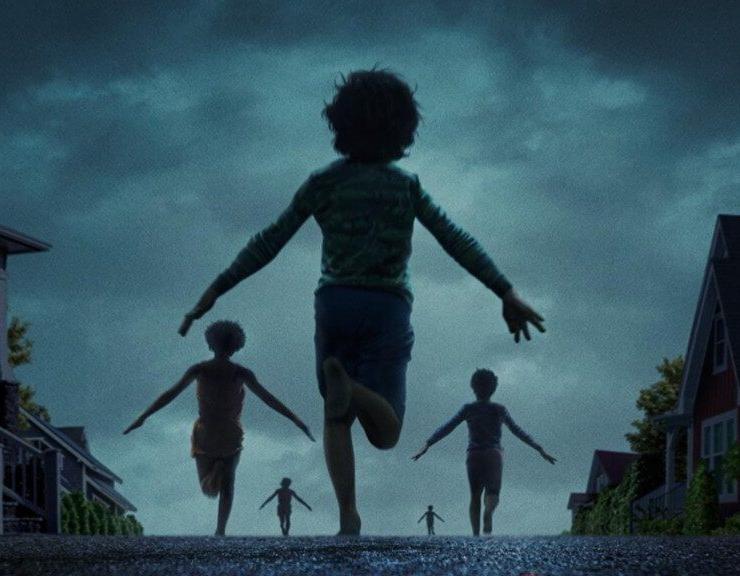
Zach Cregger’s Oscar-winning Weapons notably opens with George Harrison’s “Beware of Darkness,” taking an already somewhat brooding, yet more religiously contextualized track and pairing it with the image of kids running out of their homes into the dark, arms splayed in the notorious and chilling pose reminiscent of the infamous “Napalm Girl” photograph. Harrison’s voice was the last thing I expected to hear in a movie about vanishing kids and demonic possession; it filled me with such indescribable dread for what was to come, the “Beware” part of the hook that was once referencing inner turmoils now being extended outwards to the dangers and threats of the world. And now, I truly and wholeheartedly can no longer listen to that song without thinking about Aunt Gladys (Amy Madigan). And that means Cregger did his job.
In Bring Her Back, the Veronicas’ already-amped “Untouched,” coupled with a writhing, screaming child gushing blood from his mouth after biting down on a knife, sharp side up, is a grotesque and gag-inducing needle-drop. The dance song transforms into a beat of anguish and physical suffering, going from mood-booster to stomach-churner in 90 seconds. In an attempt to even be able to listen to that song after writing this essay (it’s truly one of my favorites of all time, and I don’t know if I could bear to lose it), I only watched the scene in full once. Even so, I think it still needs to be benched from my listening rotation for a second. Gotta desensitize.
The same goes for Spice Girls’ “2 Become 1,” the ‘90s bop that plays while the codependent Millie (Alison Brie) and Tim (Dave Franco) conjoin and merge bodies in Together. The song’s sweetness morphs into something monstrous and macabre, mirroring Millie and Tim’s own unhealthy relationship as they literally crawl under each other’s skin. Their skin stretches and squelches, the ASMR-level noises of torn and conjoining flesh scraping against the track’s downtempo melody and Baby Spice’s gentle falsetto. I heaved. There’s no amount of Spice Girls that would make it not a sickening display.
But it’s been almost two years since Longlegs came out, but even now, “Bang a Gong” remains forever altered in my mind. The classic rock favorite that previously made me think only of Marc Bolan’s tophat and my mom listening to it in high school while she underage drank is now doomed to conjure images of Nicolas Cage’s hunched-over, mouth-breathing, Satan-loving killer. After all, once a song gets tangled up in something terrifying, it rarely finds its way back to innocence.