There are two distinct halves in the history of music: before 2000 and after 2000. In a few days Paste will stake its claim on who the “greatest guitarist of all time” is, but first we have to talk about the 21st century. So many players from the last 25 years are phenomenal, but many of them haven’t kicked into that final gear that would land them in a ranking near Jimi Hendrix or Chuck Berry. But that doesn’t mean they don’t deserve a good shout. To compile this list, we polled the Paste writing cohort and came up with 75 guitarists that we consider the very best of this century (so far). We set one rule for eligibility: either the guitarist’s greatest contributions happened in the 21st century, or most of their professional work occurred in that time frame. If you’re looking for a famous player and they were best known in the 1980s, they’re probably on the big list that’s getting unveiled later this week.
There’s a little bit of everything in here: country, jazz, metal, garage rock, hip-hop; sludge, bluegrass, power-pop, sample-soul, session music. For us, good guitar playing doesn’t always mean virtuostic technique or culturally relevant riffs. It’s about telling a story with your instrument. So, we’re giving flowers to everyone from Yasmin Williams and Sufjan Stevens to Adam Granduciel and Laura Marling. And when we eventually come back and update this list, I imagine promising rippers like Emily Green and Grace Bowers will be added in. Here is our ranking of the 75 greatest guitarists of the 21st century so far. Stay tuned for more Guitar Week content, including essays on Cindy Lee and Joni Mitchell and a list of our favorite guitar scenes in movies/TV.
Contributors: Matt Mitchell, Casey Epstein-Gross, Cassidy Sollazzo, Grant Sharples, Ethan Beck, Sam Rosenberg
*******
75. Francie Medosch (Florry)
Florry’s Sounds Like… solidified them as the hazy, let-it-all-hang-out country rockers of this oversaturated alt-country moment. Lead guitar duties were split somewhat evenly between John Murray and frontperson Francie Medosch. On “Hey Baby” and “Say Your Prayers Rock,” her solos help two of Florry’s hookiest tunes transcend classic rock pastiche through back-to-basics bends and simple melodic tricks. Murray and pedal steel player Jon Cox are integral to Sounds Like…, but after seeing Florry live, it’s clear who the guitar god of the group is. When I saw them last June, Medosch turned the tremendous, ambling guitar exercise “First it was a movie, then it was a book” into a rousing concert closer, working her way up and down the neck with a smile plastered on her face. —Ethan Beck
Key Track: “First it was a movie, then it was a book”
74. “Captain” Kirk Douglas (The Roots)
“Captain” Kirk Douglas has been with the Roots since 2003, splitting guitar duties with Martin Luther and Anthony Tidd on The Tipping Point. By Game Theory two years later, he was the group’s lone guitarist. Douglas cut his teeth on Miles Davis bands, reggae, hard rock, acid jazz, spoken-word psychedelia, and rap, using his closet full of Gibsons to become hip-hop’s best guitarist. He embodies Vernon Reid and Funkadelic in equal measure, dropping soul hooks and funk breaks like it’s nobody’s business. You can see him every week on The Tonight Show, where he and Questlove and Black Thought cut up. —Matt Mitchell
Key Track: “Guns Are Drawn”
73. Katie Crutchfield (Waxahatchee)
Even before Katie Crutchfield, the Alabama singer-songwriter behind the indie-rock project Waxahatchee, earned commercial attention for her 2020 record Saint Cloud right at the onset of the COVID-19 pandemic, the artist had been quietly making waves for several years. Crutchfield’s music neatly blended together folk, country, and rock and gave each genre a polished rinse with the armed support of a steady guitar. As her sound and voice got louder and more extroverted, her prowess as a guitarist came through even more clearly, such as on the cathartic roaring hook that launches “Never Been Wrong” or the steely line that strums throughout “8 Ball.” Her more recent efforts—the bright and Americana-speckled “Can’t Do Much,” “Right Back to It,” and “Bored”—are arguably her most rousing and transportative, with Crutchfield’s piquant guitar so viscerally evoking the warmth and loveliness of the scenes the artist colorfully paints through her writing and singing. —Sam Rosenberg
Key Track: “Never Been Wrong”
72. Martin Courtney (Real Estate)
I was charmed by Martin Courtney three years ago, when I saw Real Estate at the Racket. It was one of those instances where you end up at the barricade without necessarily trying to be there. I spent an hour and a half with my head cocked at a 90-degree angle, watching Courtney slink between his acoustic guitar and a seafoam green Strat with the weightlessness of a cat on a power line. I wanted to put him in my pocket. Many might not even know Courtney by name, but they know him by his riffs (the opening chords of “It’s Real” alone could activate any late-2000s Williamsburg hipster sleeper agent). His influence travels through all the jangly, reverb-heavy pop that followed 2011’s Days (Ducktails, Whitney, and the like), and he’s only sharpened that approach in his solo work. Tracks like “Vestiges,” from his debut solo LP, and “Merlin,” off 2022’s Magic Sign, show how Courtney weaves the soft, lush flourishes in between the vocal melody lines. And he’s far from one-note, pushing his crystalline clang to its limits. —Cassidy Sollazzo
Key Track: “Diamond Eyes”
[embedded content]
71. Alex G
Back in his DIY Bandcamp days, Alex Giannascoli proved his talent early on cutting his teeth making lo-fi, lightly experimental indie rock in the vein of Elliott Smith and Pavement. As his jack-of-all-trades style evolved, his ability to cohere his acoustic and electric guitar-forward inclinations with more genre-fluid flourishes rendered his range all the more notable and fascinating. You could hear the sunny Americana twang of “Miracles” on the same record as the abrasive “Blessing” and the pleasant, humid “June Guitar” only a few tracks removed from the bubbly pop of “Bounce Boy.” Despite the immense pleasures in hearing Giannascoli confidently and skillfully shuffle through different instruments and ideas, some of his best, most effective work—“Hope,” “Proud,” “Cow,” “Crime,” and the heavily memed “Sarah”—involves the guitar, acting as perhaps the rawest, most immediate and grounding force through which Giannascoli can explore his emotions. —Sam Rosenberg
Key Track: “Blessing”
70. H.E.R.
H.E.R. grew up around guitarists, on her mother’s side that is. On her father’s side, her pops was a cover band musician. He bought her a Strat and she learned the blues Pentatonic scale. She was the first Black woman to have a signature guitar with Fender, and she’s met the moment as one of the best live players in the business—like some Betty Davis/Lenny Kravitz hybrid. Most recorded H.E.R. tracks aren’t obviously guitar-forward. The stage is where she uncorks, similar to John Mayer. She can also play a mean bass lick. My favorite H.E.R. moment is when she and Chris Stapleton performed “Hold On” together at the 2021 CMT Music Awards. Truly kickass stuff. —Matt Mitchell
Key Track: “Hold On” (feat. Chris Stapleton)
69. Jake Xerxes Fussell
If Bob Dylan tells stories with his voice, then Jake Xerxes Fussell tells stories with his guitar. I love this guy because he makes folk music sound inventive. He’s the son of a folklorist and produces art that speaks the same language. On What in the Natural World and God and Green Again, he’s traditional and transcendent—a rare bird, you could say. Just listen to 2019’s Out of Sight and you’ll be a convert. Fussell’s got melodies coming out his ears. —Matt Mitchell
Key Track: “Frolic”
68. Delicate Steve
Steve Marion’s been all over the place: alt-rock, psychedelia, surf-pop, blues. Kanye West sampled one of his songs and he’s worked with the likes Cherry Glazerr, Amen Dunes, Built to Spill, and Paul Simon. Locking into his 1966 Fender Strat, Marion is a voiceless wonder patching guitar hallucinations and hallelujahs into deep, textural rock fantasies. The guy doesn’t need lyrics, only kaleidoscopic phrases and baggy instrumentals that float on impulse. —Matt Mitchell
Key Track: “I Can Fly Away”
67. Tosin Abasi (Animals as Leaders)
Tosi Abasi’s a metalcore legend and he’s invented an entire style of playing. Using an eight-string guitar and doing “swybrid picking,” he’s innovating the relationship between harmony, melody, and polyrhythm. Most guitarists aren’t doing anything new, but Abasi—whether it’s what he’s doing now, as the leader of the instrumental band Animals as Leaders, or what he did previously, as the guitarist in Reflux—is consistently progressing the genres he works in just by never settling down. He’s a technical superstar. —Matt Mitchell
Key Track: “Cafo”
66. Lindsey Jordan (Snail Mail)
With only two albums under her belt (and an imminent third one), Lindsey Jordan of Snail Mail has already made a name for herself as one of contemporary indie rock’s preeminent songwriters and guitarists. Jordan’s 2018 debut Lush leaned heavily on guitar to soundtrack her diaristic observations on heartbreak and loneliness, constructing an emotionally intimate but sonically expansive world with just ten songs. The guitar work on “Pristine,” “Speaking Terms,” “Heat Wave,” and “Let’s Find an Out” are especially striking in how they express and elevate Jordan’s candor about her romantic angst. On her superb 2021 follow-up Valentine, Jordan continued to hone in and flex her musical range, imbuing the guitar on tracks like “Madonna” and “Ben Franklin” with a touch more pop. —Sam Rosenberg
Key Track: “Pristine”
65. Brad Paisley
I lie all the time and say that my first concert was Def Leppard, but it was actually Brad Paisley at the Canfield Fair in 2005. Mud on the Tires went platinum in the United States but most especially in my parents’ living room, where I sang the title track like I had a check to collect. This century’s country beat doesn’t have the guitar-swinging momentum of yesteryear. The closest thing to Jerry Reed has been Paisley, the West Virginia strummer who’s so talented he makes the players around him—Gary Hooker, Randle Currie, even Jimmy Heffernan and Jody Harris—look like virtuosos. So much country music is hive-mind songwriting now—melodies that are easy on the streaming-conscious ears. Paisley’s phrasings cut you open and lick the wounds clean. If country music’s all about storytelling, then his Telecaster’s got a vocabulary of its own. —Matt Mitchell
Key Track: “Little Moments”
64. Alec O’Hanley and Molly Rankin (Alvvays)
Alvvays is one of the best bands doing it right now, and much of their appeal is thanks to the dual guitar parts courtesy of frontwoman/rhythm guitarist Molly Rankin and lead guitarist Alec O’Hanley. Take the jangly picking that kicks off “Next of Kin,” the MBV-indebted squall at the end of “Pharmacist,” or the brief, chromatic solo in the middle of “Plimsoll Punks.” Alvvays’ guitars are always great. —Grant Sharples
Key Track: “Pharmacist”
63. Tony Molina
Tony Molina is known for his fuzz-drenched power-pop, laced with Thin Lizzy-esque guitarmonies and throttling solos that wrap up just as quickly as they began. Sitting somewhere between Weezer (Blue Album) and Under the Bushes Under the Stars, Molina excels when he pairs a thick stew of distortion with his simple lyrical lamentations. But he can write pure pop punk (just see his project Ovens), drop metalcore chugs into a song at random, and still find space for his twinkling, Byrds-esque folk rock. Last year’s On This Day was partially driven by Molina’s acoustic guitar playing. It was the sound of a pop perfectionist proving, once and for all, that his melodies don’t need an amp to be heard. —Ethan Beck
Key Track: “Can’t Believe”
62. El Kempner (Palehound)
El Kempner started playing the guitar because they wanted to make friends. I can’t speak on how big their circle is now, but I do know that they play the guitar like they’re about to crash a car. The chords just come at you. You can really hear that on their last Palehound album, Eye on the Bat. It’s swirly, chaotic. Kempner’s been honing their style for over a decade now, unspooling as this generational soloist making head-splitting “strap rock” with a beautiful Strat across their chest. —Matt Mitchell
Key Track: “The Clutch”
[embedded content]
61. Gregory Ulhmann
Maybe the greatest disciple of Jeff Parker currently working, Gregory Uhlmann is as underrated as they come. The rock and pop music he plays in Perfume Genius can hang with the best of them, but it’s his improvisational work with Meg Duffy, SML, and Uhlmann Johnson Wilkes that I am always returning to. Uhlmann studied jazz composition in Chicago but his playing style obliterates any strict compartmentalization. I’ve watched him play a couple of times, and the guy walks through portals on stage. His tones and textures lend environments to the music; his improvisations live on within you after they’ve stopped vibrating. —Matt Mitchell
Key Track: “Euphoric Recall”
60. Cory Hanson (Wand)
We used to make shit in this country. Guitarists with the stop-start melodic sensibility of Cory Hanson were once easier to find. On 2023’s Western Cum, Hanson mixed a dose of Allman Brothers solos with a dash of Neil Young’s road-ready curiosity. If there’s nothing new under the sun, Hanson at least understands what a blast it is to toy with classic rock song structures. Occasionally, he’ll clobber the audience with a righteous riff, only to then let a song sprawl out past the ten minute mark, taking solos at the service plazas along the way. Hanson is always a blast to listen to, particularly because even though you never know which direction he’s headed in, there’s certain to be some megawatt riffage. —Ethan Beck
Key Track: “Housefly”
59. Leslie Feist (Broken Social Scene, Feist)
Leslie Feist was a rhythm guitarist in By Divine Right, but Kevin Drew forbade her from playing guitar on Broken Social Scene songs. Luckily her work in the band Feist is some nasty, emotional brilliance. Let It Die is the epitome of her ideology: jazz chords, pop romanticism, folk picking. But on The Reminder she takes full shape with a deep-pocketed musicality that’s two, maybe three guitars wide. She’s obsessed with Latin and blues music and orchestrates masterworks in drop-D tuning. Feist is one of our smartest living fingerpickers. —Matt Mitchell
Key Track: “My Moon My Man”
58. Will Toledo & Ethan Ives (Car Seat Headrest)
Will Toledo and Ethan Ives make anxious, electrified chaos feel strangely precise. Their guitars don’t shred so much as spiral, hammering at a song’s nerves until the whole thing starts to glow. On Car Seat Headrest’s breakthrough records, Toledo’s playing sounds like it’s clawing its way out of the bedroom recordings that birthed the band: choked high notes, clanging open chords, and riffs that repeat long past comfort until they tip into revelation. He moves easily from the tight, needling lead that opens “Fill in the Blank” to the wide-open acoustic strum of a fragment like “Stop Smoking,” always treating the guitar less as a vehicle for virtuoso display and more as a pressure valve for his songs’ obsessive monologues (“The Ballad of the Costa Concordia,” my beloved). Ives, meanwhile, has grown into the group’s resident wrecking crew, steering the guitar sound in later years with tones that lurch from dry, punky bark to thick, overdriven roar, often in a single song. Together, they tap into a lineage that runs through post-punk, grunge, and scrappy indie rock, weaponizing messy downstrokes, sudden dynamic dropouts, and deliberately unpolished tones to make each chorus feel like it might fall apart if they hit the strings any harder. —Casey Epstein-Gross
Key track: “Destroyed by Hippie Powers”
57. Stephen Carpenter (Deftones, Sol Invicto)
Deftones’ blend of shoegaze and nu-metal is in large part owed to Stephen Carpenter’s admixture of viscous riffs and mesmerizing guitar tones. The rhythmic chug of “Rocket Skates,” the Siamese Dream-esque fuzz of “Be Quiet and Drive (Far Away),” and the melodic tapping of “Entombed” are just a few examples of Carpenter’s greatest performances. All of these tracks, by extension, happen to be some of Deftones’ best material, too. —Grant Sharples
Key Track: “Rocket Skates”
56. Wendy Eisenberg
Ex-Editrix and Birthing Hips guitarist and banjoist Wendy Eisenberg is one of my favorite living players. I think they’re just fantastic—a great experimentalist and an even greater improvisationalist. You can hear influences of Arto Lindsay and João Gilberto in their work, as well as Gastr Del Sol and “Greensleeves.” Eisenberg’s solo work takes many paths: bossa nova, noise-rock, country, folk music. Viewfinder is a modern classic that blurs the lines between genres, emerging with a song cycle of always-shifting, streaking jazz keepsakes. When I hear Eisenberg’s work, I’m listening to a composer at work. A recent single, “Will You Dare,” shows a guitar talent filled with not boundaries but sensations. —Matt Mitchell
Key Track: “Lasik”
55. Andrew Savage & Austin Brown (Parquet Courts)
Parquet Courts’ guitars don’t just carry the songs; they jolt them awake. Andrew Savage and Austin Brown work like two halves of a single nervous system, one hacking out sharp, overdriven leads while the other saws through chugging, downstroke rhythms. Their early records rewire New York punk and post-punk history—Television’s spirals, Wire’s angles, the Strokes’ subway-straight pulse—into something leaner, twitchier, and weirdly catchy, all nervous eighth-notes and sudden bursts of distortion. “Bodies Made Of” and “Sunbathing Animal” make it sound like the band is sprinting in place, guitars locked into metronomic riffs that threaten to shake apart at any moment, while “NYC Observation” channels a clipped, New Wave strut. As they stretch into looser and funkier territory on tracks like “One Man No City” and “Wide Awake,” Savage and Brown keep their attack spiky and bright, turning scratchy funk chops, jammy detours, and feedback-squeal exits into one continuous, high-strung conversation between two guitars. —Casey Epstein-Gross
Key Track: “Stoned and Starving”
54. Mark Speer (Khruangbin)
The Houston-bred guitarist and one-third of Khruangbin is single-handedly responsible for the surfy, chilled-out guitar revival of the late 2010s. His crisp, noodly tone is known by guitar nerds far and wide. His gospel roots influenced his predilection for reverb, and his melodic and stylistic inspirations come from Eastern techniques. Speer is one of those quiet hitters: subdued, relaxed, effortless, foot always hovering over the Crybaby wah pedal. Even when vocals are present, Speer’s guitar sustains, strengthening Khruangbin’s choral feel. He’s hypnotizing up close, sauntering across the stage with an inherent coolness, almost oblivious to his own virtuosity. But much of Speer’s greatness lies in the fact that he’s made Khruangbin’s sound so inimitable, and on an instrument as ubiquitous as a Stratocaster no less. You always know it’s him from the very first strum. —Cassidy Sollazzo
Key Track: “White Gloves”
53. Nita Strauss
Nita Strauss saw Steve Vai in Crossroads and decided to be a rock and roll guitarist. Now she tours all over the world with Alice Cooper’s band. She’s the only player on this list with a Super Bowl ring (which she got for being the Los Angeles Rams’ house guitarist in 2021), and you’d be foolish to overlook her time running Demi Lovato’s Holy Fvck band a few years back. She’s an all-time-great hired gun—a shredder who’s put life back into hard-wired rock music. —Matt Mitchell
Key Track: “The Wolf You Feed”
52. Madison Cunningham
When I took over as music editor in 2023, one of my first profiles was on the great Madison Cunningham, a then-26-year-old, daughter of a pastor from Costa Mesa who’d just won a Grammy for Best Folk Album. Listening to Revealer I knew that Cunningham was an ace in the hole. Her picking style is West Coast folk music paired with jazz chords, electric riffs, and classical ingenuity. Influences of Juana Molina and Joni Mitchell loom heavy over her work, and she’s tremendous at her craft. Cunningham’s musicianship is intricate but adventurous; her guitar licks carry 60 years of history. —Matt Mitchell
Key Track: “Hospital”
[embedded content]
51. Joshua Chuquimia Crampton
In his solo music and as one half of Los Thuthanaka, Joshua Chuquimia Crampton has redefined the compositional possibilities of guitar playing. He honors Andean dance traditions through shredded noise, trance-y loops, and crushing ascending lines. In some of his music, metal guitar surges pair with acoustic backings of charango and ronroco. Crampton flourishes in spates of texture, making blown-apart and obscured music that’s not quite magic or creative experiment, but explosive, suspended tributes. —Matt Mitchell
Key Track: “Now That I Know U”
50. Josh Homme (Queens of the Stone Age, Them Crooked Vultures)
Queens of the Stone Age has a recognizable sound, and Josh Homme’s playing tone is as unique as they come. He doesn’t care about the rules, he just wants to play esoteric riffs that unglue on songs like “No One Knows,” “The Way You Used to Do,” and “In My Head.” Homme’s shapes are full of fuzz and whip-smart melody. He manipulates blues scales to sound more discordant, and he’s hellbent on letting mistakes inform the style he’s embodying. You can never quite predict what direction Homme’s guitar is going to go in next. This is a guy who once dreamed of being a polka player, after all. —Matt Mitchell
Key Track: “Sick, Sick, Sick”
49. MJ Lenderman
Jake “MJ” Lenderman will likely go down as one of the definitive indie artists and best songwriters of the decade, and rightfully so. But don’t let his ability to write some of the best short stories of the year overshadow his guitar chops, as evidenced by tracks like “Hangover Game,” “You Have Bought Yourself a Boat,” and “Rudolph.” With a playing style perfectly poised between clamor and twang, he’s earned his spot at alt-country’s latest vanguard. —Grant Sharples
Key Track: “Rudolph”
48. Molly Tuttle
Molly Tuttle carries a compelling history in her playing. Echoing the accomplishments of Joni Mitchell and Clarence White, Tuttle’s work—especially with Golden Highway—allows roots music to flourish in the modern day without exiling tradition. And he’s a virtuoso for sure, using flatpicking, crosspicking, and clawhammer techniques to make some of the best bluegrass music around. Her musicianship is phenomenal. —Matt Mitchell
Key Track: “El Dorado”
[embedded content]
47. Kerry McCoy & Shiv Mehra (Deafheaven)
Post-rock, black metal, shoegaze, even dream-pop—Deafheaven tests the limits of heavy music, thanks to the piles of assaulting guitars from Kerry McCoy and Shiv Mehra. Their playing is brutal. They take turns implementing heaviness and intensity, using fuzz pedals, wah-wahs, overdrive, and harsh, bloody noise to perfect their onslaught of metal brilliance. “Vertigo,” ”Amethyst,” and “Baby Blue” rummage in the blast beats that make up the soul of Deafheaven. —Matt Mitchell
Key Track: “Sunbather”
46. Dev Hynes (Blood Orange, Test Icicles)
Dev Hynes is so good at production that it’s easy to forget that guitar talent is pouring out of him. He got started in Test Icicles in the mid-2000s before turning to solo music, including the indie-folk-tinge of Lightspeed Champion. Hynes found his voice as Blood Orange in 2011 when he released Coastal Grooves and was operating with only a guitar and a laptop. Since then, he’s been sprinkling tones into some of the best pop records money can buy. The psych pedals pilling Negro Swan with spanky riffs make up my favorite Hynes concoction. He’s so good at the guitar that he only picks it up when a song calls for it. That selectiveness is all over his latest effort, Essex Honey, and it pays off. “Scared of It” sounds divine when the phrases unfurl. —Matt Mitchell
Key Track: “Charcoal Baby”
45. Albert Hammond Jr. and Nick Valensi (The Strokes)
When you’re a guitar band and you make one of the best debut albums of a young, in-progress century, your legacy takes up a lot of real estate. When I think rock and roll, I don’t have to go very far down the list to find the Strokes. Julian Casablancas is good at commanding the ship, but the anchors are where it’s at: Albert Hammond Jr. and Nick Valensi, guitarists with a nose for hooks and dynamic tempos. Hammond and Valensi play around with pop, reggae, post-punk, and Britpop across six studio albums, but you could teach a course on their playing throughout Is This It or on “Reptilia” alone. Hammond’s use of a bridge pickup on “Take It or Leave It,” the noise effects in “Last Nite,” the jerky starts and stops in “Soma”—these guys don’t play solos. They fill every space with head-bobbing riffs and staccato grooves. They changed the game just by doing it straight and simple. No gimmicks here, just A+ rock and roll. —Matt Mitchell
Key Track: “Reptilia”
44. Hayden Pedigo
“Ry Cooder on acid”—that’s how I’d describe the work of Hayden Pedigo, the Texas-born, Oklahoma-based picker who’s made a few of the best guitar records of the 2020s (I’ll Be Waving As You Drive Away; Letting Go). He’s part-John Fahey, part-Terry Allen, communicating with Southwestern phenomenons with a pedal board and fingerstyle tapestries. Pedigo makes guitar music without stereotype—music without words that doesn’t need any. —Matt Mitchell
Key Track: “Rained Like Hell”
43. Mary Timony
Mary Timony started ripping in the early ‘90s with a band called Helium but didn’t make a record under her own name until 2000. No worries, she’s only established herself as one of the most inventive people in guitar music since. Like many other pickers on this list, she’s a true student of the Satriani and Vai schools of playing. Only this time, she’s got a few students of her own, especially Snail Mail’s Lindsey Jordan. Despite Carrie Brownstein calling her a “woozy wizard,” I don’t think Timony gets enough love for her craft. She’s a true wild card and her discography backs it up: punk, prog, psychedelia, blues rock, she breaks all the molds. Here’s a classically-trained player disinterested in keeping up with her studies. —Matt Mitchell
Key Track: “Glass Tambourine”
42. Nick Zinner (Yeah Yeah Yeahs)
The early ’00s NYC indie rock scene birthed a lot of great guitarists, Yeah Yeah Yeahs’ Nick Zinner being one of its finest exports. As the trio’s sole guitarist, he has a lot of ground to cover. Loop pedals certainly help, but Zinner’s playing often runs the whole gamut of the fretboard, most notably on YYYs’ masterful 2003 debut, Fever to Tell, on striking cuts like “Y Control,” “Date with the Night,” and “Pin.” —Grant Sharples
Key Track: “Date with the Night”
41. Stu Mackenzie & Joey Walker (King Gizzard & The Lizard Wizard)
As of this writing, King Gizzard & the Lizard Wizard are 27 albums and about a dozen genres deep. Psych-rock, garage-rock, prog-rock, jam band rock, thrash metal, electronica, surf music—the Melbourne lads can play, and that’s thanks to the 1-2 shred of Stu Mackenzie and Joey Walker. Their style is microtonal and hypnotic, played on custom 24 TET-tuned guitars inspired by bağlamas. Mackenzie even won a “Live Guitarist of the Year” award at the National Live Music Awards in 2020, which Walker went on to win three years later. They’re madmen who can’t stand still. King Gizz are one of the greatest bands alive because Mackenzie and Walker light those records on fire. —Matt Mitchell
Key Track: “Gila Monster”
40. Nicolas Bragg (Destroyer)
Catch me on the right day and I might argue that Destroyer is the best rock band of the 21st century. But there are no prerequisites needed for me to say that Nicolas Bragg is one of the best lead rippers of the last 25 years. He’s been with Dan Bejar and John Collins since 2002, when he played on This Night, and he’s lent perfect lines to Destroyer’s Rubies, Kaputt, Poison Season, and, most recently, Dan’s Boogie. Bragg’s playing is heavy on the reverb and heavy on canned hooks. In our conversation last year, Bejar called Bragg’s contributions to Destroyer “sideways noise.” Nowhere is that more obvious than his angular, out-of-nowhere riff in “Hydroplaning Off the Edge of the World.” It’s a slick, strange blast. —Matt Mitchell
Key Track: “Painter in Your Pocket”
39. Kaki King
Fingerstyle fanning, fret tapping, double open tunings, flamenco percussion, and seven-string Russian guitars define Kaki King’s image. Ever since Everybody Loves You, she’s enjoyed a reputation as one of America’s most talented, anchoring pickers. Her music operates with a lot of color: textures, suspended harmonics, sideways dissonance, no-fuss chords. Hearing her play, you can find the traditional folk techniques she situates in polyrhythmic lines. King’s work runs adventurous, yet her talent is meditative and she hangs out in the pocket. When her guitar gets going, her soul always tags along. —Matt Mitchell
Key Track: “Night After Sidewalk”
38. Alex Turner & Jamie Cook (Arctic Monkeys)
Before he became a lounge singer, Alex Turner and his bandmate Jamie Cook were Britain’s great white guitar-playing hopes. When the Arctic Monkeys got together with Josh Homme in Joshua Tree to make Humbug, Turner started playing long guitar solos and embracing glam-rock, greaseball garage, and radio-ready Black Sabbath riffage. Cook’s best outings come on “Piledriver Waltz” and “Arabella,” while Turner goes berserk on “R U Mine?” Commericial as it may be, Turner’s and Cook’s guitar moves on AM were, as the former put it, sent “galloping across the desert on a Stratocaster.” While promoting The Car, the band played “Body Paint” on Fallon and Turner unleashed one of his best solos in years. —Matt Mitchell
Key Track: “Arabella”
37. Sadie Dupuis (Speedy Ortiz)
Speedy Ortiz frontwoman Sadie Dupuis has long been a quiet force in the alt-rock space. Her sound is often grouped alongside artists like Pavement and Liz Phair (and she did, in fact, spend time in an all-woman Pavement cover band called Babement), but Dupuis operates with an inherently rougher, scuzzier edge to her playing. There’s a constant sense that she’s about to lose control, yet she somehow never does. Her guitar work is chaotic but still riff-focused and overpowering; the kind of power chords that leave feedback in your chest. Hooks mirror the vocal melody just long enough to establish footing before collapsing into walls of distortion and feedback, bolstered by tube amps and a stacked pedal board loaded with fuzzes and overdrives. The approach is maximalist and creative—unbound in texture—while keeping simplicity at her compositional core. That sound has only grown more consuming in the decade, thanks to the dissonant, intricate guitar patterns and character-driven phrasings that power her discography, from Major Arcana through Rabbit Rabbit. —Cassidy Sollazzo
Key Track: “Raising the Skate”
36. Kurt Vile
Name another guitarist capable of working with Kim Gordon and Mary Lattimore who also sounds like John Prine and Neil Young. Kurt Vile—former lead guitarist of the War on Drugs, current bandleader of the Violators, and songwriter extraordinaire—bridges the gap between noise and twang that now feels prescient. You can hear his stamp on the wave of modern alt-country artists like Greg Freeman, Wednesday, and Ryan Davis. With an immense catalog, Vile showcases his finger-picking and melodic sensibilities as much as his penchant for letting loose. —Grant Sharples
Key Track: “Wakin on a Pretty Day”
35. Cate Le Bon
Someday the rest of the world will figure out just how good of a guitar player Cate Le Bon is. Some of us have been here since the Mug Museum days, others hopped on board when that hook in “About Time” blasted off last year. I mean, she’s so excellent at her craft that she’s a big influence on St. Vincent’s Annie Clark, somebody often regarded as one of the best guitarists of the last 25 years, if not the very best. Everybody on this list is an absolute beast on the six-string (or, in the case of Tosin Abasi, the eight-string), but Le Bon’s musicality might be the greatest out of everyone’s. Her technique is a conduit to her wonky, skronky lead lines. And she’s never erratic, and albums like Reward and Pompeii illustrate exactly that. In recent years Le Bon’s spent a lot of time with Wilco, Horsegirl, and Dry Cleaning. To me, that signals that her best guitar work is yet to come. Watch out. —Matt Mitchell
Key Track: “Are You With Me Now?”
34. Patterson Hood & Mike Cooley (Drive-By Truckers)
Guitars screaming in different fonts, piling and piling on top of each other in slick, hellfire pockets. That’s what you get when Patterson Hood and Mike Cooley are lubed up together on a Drive-By Truckers ripper. Hood and Cooley play loose like Skynyrd tributists yet stay virtuostic. They’re not just boogie players but a duo of whip-smart gothic novelists plunging deep into key-stroke riffs. Their playing is never exotic but always familiar—lived in, drunk as a skunk, and swirling like a tornado. —Matt Mitchell
Key Track: “Decoration Day”
33. Brent Hinds & Bill Kelliher (Mastodon)
Brent Hinds and Bill Kelliher are the kings of sludge. You can thank Leviathan and Blood Mountain for that, two metal records as melodic as they are brutal, hard-hitting—full of distorted and gruesome tones. Years later on Crack the Skye, Mastodon embraced proggier, more traditional rock and roll ideas that Hinds and Kelliher adapted to perfectly. These cats can wail, like Thin Lizzy and Boston got caught in a trash compactor, or something. Hinds and Kelliher, across Mastadon’s prime, were dialed the hell in. —Matt Mitchell
Key Track: “Bladecatcher”
32. Trey Anastasio (Phish)
Trey Anastasio has spent four decades proving that so-called “noodly” jam-guitar can be as architected and expressive as any conservatory showpiece. Coming out of the scruffy Vermont scene in the 1980s, Anastasio built a reputation as Jerry Garcia’s most devoted spiritual heir, borrowing Garcia’s diatonic “walking around the neck” patterns and modal flights while folding in jazz harmony, prog-rock compositional tricks, and a touch of classical counterpoint. On stage, he treats songs like “You Enjoy Myself,” “Reba,” and “Run Like an Antelope” as launchpads rather than set pieces, stretching simple riffs into 20‑minute narratives that build, break, and rebuild again in waves. Even studio fare like the more streamlined Farmhouse material grew out of groove-first experiments that he later retrofitted with hooks and solos, blurring the line between composed and improvised guitar writing. Anastasio’s 21st-century work shows no sign of coasting, either: the legendary 2003 “Nassau Tweezer” remains a fan touchstone for how he can steer a jam from clipped funk to widescreen, feedback-laced catharsis, and he still shows up in unexpected corners, like dropping a show-stealing guest solo on Guerilla Toss’s “Red Flag to Angry Bull” last year. —Casey Epstein-Gross
Key Track: “Farmhouse”
31. Meg Duffy (Hand Habits)
In the first chapter of their career, Meg Duffy established themselves as an in-demand session player, showing up on records by the War on Drugs, Mega Bog, William Tyler, and Weyes Blood. They were a longtime member of Kevin Morby’s touring band and now serve as Perfume Genius’ lead guitarist. Even in this decade alone, Duffy’s credits are immense: Christian Lee Hutson, SASAMI, Matt Berninger, claire rousay. When I listen to their parts on Meija’s “There’saAlways Something,” or Marina Allen’s “Red Cloud,” I am snared by a gun-for-hire guitar sound I’ve been able to recognize since 2017, since their debut Hand Habits album Wildly Idle (Humble Before the Void). Their improvised, multi-minute compositions with Gregory Ulhmann present an intuitive posture; the guitars on last year’s Blue Reminder draft thought-out solos, buttressing strums, and twanging, splashy voicings. —Matt Mitchell
Key Track: “placeholder”
[embedded content]
30. William Tyler
We’re talking about one of the all-time greats here. After stints in Lambchop and Silver Jews, William Tyler stepped out on his own with Behold the Spirit and began his ascent towards being the premiere cosmic country picker in the United States. This guy could pluck a toy guitar and make it sound like the prettiest thing you’ve ever heard. He’s made records with Jake Xerxes Fussell, Marisa Anderson, and Four Tet’s Kieran Hebden and experimented with disintegrating tape loops and found sounds. Tyler’s one of a kind, and his six-stringed language is richer than most of our vocabularies. —Matt Mitchell
Key Track: “The World Set Free”
29. Marissa Paternoster (Screaming Females, Noun)
The best part about Marissa Paternoster’s sound is how big it is. Whether she’s powering Screaming Females or bursting through her solo project Noun, Paternoster is decidedly a top-shelf ripper. Explosive, supercharged riffs and improvisational solos make her music badass; she’s a music-first player who overplays only in service of the song. The pull-offs around the 15th fret on “Let Me Into Your Heart” are bonkers. She’s not a tone-chaser, but a tone-obliterator. Screaming Females forever. Paternoster’s guitar shapes are the type you tell your kids about. —Matt Mitchell
Key Track: “I’ll Make You Sorry”
28. Guthrie Govan (The Aristocrats, Steve Wilson Band)
Guthrie Govan was named the winner of Guitarist magazine’s “guitarist of the year” competition in 1993 but didn’t share a solo record for another 13 years. There’s no better modern practitioner of jazz-fusion and prog-rock (and he can even play country and metal). Govan does things with ten fingers that most people couldn’t do with 50. He’s worked with Hans Zimmer and toured with Joe Satriani and Steve Vai. When he was asked to join Asia, he beat out Brian May and Steve Lukather (though Govan says it’s because he was the “more affordable option”). Govan is precise in the pocket, full of sophistication yet ready to shred. —Matt Mitchell
Key Track: “Waves”
27. Adrianne Lenker (Big Thief)
When Adrianne Lenker needed to exorcise a heartbreak at the beginning of a pandemic, she produced the stunning album songs, where her densely-weaved fingerpicking elevated straightforward relationship tales into a generational breakup album. Lenker’s honest folk numbers might be her current calling card, but she’s just as gifted at warping feedback and meditative, snarling electric guitar solos when playing with her band. Early live renditions of “Dragon New Warm Mountain I Believe in You” turned the floating folk number into a thumping rock expedition, while most Big Thief setlists are incomplete without her solo on “Not,” which typically alternates between painful and jawdropping. —Ethan Beck
Key Track: “Not”
[embedded content]
26. Adam Granduciel (The War on Drugs)
Adam Granduciel, the lead singer and guitarist behind Philly indie-rock group The War on Drugs, isn’t much of a singer, but that’s not meant to be a dig. His smoky vocals operate on a similar wavelength as Bob Dylan’s, less focused on quality and more on passion. And like Dylan, his mellow yet impeccably intricate guitar playing is where his true voice as an artist lies, complementing his poetic, salt-of-the-earth lyrics while functioning as a compelling soundboard for his band’s ‘80s-inflected synths and percussion. Whether it’s the propulsive, Springsteen-adjacent chug that powers “Holding On,” “Red Eyes,” and “Burning” or the meditative, melancholic reverb on “Pain” and the 11-minute epic “Thinking of a Place,” Granduciel has a flair for summoning the catchiest parts of rock ‘n’ roll’s past as a foundation for exploring personal present anxieties. —Sam Rosenberg
Key Track: “Pain”
25. Laura Marling
Laura Marling arrived fully-formed as an erudite singer-songwriter who chronicled human inconsistencies over delicate musical touches, such as hushed strings or light piano chords. The heart of her operation remains her often fingerpicked, sometimes open-tuned acoustic guitar playing. For Marling, each strum or pluck feels anticipatory, an expression of just the right note at the right time. She knows how to push forward, whether she’s playing chicken with a reverb-heavy electric guitar on “Always This Way,” pushing Joni Mitchell-esque open chords on “I Was an Eagle” or leaning into ravishing picking on “Patterns.” Her meticulous playing is the motor of her discography. —Ethan Beck
Key Track: “I Was An Eagle”
[embedded content]
24. Ty Segall
Ty Segall is the kind of artist to let his guitar do his talking. Quite literally—the most recent time I saw him perform in London, he failed to say a single word to the audience, eschewing banter in-between songs in favor of rupturing eardrums and boggling brains with his fretwork for the entire set. Since the garage rock revivalist’s 2008 eponymous debut album as a solo artist, Segall has become a prominent torchbearer for classic rock. Flitting between garage rock, psych, prog, proto-metal, and glam rock, his own irrepressible creativity is steeped in the legacy of the artists he embraced from a young age. —Tom Curtis-Horsfall
Key Track: “Finger”
23. Marnie Stern
Not all talk-show band members are as frenetic or freaky as Marnie Stern. Playing guitar in the Late Night With Seth Meyers house band 8G was a solid gig, but Stern’s style goes beyond television tunes. She’s a cross between Carrie Brownstein, Ennio Morricone, and Eddie Van Halen, giving a nervy and restless edge to classic, finger-tapping innovations. She plays her ax with ample doses of finesse and muscularity. It’s complex, urgent, and experimental stuff. —Matt Mitchell
Key Track: “Shea Stadium”
[embedded content]
22. Aaron & Bryce Dessner (The National)
You can’t pick just one Dessner brother. Both are integral to the National’s indie rock milieu, as is the way they complement each other’s playing on songs like “Abel,” “Day I Die,” and “Sea of Love,” to name a few examples. Throughout their far-reaching catalog, Aaron and Bryce display a tacit knowledge of how to best serve the song, knowing when to step back and when to arrive with full, blustering force. —Grant Sharples
Key Track: “Abel”
21. Julian Lage
The best technical player on this list is Julian Lage. The guy just has talent. His genius isn’t overbearing either, and I’d imagine his workshops are open, warm. I listen to his work and I hear the efforts of somebody without ego. There’s no one like him. Lage’s jazz compositions come from an obvious place of discovery, not dictation. His music survives on fundamental nourishment. You’ll never be able to play like him yet you’re OK with that. Lage is the epitome of “a cut above”—if there’s any guitarist that transcends their instrument, look no further. —Matt Mitchell
Key Track: “Serenade”
20. Jonny Greenwood & Ed O’Brien (Radiohead)
Radiohead’s guitars feel like a full weather system: shocks of noise, shards of melody, and a constant electrical hum in the background. Jonny Greenwood’s parts veer from the strafing, half-sabotaging bursts in “Creep” to the whiplash shifts of “Paranoid Android,” where brittle fingerpicking, sky-splitting leads, and lurching riffs all feel like movements in a single, anxious suite. Ed O’Brien is the quiet co-conspirator, building swells of delay, reverb, and modulation that make even a simple progression feel haunted, then locking into wiry rhythms when the band leans back toward rock. As the group moved away from traditional guitar music, their roles only got stranger and more inventive—jagged, overdriven sprinting on “Bodysnatchers,” blurred, chiming harmonies and smeared chords elsewhere—showing how far you can stretch the idea of “two guitarists in a rock band” without breaking it. —Casey Epstein-Gross
Key Track: “Bodysnatchers”
19. Blake Mills
Blake Mills is like a one-man Wrecking Crew. Not only is he one of this century’s best session players, lending strings to records by Ed Sheeran, Alabama Shakes, Andrew Bird, Perfume Genius, Bob Dylan, Brandi Carlile, and countless others, but his expanse is impressive and his subtlety is always in-demand. Whether he’s playing nimbly behind Fiona Apple or coloring Jenny Lewis’ storytelling, it’s hard to imagine a guy as adaptable as Mills. His fingers glide over frets and his chords give songs stunning clarity. He’s a secret weapon in a deluge of pickers, mastering the slide guitar and making innovative strides with Roland GR-55s. Even the best players turn into can’t-hack-its in his company. —Matt Mitchell
Key Track: “Vanishing Twin”
18. Courtney Barnett
Courtney Barnett’s playing feels like an extension of her conversational drawl: loose, cutting, and smarter than it first lets on. Her parts rarely chase showy solos; instead, they lean on thick, fuzzed-out chords, wiry riffs, and bursts of feedback that underline every punchline and panic spiral in her lyrics. She came up fingerpicking and often played electric without a pick, which gives her attack a slightly smeared, percussive quality—even when the amps are blaring, you can hear the human grip behind each chord. From the quiet melancholy of “Depreston” to the garage-rock stomp of “Nobody Really Cares” to the jagged crunch of “I’m Not Your Mother, I’m Not Your Bitch,” she draws on grunge, indie, and garage rock to generate momentum rather than virtuoso fireworks. Her tandem work with Kurt Vile only underscores how naturally she inhabits a laid-back, jammy space, turning unhurried grooves into a kind of quiet hypnosis. —Casey Epstein-Gross
Key Track: “Pedestrian at Best”
[embedded content]
17. John Mayer
It’s easy to clown on John Mayer for his silly mid-performance facial expressions or just his general corny vibe, but the man can play. I mean, he’s the only guy south of 50 that could really hang with the Dead. Rock, blues, pop, psychedelia—he’s a real ripper. The songwriting on Continuum made him a superstar but I’d argue that 2021’s Sob Rock and his 10-year run with Dead & Company solidified him as a guitar legend. Sure, he’s probably the most “mainstream” pick on this list, but most slouches don’t reach that many people. You know the “Gravity” and “Slow Dancing in a Burning Room” solos because they were humongous 20 years ago. Finesse, technical ability, catchiness, whatever—Mayer rinses most of his peers. —Matt Mitchell
Key Track: “Wild Blue”
16. Billy Strings
Billy Strings is the people’s bluegrass prophet. The genre is alive and well in the 2020s, and we have him to thank. Ever inventive, he can slide from expansive and enrapturing Spanish textures (“Escanabana”) into gentle, old-time barn-burners (“Gild the Lily”), expanding every track in a live, “jamgrass” setting. His crossovers are impressive: not only did he form close relationships with Bob Weir and Trey Anastasio, he also teamed up with Post Malone on the F1-Trillion track “M-E-X-I-C-O,” casting an ever-widening net of influence. Strings is a two-time Best Bluegrass Album Grammy winner who counters his dexterity with a lighthearted ethos—who else builds a backing beat out of bong-rip audio (“MORBUD4ME”)? Strings’s intricate, twisty acoustic work makes you sit back and say, “Damn!”—what else is there to say? He has the kind of skill that inspires Deadhead levels of obsession, and he’s been filling arenas for most of the 2020s. —Cassidy Sollazzo
Key Track: “Dust in a Baggie”
[embedded content]
15. Brittany Howard (Alabama Shakes)
Brittany Howard isn’t just a magnetic frontwoman and powerhouse vocalist; she’s also an incredible guitarist. From her rhythmic plucking to her fuzzed-out tone, Howard can fire off an incendiary solo in between her impressive vocal runs. In both her solo work and with Alabama Shakes, she carves out space in her songs to highlight her guitar chops. She taps into Prince in multiple overlaid solos on “Power to Undo” and the funky shredder on “He Loves Me,” and she exhibits her melodic side during the bridge of the Shakes’ “Gimme All Your Love.” There’s really nothing that Howard can’t do. —Grant Sharples
Key Track: “Power to Undo”
[embedded content]
14. Yvette Young (Covet)
Yvette Young grew up surrounded by musicians and began piano lessons at age four, violin lessons at age seven. That background allowed her to teach herself guitar by ear. She’s explained her technique over the years, how she doesn’t think in chord shapes but a million different tunings. Influences of Mike Kinsella, Steve Vai, and Eddie Van Halen linger while Young carries on as a finger-tapping maestro, inventing new ways to make an Ibanez Talman sound fucking awesome. Plus, she’s the best math-rock guitarist alive and teaches classes on the instrument. Her band Covet rules. —Matt Mitchell
Key Track: “Nero”
13. Bradford Cox (Deerhunter)
My own personal guitar god, Bradford Cox made absolutely nasty sounds on those early Deerhunter records. He’s an intuitive player riffing on instinct, and the results are abrasive and downright maddening. The way he pulls threads from drone, psych-rock, and girl-group pop music in order to make his fucked-up sounding, Roy Orbison-does-Stereolab style is complicated and compelling. He’s got a seriously profound and warped sense of brilliance, one that spills out across Halcyon Digest, Cryptograms, and especially Fading Frontier. —Matt Mitchell
Key Track: “Nothing Ever Happened”
[embedded content]
12. Jack White
No matter what band he’s playing in, Jack White can do it all. But ever since the White Stripes’ 1999 eponymous debut, the Detroit native has upheld his reputation as a master of the six-string. His earnest blues covers, his oddball experimentations with tone, and his pure technical abilities render him the veritable mad scientist of modern-day guitar heroes. He has a wide-ranging portfolio these days as a label head, engineer, and audiophilic vinyl enthusiast, but his stunning guitar skills, in which riffs and licks reign supreme, will always be undeniable. —Grant Sharples
Key Track: “Ball and Biscuit”
11. Sufjan Stevens
At the 2:10 mark in “Impossible Soul,” Sufjan Stevens dives into one of the most disgusting guitar solos ever. He feeds a whammy pedal through a fuzz pedal, and it fucking rules. My favorite part of Stevens’ musicality is that most of what he does is irreplicable. You can’t touch “Impossible Soul.” You can’t sniff the lead lines on “Djorhariah,” nor could you even get close to that intro in “Sister.” He doesn’t have just one signature tone, because he’s a virtuostic son of a gun ripping through nasty, noisy riffs and proper, potent solos. Sufjan is on the podium of “holy shit” lick-makers. He does rock and roll better than anyone, and none of his records sound like rock and roll. —Matt Mitchell
Key Track: “Springfield, or Bobby Got a Shadfly Caught in His Hair”
10. Annie Clark (St. Vincent)
You don’t quite know what you’re gonna get with a St. Vincent song and that’s been by design since the beginning of her career. Annie Clark, the Oklahoma-born singer-songwriter behind St. Vincent, has always been interested in subverting expectations and her wielding of the guitar is one way in which she’s done so. “Now, Now,” the first track off her 2007 debut Marry Me, established that right out of the gate, with Clark’s pleading, pretty falsetto contrasting heavily against her thrumming and squealing guitar licks that build to a distorted climax this side of “A Day in the Life.” This pattern of Clark marrying her Kate Bush-esque vocals with a Davie Bowie/Byrne-inflected art-rock sensibility continued on later tracks to increasingly thrilling effect. The rubbery and operatic “Actor Out of Work” led to the early 2010s masterstroke “Cruel,” which led to the jutting, jittery bounce of “Birth in Reverse,” which led to “Los Ageless,” whose woozy, fuzzy guitar line has become almost synonymous with the city it’s playfully satirizing. These mesmeric gems are a testament to Clark’s singular originality as a rock artist, transfiguring classic vintage sounds into refreshingly current anthems. —Sam Rosenberg
Key Track: “Cruel”
[embedded content]
9. Jason Isbell
Jason Isbell, the grandson of a Pentecostal preacher and picker, started playing in garage and cover bands as a teenager, even playing the Opry at 16. Soon enough he was in his early twenties and turning the stove all the way up on the best Drive-By Truckers album, Decoration Day. Not many musicians could go pound for pound with Patterson Hood and Mike Cooley, but that’s what makes Isbell that guy. He can play it heavy and he can play it gently, like “Try” on Sirens of the Ditch or “If We Were Vampires” on The Nashville Sound. He’s even good on other people’s work, like the electric riff he drops into Justin Townes Earle’s “Harlem River Blues.” When he’s manning the 400 Unit, Isbell has good pickers like Sadler Vaden and Will Johnson accompanying him. But it’s hard to see him as anything but his generation’s Neil Young. Did you see that recent Truckers performance of “Hell No I Ain’t Happy” on Colbert? Jason Isbell plays the guitar like the University of Alabama plays football. —Matt Mitchell
Key Track: “Go It Alone”
[embedded content]
8. Derek Trucks & Susan Tedeschi
Husband-and-wife duo Derek Trucks and Susan Tedeschi are among the gold standard for 21st century guitar playing—Tedeschi Trucks Band has perfected the rootsy, bluesy, twangy strain of Americana rock that’s bewitched boomers and millennials alike. Everyone likes to talk about Tedeschi’s voice (and it is magical), but this is a guitar list. And I’m here to say that you haven’t lived until you’ve seen her shred behind her head, Hendrix-style. Both powerhouses in their own right (Trucks’s open E, bottleneck signature might as well make him the Duane Allman incarnate, and Tedeschi with her polished lyrical phrasing), they’re an entrancing duo to witness in action. They work against and between each other—Trucks with his grit and intensity, Tedeschi weaving in her smooth melodies and sneaky meanderings. Trucks especially travels through Tedeschi’s gripping vocal passages with an intuition that comes with sharing the stage together for almost 20 years. They break into honky psych jams (“Don’t Know What It Means”), ripping blues rock (“Come See About Me”), and slowed gospel-funk (“Ball and Chain”) just as easily as they cover Derek and the Dominos and John Prine. Their interplay is conversational, leaving just enough space to push, bend, or redirect a song, one never overpowering the other, unfolding alongside their bombastic backing band. —Cassidy Sollazzo
Key Track: “Midnight in Harlem”
7. Carrie Brownstein (Sleater-Kinney)
Carrie Brownstein, one-half of Sleater-Kinney, cut her teeth in an Olympia scene that placed an emphasis on emotive, blown out, and intense guitars. Over time, Brownstein has become a player with a strong voice. She often chases riffs that counter her bandmate Corin Tucker’s almost bass-like approach to the instrument. Their guitars constantly circle one another, intertwining melodies into a disorienting, all-consuming cyclone. On tracks like “Be Yr Mama” or “One More Hour,” you can physically feel Brownstein’s guitar brush against the vocals, getting harsh and abrasive to match a pulsing, staccato melody. With the latter, especially, high-pitched shrills vibrate on top of Tucker’s soaring vocals, the brewing turmoil hitting a fevered peak. Brownstein is also known for favoring her 1972 Gibson, a period when the model is often said to have dipped in quality. That preference gives her tone that tinny, pitchy edge—which, paired with her C# tuning, becomes a thick conduit for a one-of-a-kind melodic weight. —Cassidy Sollazzo
Key Track: “Get Up”
6. Yasmin Williams
Yasmin Williams makes it sound easy. She makes exceptionally difficult music to play, but it sounds absolutely breathtaking and effortless. For someone who first took an interest in the six-string through Guitar Hero, her instrumental records possess none of the overwrought pyrotechnics of your standard shredding fare. Instead, she often places the guitar in her lap, the way she learned to nail the harder difficulties in the video game, and plucks, strums, and thwacks away to wring new possibilities out of a ubiquitous instrument. Drawing from fingerstyle and folk, Williams is undeniably among the greatest artists of her craft. —Grant Sharples
Key Track: “Juvenescence”
5. Mdou Moctar
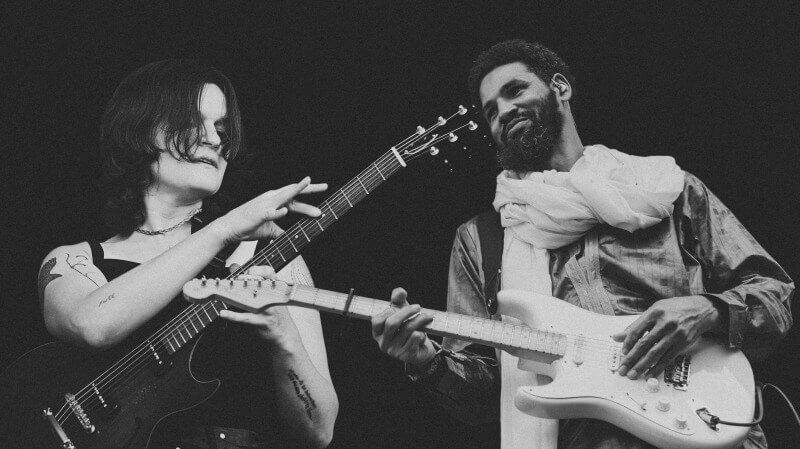
You always look forward to the guitar solos in Mdou Moctar songs. The Tuareg bandleader is a guitar hero in every sense of the word. He’ll rail against French colonialism in his native Tamasheq, and then launch into a solo, often with hammer-ons and pull-offs galore, that feels like a chorus on its own merits. On albums like 2021’s Afrique Victime and 2024’s Funeral for Justice, his love of Tuareg culture, and his disdain for those who threaten to uproot it, resound through his playing alone. —Grant Sharples
Key Track: “Afrique Victime”
4. Jeff Tweedy & Nels Cline (Wilco)
Jeff Tweedy and Nels Cline are both phenomenal players themselves, but when working in conjunction, they’re virtually unstoppable. Tweedy, once the bass‑playing foil in Uncle Tupelo, spent the 2000s quietly rebuilding himself as a guitarist, moving from steady, empathic rhythm and fingerpicked acoustic work into leads that sound like thought made audible—hesitant, then surging, then barely holding together. Cline arrives from the avant-garde and jazz world like a spark thrown into that evolving language, bringing squalls of feedback, smeared chords, and liquid, harmonically adventurous lines that can sit as easily inside a country-rock tune as they can in a blown-out jam. When working in tandem, they let Wilco’s songs tilt seamlessly between understatement and upheaval: verses cradled by warm, ringing chords, choruses strafed by dissonant flurries or long, keening melodies that stretch a simple progression into something oddly cosmic. —Casey Epstein-Gross
Key Track: “At Least That’s What You Said”
3. Wata (Boris)
Boris is the greatest metal band of the last 30 years, and Wata powers that engine with her overtoned, overdriven notes, and Orange amplifier towers. Wata plays through fuzz and drones without ever producing just “noise,” and her dexterous playing experiments with doom metal, shoegaze, ambient, and even psych-rock. Boris’s avant-garde journey features Flood, Pink, and Noise in this century alone and, with her EBow in hand, Wata channels the art of Merzbow, Michio Kurihara, and Keiji Haino. —Matt Mitchell
Key Track: “Farewell”
2. Jeff Parker
It’s easy to get caught in Jeff Parker’s web. Maybe he’ll offer one beat of a note, bringing in each measure with style. But the sands shift under his playing quickly. On 2024’s The Way Out of Easy, his delicately brushed, clean guitar patterns occasionally stand alone. Before you can blink, Josh Johnson’s alto saxophone or Anna Butterss’ double bass have taken control of the song while you were stuck in the mist of Parker’s guitar motifs. A purist might say it’s cheating to include Parker on this list. After all, he began augmenting the sound of fusion ensembles in the late 1990s, while pushing post-rock quintet Tortoise to some of their jazziest work on 1998’s stunning, spiraling TNT. Parker’s work in the 21st century is just as worthy of acclaim. Only four months ago, he provided western touches and sustained, supportive playing to another solid Tortoise album. And he betrayed a certain confidence in his playing with 2021’s Forfolks, a series of pieces for solo guitar. Few guitarists can marshal drones and sturdy, soft touches into such sublime results. —Ethan Beck
Key Track: “Four Folks”
1. Patrick Flegel (Women, Cindy Lee)
Patrick Flegel started slinging bowed guitar moves 20 years ago with his brother Matt in a band called Women—a band that made one of the best debut albums of all time and an even better successor. But eventually Women broke up and Flegel bounced around between short-lived offshoots. Then came Cindy Lee, the drag-rock pseudonym Xeroxed into life across six brilliant lo-fi records. Flegel graces a stage in gold-sequined dresses and knee-high go-go boots, places his Gibson SG across his chest, and pulls impossible sounds out of the strings. How do I describe the musicality of Flegel’s work as Cindy? Hmm. Well, it’s like Alice Cooper, Kim Deal, Ryuchi Sakamoto, Chris Bell, Charlie Megira, Karen Carpenter, Chet Atkins, the Roches, and Connie Francis—not all at once, but in fragments.
Flegel’s guitar playing is messy but virtuostic. It’s heady, out of tune, and bending. Flegel, in a way I crave, operates as a sentimental, moody guitarist averse to staying in any one pocket. There is little bounce but a lot of sensation—creative impulses blown apart and patched back together. In “Flesh and Blood,” you can hear a foot pressing down on a pedal. “Dry Dive” expels metallic, noodly fascinations. Throughout “Love Remains,” Flegel’s lovey-dovey, swooning guitar shapes talk in paragraphs. With Women, he covered noise-rock in cobwebs and left the edges of songs like “Shaking Hand” ragged. As Cindy Lee, the music is uncanny, androgynous, and splintered with feedback and reverb. Public Strain took guitar music to impossible places in 2010, and Diamond Jubilee changed indie music forever two years ago. All paths come back to Flegel’s innovations. —Matt Mitchell
Key Track: “Always Dreaming”