
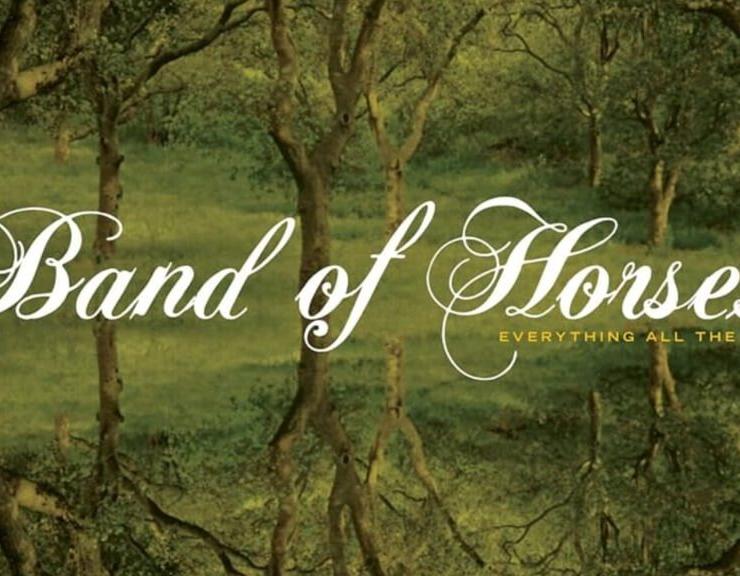
Ben Bridwell thinks it’s the ringing of those notes. Those four simple, arpeggiated guitar chords that kick off “The Funeral,” Band of Horses’ most famous song to date, have helped the Seattle-bred, South Carolina-based indie rockers fortify an enduring career. “I just got lucky with that chime of those notes,” Bridwell, the band’s sole original member, told me in a career-spanning interview four years ago. “Obviously there’s a lot of pull with people going through hard times and losing people. I was honestly thinking about the sadness of the thought of losing people that I still haven’t lost yet.” Its emotional resonance, its underlying wistfulness, and its malleable yet sincere sentiment struck people in 2006, and it still does 20 years later.
As the lead single of their debut album, Everything All the Time, “The Funeral” was an appropriate introduction to Band of Horses, and it still feels like one today. It’s the most likely candidate to get you deeper into the band, to dive into the album it’s from and everything that follows it. “The Funeral” encapsulates their distinct alloy of Pacific Northwest indie with Southern drawl, and it conveys the emotive strain that Bridwell’s voice adopts on so many of their best songs. Aiding this is its cultural ubiquity. It’s been in everything from military films to poorly aged sitcoms to peak-Kid Cudi music. As of this writing, it has been certified 2x platinum by the Recording Industry Association of America (RIAA). Applicable to a wide range of feelings, the song’s ambiguous relatability doesn’t sacrifice any of its pointed intensity. The passion is right there in Bridwell’s voice, in the way he sings “the dead leaves lay on the lawn, for they don’t have trees to hang upon.”
Even though Bridwell himself told me that he wrote “The Funeral” while grieving the inevitable deaths of those closest to him, he has also described it as a song about the social anxieties of anticipating large gatherings of friends and family, whether that’s Christmas, New Year’s, or a funeral itself. The original version, the one that appeared on their 2005 Tour EP, was called “Billion Day Funeral,” alluding to the final line in the chorus. A “billion-day funeral” could refer to how such gatherings can take on a ceaseless tedium, how people feign emotion at such events out of empty decorum, how mourning can start to feel like a never-ending task, or maybe all of them, or maybe none of them. For Bridwell, the meaning has probably shifted over two decades’ time, just as it has for everyone who’s heard it.
Songs mean different things to different people, obviously, but Band of Horses, especially on their debut record, embody that notion to the fullest. Bridwell is an elliptical writer, cryptic in his phrasings while imbuing his impressionism with primal catharsis. While the specific narratives can be hard to discern (aside from the marijuana-induced haze of “Weed Party”), the significance is never lost. These songs are poetic in the sense that their pliability and vague musings never preclude connection but invite you ever deeper into their fabric. What they lack in linear storytelling, they fill with tangible profundity.
“Monsters” envelops you like a warm blanket, its plucked banjo and slide-guitar adorning the tune with a lived-in charm. Bridwell sings of the titular creatures that “come to feed on us / giant little animals for us,” but there’s an undercurrent of hope that courses through in the refrain: “Though to say we got much hope / If I am lost, it’s only for a little while.” “The Great Salt Lake,” not an ode to the Western Hemisphere’s largest saltwater lake but to South Carolina’s Lake Murray, portrays Bridwell’s gift for vivid scene-setting. He may center his lyrics on his home state, but he litters incidents he’d heard about some characters in Salt Lake City, as if he’s seated next to you at a bar and regaling you with fun stories. “Back of the boat was painted ‘Wrecking Ball,’ / There was country music playing / But he don’t like it at all,” Bridwell sings, the twang in his voice ironically prevalent. Everything opens up in the chorus, and the bridge is particularly striking when Bridwell goes into his higher register: “If ever beat down / We know who we are / They know we all want more.”
Much credit is due to the sonorous guitars from Mat Brooke, one of Bridwell’s former Carissa’s Wierd bandmates, and Tim Meinig’s resonant drums. It helps that Seattle legend Phil Ek is behind the boards on Everything All the Time, granting each song a cavernous space for the four-piece to occupy. You can hear it on “The Great Salt Lake,” “The First Song,” and “The Funeral,” in which each instrument is given plenty of room to breathe and contribute to the wide stereo field. Known for a pedigree that included like-minded contemporaries like The Shins and Built to Spill, Ek captured the sound that Sub Pop reps likely heard when they caught Band of Horses’ opening sets on a tour with Sam Beam, the brainchild of Iron & Wine, then fresh off the success of Our Endless Numbered Days, released on the label in 2004. It helped that Beam and Bridwell were South Carolinian buddies, and Bridwell’s band was clearly doing something special. That much is evident on the Tour EP alone, which includes early renditions of songs such as “Part One” (then called “Savannah Part One”), “The First Song” (then called “The Snow Fall”), “Wicked Gil,” “The Funeral,” and “The Great Salt Lake.” Of course, these nascent forms are much more ramshackle in nature, but Band of Horses’ core sound was almost fully formed from the outset.
Shortly after recording Everything All the Time, Meinig and bassist Chris Early departed the band, and Brooke, who co-wrote “I Go to the Barn Because I Like The” and acoustic closer “St. Augustine,” left soon after the album’s release to start Grand Archives. But that didn’t impede Bridwell’s momentum. He kept trucking just a year later with a new lineup and the also-excellent Cease to Begin. Maybe what made such a fast, jarring transition so feasible was the beautiful simplicity of his songwriting and the band’s rudimentary instrumental setup. Originally, Bridwell wanted Band of Horses’ style to resemble something akin to Electric Light Orchestra, thick with synths, strings, and other embellishments, as he confided to MAGNET the summer after Everything All the Time’s release. Ultimately, he landed on something less complicated, something that relied less on studio trickery and more on a live-band feel. Who’s to say what that iteration of Band of Horses would have accomplished, what they would have sounded like? It’s an interesting hypothetical to consider, but Bridwell’s final decision has proven fruitful. We now have one of the best indie-rock records of the aughts. We now have that homespun grace. We now have the ringing of those notes.
Grant Sharples is a writer, journalist and critic. His work has also appeared in Interview, Uproxx, Pitchfork, Stereogum, The Ringer, NME, and other publications. He lives in Kansas City.