
There’s a famous Margaret Atwood passage about the impossibility of going unwatched as a woman, about how solitude doesn’t actually neutralize the gaze so much as internalize it. The “watcher” migrates from the world outside to the space behind your own eyes until “you are a woman with a man inside watching a woman,” until “you are your own voyeur.” Even inside the comfort of one’s own home, the surveillance state and its subject share a single body. Mitski’s eighth album is, on its surface, a record about a woman who has locked the door. Nothing’s About to Happen to Me is structured as a concept album—its narrator a recluse sealed inside a deteriorating house, surrounded by stray animals and spirits and the persistent, low-grade company of her own dread—and the title reads like a grim declaration of intent: nothing will happen, because nothing can reach her. She is, per the press materials, free inside; deviant outside. The door is shut.
But what Atwood understood, and what Nothing’s About to Happen to Me keeps circling back to without ever quite saying it aloud, is that the woman behind the door is still performing: still narrating her isolation to an audience, still cataloguing her own disappearance, still imagining, on “Dead Women,” the precise way her body would be embalmed and auctioned and rewritten if the world got its hands on her. You don’t write a song about how no one can reach you unless you’re exquisitely aware of everyone trying. The house is sealed, but the woman inside it has a voice like a window left open, and she can’t stop singing toward the street. She’s alone, but she’s not unwatched; she’s watching herself be alone, which is a different thing entirely. And Mitski, of course, is watching that woman watch herself, and we, the audience, are watching Mitski. The whole album is a series of nested gazes—a matryoshka doll of subtle voyeurism.
That tension—between isolation and the compulsive need to narrate it—is what makes Nothing’s About to Happen to Me one of the more conceptually fascinating records Mitski has released, even when it doesn’t entirely deliver on the full scope of its premise. This is her second album built from the lush, pedal-steel-and-strings Americana she and longtime producer Patrick Hyland first developed on 2023’s The Land Is Inhospitable and So Are We, and it extends that palette with real confidence: the arrangements are spacious and warm, the orchestration meticulous, the band (her touring ensemble from The Land cycle) playing with an almost theatrical attunement to Mitski’s dynamics, swelling when she swells, retreating when she pulls back, the whole thing calibrated to follow her voice like a spotlight follows a performer across a darkened stage. Which is, of course, the irony: an album about isolation, staged with the precision of a one-woman show before a live audience.
When the spotlight does flicker—when Mitski lets the staging slip and the house actually starts to feel unsafe—the results are extraordinary. The album’s standout moments are, not coincidentally, the ones where she sounds least comfortable, least settled into any single mode; they’re the songs that push against the record’s prevailing poise, whether through sheer volume or through formal strangeness, and taken together they sketch the outline of a version of this album that’s wilder and more varied than the one we ultimately get.
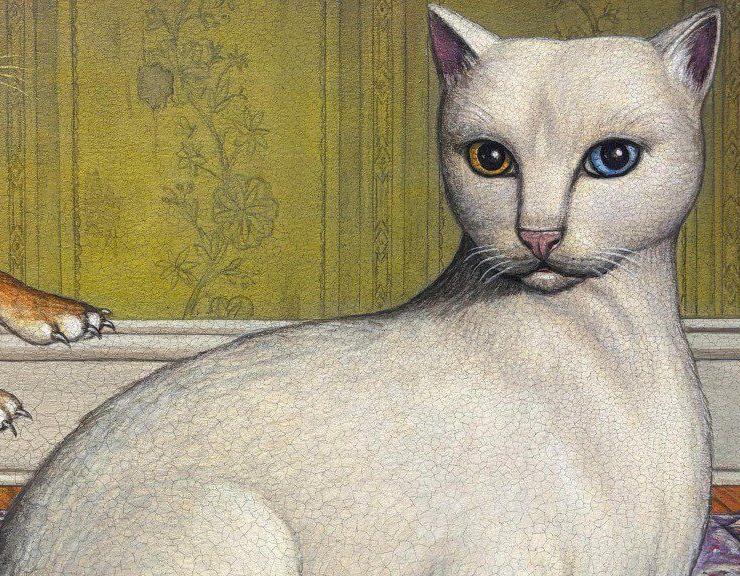
“That White Cat” is the clearest case. The drums are frantic and propulsive, shoving the song forward with a physicality that most of the record deliberately avoids; Mitski’s voice, meanwhile, finds a rawness it rarely reaches on the surrounding tracks, the controlled instrument betraying its player for a few glorious seconds. Lyrically, it’s also the album’s funniest and most incisive song, both a spiraling domestic ecosystem (the appalled accusation latent in her delivery of “It’s supposed to be my house / but I guess according to cats / now it’s his house” is just wonderful) and a desperate search for purpose. “Where’s My Phone?” operates in a similar register, if a slightly more familiar one: it’s the album’s most direct callback to the fuzzed-out angst of Bury Me at Makeout Creek, the guitars gritty and the production deliberately rougher than anything around it. The content itself performs the same spiral: the lost phone becomes a lost self (“Where’s my phone / Where’d I go”), the search for one indistinguishable from the search for the other. While Be the Cowboy and its subsequent records saw her certainly find her comfort zone in self-deprecating love songs and keening balladry, I’ve always found Mitski most compelling when she leaves it and ventures out into that brutal, more riotous unknown: the rollicking rock of Puberty 2, the heavy distortion of Makeout Creek, the devastating rawness of Lush, the wailing into her guitar on that famous Tiny Desk Concert.
If “That White Cat” and “Where’s My Phone” represent the album at its most unhinged, “I’ll Change for You” is its most unexpected left turn—and arguably its most interesting sonic experiment. The instrumentation drifts into a bossa nova-inflected jazz lounge, warm and plush, vibraphone and flute and piano pooling beneath Mitski’s voice like smoke under low light. It’s a departure sharp enough to feel almost disorienting after the surrounding Americana, and that displacement is the point: this is a song about being drunk outside a bar at closing time, watching cars pass and waiting for a ride that isn’t coming, and Mitski makes the music mirror the setting rather than the feeling. That logic lives in “In a Lake” as well; it begins small and folky, all accordion and banjo, but then the bridge arrives and the whole thing detonates: horns, strings, a full orchestral surge that swallows her voice in a wall of sound so dense it borders on cacophony. The lyric at the moment of eruption is “in a big city you can start over,” and Mitski buries herself inside the noise the way you’d disappear into a crowd: anonymous and overwhelmed and possibly, depending on the day, free. It’s a gorgeous piece of structural thinking, the kind of form-as-content work she’s always excelled at.
The songs surrounding those peaks are, individually, largely fine—often more than fine—but they share a sonic and structural vocabulary that can make distinct emotional landscapes blur into a single watercolor wash. “Cats,” “Instead of Here,” “Rules,” “Charon’s Obol,” “Lightning” are songs about very different things: a relationship fading into the company of pets; the seductive pull of total disappearance; a woman becoming the guardian spirit of a house where other women died. Yet they unfold at similar tempos, in similar registers, with the same warm bath of pedal steel and strings while Mitski’s voice holds at the same careful, lustrous remove. It’s a subtler problem than simply having weak tracks, because none of them are weak. The devastating mid-album number “Instead of Here” contains one of the album’s most harrowing conceits—Death personified not as a reaper but as a patient acquaintance who knows she’ll call again and promises to mosey on back just in case—and “If I Leave” beautifully exemplifies the terror of being unknowable. These deserve melodies that match their weight. There is something to be said for the power of restraint, undoubtedly, but given that this is a concept album whose premise feels like a spiritual successor to The Yellow Wallpaper—a woman sealed inside a house, the walls closing in—it might have benefitted from allowing the sound some room to unravel.
Yet I do appreciate the fact that, for all its architecture of retreat, Nothing’s About to Happen to Me keeps letting the world leak in through the cracks: the sounds of a bar on “I’ll Change for You”; the cacophony of a city on “In a Lake”; the omnipresence of critters throughout; the cosmic game of Marco Polo that closes “Lightning”; Mitski’s narrator calling out to the thunder and waiting, with something between dread and hope, for an answer. Even “Dead Women,” the album’s darkest meditation on what happens when the public gets its hands on a private life—strangers rifling through her belongings, embalming her body, rewriting her story until “she gave her life so we could fuck her as we please”—is written from the perspective of someone who has imagined her own consumption in forensic detail, which is not exactly the behavior of a woman who’s stopped thinking about the audience.
This has always been Mitski’s particular knot: the artist who watched “My Love Mine All Mine” soundtrack millions of strangers’ lives and responded by pulling further inward, who has spent the years since Be the Cowboy steadily retreating from interviews and social media and public selfhood, and who then—because she is, in the end, a songwriter—made an entire album about the retreat itself, packaging her solitude into eleven tracks and handing it to the very world she’s trying to shut out. The house is a set piece, and she knows it. She’s too sharp a writer to pretend otherwise. The album’s most honest moments are the ones that seem to acknowledge this paradox without trying to resolve it: the narrator alone but composing, invisible but singing, the gaze turned inward exactly the way Atwood described, except that what it finds there isn’t silence but music—and music, by definition, needs someone to hear it. [Dead Oceans]
Casey Epstein-Gross is Associate Editor at Paste and is based in New York City. Follow her on X (@epsteingross) or email her at casey@pastemagazine.com.