
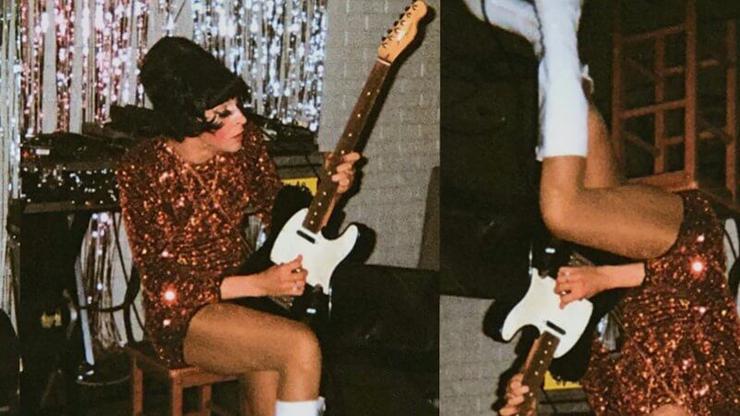
I like Cindy Lee. That’s real wrist-jangling music done up in nocturnal drag and noisy whateverthefuck. The songs are like dinosaurs swirling in gas tanks. Through my veins runs her soup of little bitty space men and sequined dresses made of gold-tinted razorblades. Hell and sugar; What’s Tonight to Eternity? and Act of Tenderness freakout shit. In my childhood stupor, rock and roll impregnated my soul with power chords, too-tight bluejeans, and chest hair. I swallow eight spiders a year while I sleep and one of them is teeth-yellowing guitar music cranked up all the way. I vibrate when bending feet crease thigh-high white boot leather under gothic stage lights. A drag queen playing a Gibson SG without a strap? Just about the coolest thing.
Some kids find their dads’ Playboy collections under a bed or in the garage, but I found my dad’s AC/DC CDs in a cabinet beneath the living room TV. I found his Playboys too, obviously, but the rock and roll coming out of that schoolboy Angus Young’s Gibson SG was like a tractor beam. Zzzt. Sucked me right in. It was easy to love Angus’ shape when I was six years old, because the phrasing and vibrato of his leads were instantly recognizable and easy to pay attention to: doublestop blues notes, pitch bends, major and minor scale blends. Of course, I didn’t know any of those words, but the chords stuck around in my cells. I’ve tried to resist all of that in the 20 years since, but I just can’t shake guitar music, man. I’m addicted to it. It powers my car and chaps my ass. Had I not borrowed Dad’s High Voltage disc, I might still be a Kenny Chesney fan. Oh my God, can you imagine?
Up the road from my folks’ home is this antique mall that’s open 360 days a year, 9 a.m. to 5 p.m. I’ve spent too much money there—too much money I don’t have—on shit I don’t need: commemorative plates from Princess Diana’s wedding, empty Coke bottles, a Toy Story-themed French fry bag from Burger King, a Ken Griffey Jr. chocolate bar still in the wrapper, costume jewelry, a bowling pin, Stephen King mass-market paperbacks, a Six Million Dollar Man board game, Dairy Queen vanilla cone whistles. But the best find was a 1961 Magnavox transistor radio with funky antennas that jut out horizontally. The seller kept it behind glass and next to Barbie’s Corvette, so I figured it worked OK. And for $35, I couldn’t walk away without it.
Overwhelmed by my new analog treasure, it slipped my mind that my folks’ house didn’t get good phone service, let alone good radio reception. Something about bad drywall or fiberglass insulation. Maybe both. Ah, well. I tried putting tin foil on the antenna ends, but no dice, so I put the damn thing in my closet. A couple years later I was filling boxes with all the belongings I’d be lugging across the country to Los Angeles and packed the radio. No clue why, because it just wound up in a different closet. But the other day I pulled it out and thought I’d try surfing a bit. It’s a piece of machinery older than my dad and it can barely parse through all the high-pitched FM static, but a couple stations did whisper out—radio hours to the right end of the dial, blasting country and pop tunes that sound equally generic. Heading left, I stopped on the notch between 91 and 92 and heard Del Shannon doing his thing, singing “Runaway.” One of my favorites.
I sprawled across the floor and listened for an hour with my eyes closed. There were no commercials, only four-song runs, interstitial disc-jockey sound bites, and random gusts of warping fuzz. The guy in the box played the Chords and the Chordettes, the Coasters, the Platters, and Maurice Williams & the Zodiacs. Eventually the broadcast gave out and I couldn’t get it back. All my dial turns led to dead ends. I listen to doo-wop on my phone and on my turntable. It’s my favorite genre—diegtic soundtracks for kids speaking in drag-race tongues and Coca-Cola bugaloos. Thankfully those streaks of retro haven’t turned me into one of those TikTok greasers. But most “oldies” stations anywhere only touch sixties and seventies pop music, so I don’t flip the radio on for a fix much. But the idea of a doo-wop station operating out of Los Angeles County? Now that would be a prize. One Google search and I’d know where the signal came from, I figured. But it turns out that there’s no online record of any doo-wop channels around here. The registered stations in the city that span 90.3 to 93.1 FM are classical, Christian contemporary, Spanish hits, hip-hop, and public radio. I don’t know where Del Shannon came from. I didn’t imagine him, but maybe my Magnavox opened a portal.
And the older I get, the more portals I find. Cindy Lee’s is a Xeroxed Shangri-La full of fanged, bowing slings—shapes of Alice Cooper, Ryuchi Sakamoto, CAN, Kim Deal, Charlie Megira, Connie Francis, and Karen Carpenter pulled out from beneath the cobwebs of Women’s brutalist guitar methodology. I do not believe in magic, but I do believe in Cindy’s noise bouncing off the satellites, with her chrome and androgyny all over everything. She is a woman of Ymir—a wah’ing pedal-board transmission patched in from some faraway, sensitive Canadian border. Sometimes I think about little Matt with a portable CD player pinned to their hip, Highway to Hell blasting into good, unspoiled ears and devil horns held the fuck up. That same light leaks into me when Cindy sits her Gibson on a barstool and lets the sustain carry through a room. She’s a shit-hot guitar mutant with rose-dotted cheeks holding her instrument sculpturally and making deformed, impossible sounds come out of it. Unpredictability hasn’t thrilled me like this since Bob Wickman was the Cleveland Indians’ closer. I think “Dry Dive” has one of the most wonderfully chased tones ever.
But I’m not going to juice the numbers to make myself look good. Not only was I 14 years old when Women broke up, but 2012 was the year I wore my Take Care CD (the clean version, copped at Walmart by a friend and given to me at an Applebees birthday dinner, by the way) out. Patrick Flegel? That’s a name I didn’t know until COVID, when I was pent up at my folks’ house and clicking on random albums Bandcamp recommended to me. I don’t remember most of them, but I do remember What’s Tonight to Eternity?, because I just couldn’t square what the hell I was hearing. It was like Leyland Kirby got his mitts on a Skyliners tape. Flegel, dolled up in the hidden uniqueness of a starlet Calgary ghost, stilled the clatter of my beating heart with “Just For Loving You I Pay the Price,” “Heavy Metal,” and “I Want You to Suffer”—grating, harsh, docile blurs of girl-group and noise-rock boldness. Trans-rock rumbling like an engine; colors twirling beneath snow-scattered labyrinths.
Four crooked years later Elise woke up our text chat like Paul Revere, delivering the news of Cindy Lee’s two-hour, 32-song Diamond Jubilee finally appearing on YouTube. Between the psychonautic viaducts of “All I Want Is You,” “Flesh and Blood,” “Kingdom Come,” “Stone Faces,” and “Durham City Limit,” I could feel the artifacts crumbling in my hands—Brill Building phantasma edged into noise hell by a Gibson SG jolted by human splendor. Now, I haven’t lived very long but I’ve lived long enough. Friends leave, sheets untangle, hearts shatter. You need an extra week to get over the flu, and it costs a paycheck just to eat a good meal. It’s a bitch getting older. The things you loved a few decades ago don’t hit the same because they’re still the same and you’re not, because you’re weird and they’re not the right kind of weird anymore.
Diamond Jubilee, though. Goddang. I don’t know anything, really. The opinions I see about it online mostly come from critics—writers hot-wired to like this stuff because they read a Deerhunter review on Pitchfork 15 years ago. I suppose that’s a better algorithm than one overrun with fancams. 21 years ago I heard Angus Young’s dirty, sweaty, puke-breath tone for the first time and saw it write my name in the stars. Now, though, I need something that twists all around me instead. The going price is going to Hell, and good, strange art can buy you the last ticket out of it. Cindy Lee is unlike anything anyone has ever played, even though we all try to put a finger on where we’ve heard those pop extractions before. The angular, bottomed-out riffs and tempestuous feedback and ramshackle falsetto might be unapproachable for some, but Flegel guts the music and yanks out its gooey, timeless innards, singing about love and loneliness and getting “lost in the stars, I’m only flesh and blood” like the gum-chewing dandy he is, twirling gear cables like a lasso.
Cindy Lee is the ultimate remedy of spank and spunk—a luxuriating, cathartic decoration swimming in the consequence of what gauche, late-2000s abrasiveness Flagel and his brother embodied in Women. When Diamond Jubilee plays, the radio tilts all around. The static distorts with every strum and there’s lipstick on the microphone. Reverb is an accessory not like texture but like an amulet necklace dangling above a shiny slip dress. When I say I am hearing the greatest living guitarist, know that it’s because the bridge in “Government Cheque” is a sedative oozing impossibly out of metallic, bending strings. That it’s because “Dracula” is a beehive-wigged seductress crouching down next to me, knees touching together, and whispering fistfights into my ear. Look out, it’s the next Voyager Golden Record: switched-on boogies for the aliens to ply their civilizations with. All modern roads come back to a devil horn-shaped SG and Patrick Flegel’s uncanny, unprecious, and uber-spectacular craft where I’m left to wa-wa-wa-wa-wonder.
Matt Mitchell is the editor of Paste. They live in Los Angeles.