
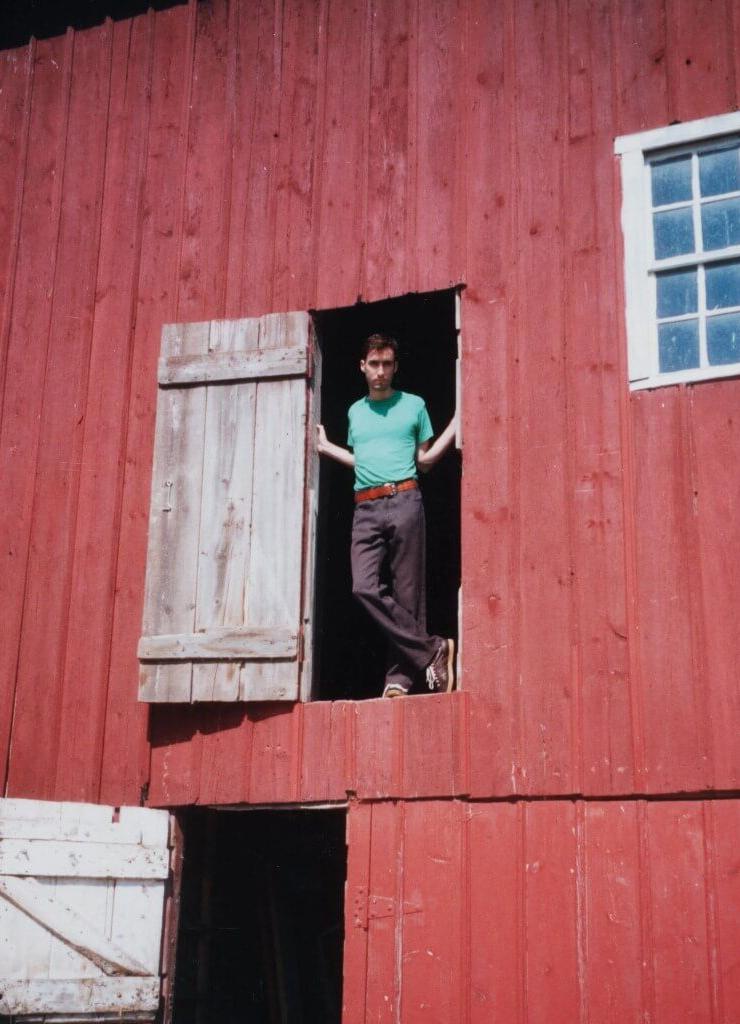
The Mysterious Production of Eggs didn’t arrive in the world so much as it slowly hatched, one false start and discarded version at a time, in the long shadow of a red barn in western Illinois. By the time it was finally released in February 2005, Andrew Bird had already made and scrapped the album twice, relocated from Chicago apartments to his family’s Driftless-area farm, built himself a studio by hand, and discovered that the barn he thought would be his recording salvation was better suited as an incubator for ideas than a place to actually capture them on tape. The record that emerged from that chaos—stitched together from sessions in Nashville, Chicago, and Los Angeles, and finished in Tony Berg’s backyard studio with engineer David Boucher—is the one that crystallized Bird’s singular universe: looped violin and glockenspiel, orchestral whistle, dense wordplay, and a child’s-eye view of a world bent on standardizing everything that can’t be measured.
Two decades on, Eggs has become both a fan favorite and a hinge point in Bird’s catalogue, the moment where the old-time swing of his Bowl of Fire years fully gave way to the intricate, inward-facing songs that would define the next 17 albums. Written largely in isolation at that Illinois barn, its songs circle the same set of obsessions: childhood imagination versus institutional control, the failure of language, the urge to quantify emotion and experience and even wonder itself. “Measuring Cups” takes aim at gifted-and-ungifted sorting rituals; “Banking on a Myth” goes after the commodification of genius and feeling; “Masterfade” uses the language of production equipment to analyze the power imbalance of a relationship. Even the title, lifted from a 1920s magic catalog promising “The Mysterious Production of Eggs” as a simple stage trick, turns sleight of hand into a metaphor for creativity itself: making something appear from nothing, then watching it vanish again.
What’s easy to forget, especially now that the album sits firmly in the indie canon with glowing reviews and a high Metacritic score at its back, is how fragile it felt on the way there. Bird spent years feeling like he was failing this record: first when the barn-band version came back sounding like a suit that didn’t fit, then when the Weather Systems-era Nashville takes still weren’t quite right. It wasn’t until Los Angeles, when Berg told him to “stop flailing” and Boucher started pushing his vocals uncomfortably close and thin in the mix, that the songs finally snapped into focus. On the finished album, you can hear both the control and the strain: arrangements so meticulously layered they border on architectural, sung in a head voice whose intimacy is undercut by lyrics full of trepanation jokes, apocalyptic dinner parties, and nervous tics flinging bad thoughts off I-80 at three in the morning.
The 20th anniversary box set of The Mysterious Production of Eggs arrives as both artifact and X-ray, opening up the record’s long gestation for inspection. Spread across three LPs, it pairs the original tracklist with early barn-band takes and alternate versions that show just how many lives a song like “Capital I” lived before landing where it did—on his fourth album, Armchair Apocrypha, with a new title (“Imitosis”); it didn’t even make it on Eggs, in the end. There’s a full song-by-song essay from Bird, plus a sprawling historical narrative by Anders Lindall that traces his path from Chicago’s Bloodshot-adjacent swing scene to the Driftless farm. Jay Ryan’s illustrations, originally conceived as a storybook where each song had its own picture, are expanded and reworked here, Nervous Tim’s tarped animal body and bird-claw feet still wandering the margins like a Maurice Sendak character who slipped onto a record sleeve instead of a page.
When we talk now, Bird is in the strange position of revisiting an album that, for a long time, he mostly viewed as a knot of exhaustion and self-doubt. There’s a tension baked into any anniversary project, especially for someone who insists he never wants to believe his best work is behind him (see: the title of his excellent 2019 record, My Finest Work Yet). Talking through Eggs in 2026, Bird keeps circling the same fault lines: the danger of building songs piece by piece until they feel over-engineered, the difficulty of writing lyrics that leave enough negative space for listeners to inhabit, the way certain inside jokes and invented words become portals rather than puzzles. He’s wary of nostalgia, allergic to the idea of an album as a museum piece, and adamant that the only way to keep a record like this alive is to keep finding new ways to play it—solo, with a scrappy loop rig in a Honda Element; with a drummer rebuilding grooves out of Frankensteined takes; or now, with a live orchestra behind him, forcing him to hit precise tempos and resist his natural urge to go off script.
Yet for all Andrew Bird’s reluctance to linger in the past, you can feel him making a kind of uneasy peace with The Mysterious Production of Eggs as both a turning point and a living thing—less a relic than a particularly strange, resilient organism that’s still evolving every time he plays “Tables and Chairs” or “Fake Palindromes” a little differently than the night before. In that sense, the box set isn’t an attempt to pin a butterfly under glass so much as a chance to watch it molt again in real time, cracks and all. This interview has been edited for length and clarity.
******
Paste Magazine: You’ve said elsewhere that you were initially reluctant to look back this much on Eggs while you were preparing for your upcoming album. Is it rare for you to return to your older work? How did you come to terms with doing it for this?
Andrew Bird: I don’t mind looking back at old work, especially if it’s been sitting there for a while and it feels like you’re it feels like you’re covering yourself. But the whole retrospective mindset is not always the best for when you’re in the middle of writing the next thing. You can kind of give yourself a complex, comparing what you’re doing to what you once did—just a general, mere suggestion that your best work is behind you is enough to send you reeling, and these anniversary things tend to subliminally suggest something like that, which I certainly don’t like to believe. By now, I’m almost 18 records in, and every time I go to make one, it’s still an epic struggle. I still don’t know what’s going to come out of me. I don’t know if I’m going to finally get that vocal performance that I don’t feel like I’ve ever gotten, I don’t know anything. Even after all these years, I still walk in thinking, “I don’t know if I’m going to be able to do this,” you know?
It doesn’t get easier, then.
No. No, it really doesn’t. But at the same time, though, waking up not knowing what you’re going to be able to do is exciting. If you feel like you haven’t quite nailed something that you want to nail, it keeps you trying.
You had to look back at the album a great deal in the process of creating this box set, I imagine. How did it affect your current work on your upcoming album?
It actually turned out to be quite interesting to have to go back and listen to Eggs, because I just have this image in my head of what it was, mostly due to how hard it was to make. Plus, I generally have a negative attitude towards a lot of stuff I’ve done in the past; it’s just the way I’m wired. So, for all these years, I always thought, “Oh, [Eggs] was great, it was cool, it was a good album, I was happy with it at the time, but it’s just not as exciting as it is live” or “it’s not as energetic as I wish it was,” or whatever. I have all these things, you know? But then I listened to it because I had to, and realized how detailed and intricate it was. There’s so much counterpoint, so many details that I forgot about.
In terms of, like, production and sounds, I think Eggs is the most experimental album I’ve made, at least in that sense of, like, “Okay, I hear this burst of static here and I have to find out a way to create that static on ‘Opposite Day.’” All the things that become part of the rhythmic track that are not drums, you have to imagine from scratch. Like, with “Nervous Tic Motion,” we were just kind of playing around with this dinosaur of a drum machine—like a Wurlitzer organ drum machine, which was like a big humidifier from someone’s basement from the ’70s—and messing around with these kinds of glitchy little rhythms. But I’ve moved away from that kind of obsessive approach since, I think; I’ve gotten more into doing studio sessions that are just live, scrappy, performances, which is just very different from Eggs.
This recording process sounds like it took a serious toll, so I don’t blame you. I mean, there were basically three separate versions of the album across five years, right?
Yeah. A lot of the previous versions are so manic and overwritten and proggy that, when I played the first version of Eggs for my manager Andrea [Troolin], she said, “I don’t know. It just seems like you’re wearing a jacket that doesn’t quite fit right..” And that was hard to hear, but it was also like, “Yeah, I totally get it.” So that’s when I had to scrap that version, and try to make it more like Weather Systems, which I made in the interim. But then I had to scrap parts of that as well, because Eggs wasn’t such an ambient thing; it was more of an intricate concept album. So it was difficult. I definitely hit some lows where I was like, “Man, what’s wrong with me?”
How did you climb out of those pits when you were in them?
Honestly, I would usually just jump on stage and play the songs live. That would reaffirm things and just simplify it for me: “Okay, I know who I am.” The longer you stay in the studio, the easier it becomes to forget who you are—it’s like listening to your own voice message on your phone. When you hear yourself singing in the studio, you keep kind of trying to sculpt yourself into who you want to be, which is not a healthy thing. So I don’t like to be in the studio more than three or four days at a time; I always need to jump onstage to remind myself who I am, because in the studio, it’s just not a natural environment.
Was building the barn in the first place an attempt to counteract the unnaturalness of the studio, then?
Definitely. I had this idealized vision of just getting up and recording and not having it be a big event, you know? ‘Cause I was used to living hand-to-mouth in Chicago and trying to get enough money together to do studio time and watching the clock and getting all stressed out, so I thought, “Oh, if I just had this live work space and all the time in the world, I could do it easily.” And, well, it didn’t work out like that at all. Some people can do that, but I’m just not wired for that, I don’t think. But it was great for other things—I mean, I don’t think I would have made Weather Systems if I hadn’t moved out to the barn.
So even though I’m glad I did it in the end, I just really don’t know if I have the mental energy to do now what we did back then. That was a… a youthful brain that could do that. [Laughs] And since that album, too, I find that every time I try to build a song one track at a time, it starts to feel like architecture instead of performance. It feels like you’re building something but you lose the blueprint in the process. When I hear those songs now, I’m not as thrilled by them as I am by a live performance where you kind of stumble a bit. Those kinds of imperfectation are more exciting to me than carefully constructing something.
In that case, do the “failed” versions of the Eggs songs appeal to you more now than they did then? What was it like coming back to all the renditions of the tracks that didn’t make it into the final record? Do you feel differently about any of them now?
Well, there were still lots of things—like “Opposite Day”—that ended up surviving all the different versions, so it was just a matter of peeling back layers and layers of the onion and then kind of re-layering it. But the others… Honestly, they’re still a little cringy at times! Like, the previous versions of “Measuring Cups” are so hard to listen to, especially because the actual song is, like, the closing thing to a perfect recording of a song for me: the pillowy drum sound, the general mood of it. There are a few demos, though, that—listening to them now—it’s like, “Oh, yeah, that could have been the version of that song that we kept in.”
Any in particular that come to mind?
All the different versions of “Capital I” and “Imitosis” were perfectly valid versions of that song. It’s just that sometimes, when you make an album over such a long period of time, you just keep taking it apart and changing it to keep it fresh and ready to go. When you write the same songs over, like, a five year period, it almost starts to feel like an exquisite corpse. You’re kind of within the song communicating with your previous self, with where you were at a few years ago, and just trying to keep track of where you were and where you are is mentally exhausting. It’s like there’s other people in the room, but they’re all you, and that’s somehow worse. It’s hard to stay on topic.
This was especially true for Eggs, I think, because whatever I had planned for in my head, by the time I got to making it, I had already moved on to something new, and the plan couldn’t catch up to where I was at musically. It was just trying to synthesize all these different things—like, what I learned from doing Weather Systems and this ambient stuff and textural stuff and more minimalist stuff, and putting that all into this new album. It just took forever to figure out what it was.
Another reason it was so difficult, too, was that I was used to being in this band dynamic where people in the band brought their own record collections to the party. And as an adaptable musician with a pretty big ear, I’m always just subconsciously adapting to whatever they’re bringing to the table. I think I had to clear the room of those great musicians, though, to find out what I really heard in my head at the time. I was forced to strike out without a net, stylistically speaking; it was kind of the first time I didn’t fall back on having, like, half the record be written by my favorite songs. That doesn’t mean it was easy to do, though. A lot of the older versions feel like studies, like you can tell that I’m grasping at my own influences. I mean, “Skin Is, My” was pretty much just a funky party tune, and, like, that’s not what I want to do. It’s worth hearing, but you can hear why maybe it didn’t make the final album.
With all that in mind, how did you ever arrive at a finished version of Eggs you felt confident in?
Well, when I got invited out to Los Angeles to work in a studio, I was introduced to David Boucher, an engineer who I’ve worked with since then, and he was young and very eager. And Tony [Berg] just kind of played emotional support. He didn’t really produce it, per se, but he would just pop his head in and say, “That’s the most amazing piece of music I’ve ever heard.” He’s known for that kind of hyperbole, but it certainly doesn’t hurt when you’re feeling that insecure. So it was just a solid run of sane work—everyone had families, so it was mostly a typical 9-to-5 schedule instead of the nocturnal situation I often had in Chicago. It was a lot more professional, in some ways. L.A. is, for better or worse, a place where people go to get paid for being good at what they do.
You’ve said before that David pushed you towards these extremely close, intimate vocals, and this, like, counterintuitive thinness in order to make things sound bigger, and you were initially reluctant to that. What was it that he said—or what did you hear on playback—that made you finally trust that approach?
You know, I don’t know! All I know is that the longer I spent working on it, the more time I spent being adaptive, I got more and more into my head voice, which is inherently more intimate and quiet. When you get onstage, you project. Your range is just completely different. I wanted to keep that energy even when I was singing in my head voice, but I just didn’t know how. Some people can do that very well—like, when I was working with Madison Cunningham [on the 2024 collaborative record Cunningham Bird], I was just, like, “How do you do that? How do you sing so quietly but still have so much energy in it?” It still perplexes me, really.
But with David, it got a little contentious, honestly. I remember saying a recording sounded “too much like Justin Timberlake,” and he said “Those are fighting words.” [Laughs] That kind of lip-smacking intimacy, it just wasn’t the aesthetic that I was into at the time, but I do get it now. It’s very nice to listen to, you know? Nick Drake, for instance, is so pleasant because he’s got this soft voice—there’s not too many hills and valleys, not too much jerking the listeners around. But as soon as I got onstage, all that always changed; they just became these wild, anything-can-happen kind of performances.
How did you translate songs as complicated as the ones on Eggs to a live stage? Was it daunting?
Well, right after finishing the album, I headed out on a very intensive period of mostly solo touring. For years, I had various Dodge Conversion vans for touring, and I downsized to a used Honda Element that all my amps fit perfectly in. I was still living at the farm, and I would just pack it full of amps and just leave, just take off on the road to tour by myself all over the country, and through Europe many times. It was all very scrappy—glockenspiel in a suitcase with looping pedals and clothes on top of that, and guitar, violin, trains through Europe. It was a little insane to do that all by yourself, but I just found the whole thing to be a really great adventure. It also forced me to just strip down the record a lot. When you do a studio album like that one, you kind of have to just forget about trying to replicate some parts, so you just leave them there and eventually you forget about them. Which, to be fair, I think is a healthy thing to do.
Well, with the orchestra tour on the horizon, I’d imagine you’re now learning to re-complicate the songs. What’s that whole process been like?
It’s pretty novel to play the songs with all those details in there since you have 50 musicians to help you do that. “Tables and Chairs” and “Masterfade” have got to be my favorites for that, I think. Playing with the orchestra forced me to take all these little parts that I had kind of forgotten about after playing it live for so many years—to hear them again is kind of crazy; like, “Oh, that’s cool, there are so many subtle things in there.” The orchestra just brings out something in my singing that’s cool, too, because I have a very adaptable ear.
It’s just a totally different beast than a band, you know? Like, you can’t go off script, which I often do—and enjoy doing. And since the main period of touring after that album was done was mostly solo, I got really used to going off script as much as I wanted, rambling and telling stories and doing whatever the hell I wanted with the album. But this is… Here, you have to embrace this cultural hierarchy institution that’s, like, hundreds of years old—this collective way that music is made and has been made for centuries. And every time you play, from one city to another, you’re building a show from scratch with another 50, 60 musicians—sometimes with very little time!—and forging a relationship with them. So a lot of the stuff I wouldn’t think about with a band, like a super specific tempo and whatnot, becomes so crucial. But it’s exciting too, because even then you don’t know what’s going to happen. Oftentimes, there could be train wrecks, and I love that stuff.
Like, there was one time in Seattle, I forgot to move the capo before I picked up the guitar in the middle of “Tables and Chairs,” and when I came in with a big power chord for the final bit, I was completely in the wrong key. It sounded super atonal and weird and I had to, like, stop the whole orchestra and move the capo and start over again. But it’s fun to feel enveloped in that sound and to sing with that sound. It’s a very different thing.
You were classically trained initially, right? Did that play a role in deciding to do the orchestra tour? How did it come about?
Uh, to be honest, it was not my idea [laughs]. I think it was Andrea’s idea. I came from that world originally; I was at Northwestern Music School, but after I left school, I kind of never read music again! I like the freewheeling situation of the band, you know? So it honestly took some coaxing to get me to do this. But once I’m in it, I’ve started to really enjoy it. I enjoy how ‘seat-of-the-pants’ it is, how you have to roll with whatever happens. It’s just a new way to perform the songs, a new way for the audience to experience them. It feels like an event. We did these arrangements with this guy Nate Thatcher in Minneapolis, and he did a beautiful job. Every time, I feel lucky I get to do it.
We’ve talked a lot about the sonic and stylistic aspects of Eggs, but I want to get into the lyrics some, too. What was your songwriting process like, and has it changed since then?
Both then and now, I generally start with melody, like, 80% of the time. There’s a certain kind of song that is lyric driven—like “Sisyphus” and other more rambly ones—but mostly it’s trying to find the right words to fill the shape of the pre-existing melody. And so I often get started with just a phonetic fascination with words and the sounds of words and how they fit that shape of the melody, and that’s enough to get me started. It grinds its way towards making some sense from there—or it doesn’t, and I replace the thing I started with because it doesn’t make any sense and it was just for the sonics. Or maybe I keep it anyways, because I must’ve thought of it for some reason; it came from my subconscious, you know? It can’t be completely random.
That was the case with “Sovay,” right? I mean, the word “sovay” itself is literally not a word—was it one of those placeholder “words” that then took on meaning of its own?
Yeah. I got to the chorus and I was like, “I don’t know what I’m trying to say, but whatever it is, let’s give it a name” and I named it “Sovay.” I know what I’m trying to say, but I don’t think there’s a word in the English language for it.
I know that childhood is often the theme people talk about for this record, but I always find myself drawn to the album’s approach to and focus on language itself—with “Sovay,” with “The Naming of Things,” all of that. I remember reading a quote of yours somewhere about this desire to have new words with less precise meanings, which I find really fascinating—and true, too, in a way I don’t quite know how to verbalize. What do we lose, do you think, in the act of definition?
I think that when a song is too explicit about X, Y, and Z, it doesn’t leave much room for you to perform it in your own head as a listener. Once it gets into your eardrums, it becomes your own; your brain is interacting with it and making it something new. But when it’s too explicitly one thing, it can be digested and moved on from. So if there’s some ambiguity in there, it gives your brain reason to keep turning it over, gives you reason to keep playing it. It’s like I’m passing it off to you as a listener to have it live inside you, too, and there’s work to be done in that.
I’d imagine it’s hard to write sometimes because, in order to write, you’re obviously limited to words with defined meanings 99% of the time. Aside from specific instances like in “Sovay” where you simply come up with a new word, is it hard to navigate writing songs without defined, explicit meaning when the words being used inherently have defined, explicit meanings themselves?
Yeah, for sure. At the same time, though, I think we all often perform ourselves in a way that makes more “sense,” so to speak, but really, the way our brains work is sensory and associative, not logical or linguistic. Like, you hear something, and it makes you think of something else. You see a plane flying over, and maybe in your mind you see the spine of a book. It seems random, but you’re making these connections because that’s what’s on your mind, you know? And I still work that way to this day. The less explicit a song is, the longer I tend to want to perform it.
Right, because there are still new things to discover in them.
Exactly. They’re more elastic, both lyrically and musically. That’s true for when I was playing classical music, too; as I progressed from, like, Bach, which had very little directions on how to play it, to the late Romantic period, which had tons of Italian suggestions and directions on exactly how to play it, I realized I really preferred the Bach stuff—because every time you play it, it’s different. It’s not telling you exactly how it should be done. And it’s the same thing with songwriting, I think. Sometimes I really have a thing I need to get across, and sometimes those songs can be a little burdened by what they’re trying to say.
Are those the songs that you feel don’t hold up as well?
For the most part, yeah. There are ways to make those songs more fun to play, but some songs just become over-burdened—like the song “Puma” from Are You Serious?. I never do that song. It was just very specifically about some difficult things that happened, and I have no interest in re-experiencing that night after night. And sometimes I do still write myself into a corner, so I have to break it all down to try to find the freedom in it again.
What’s your go-to way of doing that? Like, once you find yourself back in that corner, how do you carve your way out?
It’s hard. When you’re writing a song, some things just become sacred. Forgive the crude expression, but you can get up your own butt sometimes. In your own universe, some words become important and sacred and worth intoning and singing for people, and it’s best not to start a song knowing what you want to say.
There are a lot of inside jokes that snuck their way into Eggs, probably for that reason. Back then, I wasn’t always sure that anyone was paying attention, which was kind of nice, in a way. “Fake Palindromes” is definitely one of those—it’s kind of just a song you write in a totally exhausted state where you’re, like, sitting in a Denny’s and everything is absolutely hilarious because you don’t have anything left to give. It’s a bit of an altered state, you know? I could say I wrote it on mushrooms because it sounds like that, but I didn’t. [Laughs]
But sometimes, if listeners take some of those inside jokes at face value, maybe they don’t read so well? Like the line in “Tables and Chairs,” “Don’t you worry about the atmosphere”—I was playing a show one time and someone shouted out in the middle of the song, “But I’m worried about the atmosphere!” [Laughs] And I was like, “Oh, shit. Yeah. Well, I guess I can’t fault you for hearing it that way. Why would you know otherwise?” I actually considered changing it for a minute there, just because I’m aware of how people are interpreting it. I was like, “Well, I don’t want that to be the message or takeaway from this song.”
“Don’t worry about the ozone, guys! There is no such thing as pollution! Global warming does not exist!”
[Laughs] Right! But I’ve come around to it, and now I think it was folly to even consider changing the lyrics. Really, I think Noble Beast was the peak of all that in-my-own-head naval-gazing, that inside joke focus. At that time, I was just really down on language being confining or something. But after that album, I went on a quest to try to be more universal and use simpler, more direct language. So you just go through these cycles of reacting to whatever you did before. And through it all, you’re just trying to make sure you’re not letting parts of your soul and musicality wither for the sake of one thing. I still find this process of taking these tangential thoughts and turning them into a song just infinitely fascinating.
You’ve talked about Eggs being something of a concept album about this little prince-like child kind of going through and facing this world that was constantly constraining them and trying to commodify their imagination. At what point in the process did that sort of come together as a through line?
Not until pretty far into it. But, I mean, every album is about whatever was obsessing me or on my mind over the two, three years that I was writing it. And during that period, I was just kind of doing a post-mortem on my experience with institutional education. I just had a kind of a shitty time in junior high and high school with standardized testing and bullying, so I had an axe to grind about all that stuff. It’s not all the songs, but it’s quite a few of them. Some of them are more pointed—like, in “Banking on a Myth” and “Measuring Cups,” I’m definitely pissed off—and other ones are more subtly about that. And even looking back on it all now, certainly nothing feels that dated to me.
Yeah. As someone who was in those institutions more recently, I can absolutely confirm that the problems that you’re talking about are very much still there.
Exactly. I mean, sure, maybe they seem a little more quaint to me now compared to where the world has gone since then, but there’s still a lot of universal stuff in there. Like, they’re cutting humanities programs left and right now. God, at my son’s school, there’s this big board about the music program that says, like, “Music helps you be better at math!” as if that’s some sort of, like, necessary justification for the existence of the music program for all the power parents. It’s like when people say “music is math,” as if that’s a cool thing to say. Like, no, that’s exactly what it’s the antidote to. Music is supposed to balance out all those things that give you some sort of concrete answer that makes total sense or whatever. So that still drives me nuts.
When you have a kid, you relive all this stuff again, and that can be, like, total PTSD—you have to be like, “Okay, get over yourself, this is not about you.” But watching your child go through the same things and the same system can be quite viscerally painful. So I think the songs that deal with that are very, very current.
Where do you see Eggs in your discography these days? As a turning point, a jumping off point? How have you reckoned with the afterlife of it?
I think of Weather Systems as being the beginning of that turning point and Eggs as when I figured out how to synthesize what I learned from that into more of a songwriting approach. In Weather System, it’s almost like the whole album is one song. But Eggs is like every song is a whole world unto itself. You could unpack every song and make an album out of it. There are so many ideas, so many melodies. Every song is a chapter in a novel; something beyond just a diddy, you know? And that was definitely dangerous territory back then, both onstage and in trying to make that album. It took a lot of alone time, which left a lot of room for wrestling with demons—there were no distractions; not even a radio, let alone a phone or TV. So, I mean, I don’t think I’m ever going to do anything quite that extreme again, but I don’t think I have to. I think it did the work.
What do you think the version of yourself at the barn back in 2001, 2002, whatever, would think if they could hear the music that you’re making now, the trajectory that you’ve taken?
Jeez, I don’t know. I think… Back then, I didn’t know what it was like to be, like, the classic “just pickin’ up my guitar, here’s my song” troubadour kind of guy. I was still kind of mostly a violinist—sort of experimental, sure, but I was really just starting to get curious, because I didn’t feel like I fit into any of the indie rock stuff of Chicago in the ’90s. It wasn’t until I got out to the farm and I was messing around with the looping pedal and the violin that that changed a little. I didn’t have any albums with me except Low’s Trust and the Kinks’ Preservation Green—those were the only two albums I listened to because everything else was in storage—and I was just drywalling the barn, which was super tedious, while listening to those albums. Sometimes I’d make a loop then just go and do something else, letting the barn just fill with that pattern, that music, and I’d discover how my thoughts and the lyrics I was working on would get couched in that sound. I was just trying to figure out how to make something that structurally simple engaging to a listener.
I’ve always been pushing myself, challenging myself, to become more of that troubadour of sorts—a guy that can pick up a guitar and hold your attention with as little as possible. No fancy fiddling, nothing. And I think that my past self, hearing what the future self has done, would be pretty proud of that.
Casey Epstein-Gross is Associate Editor at Paste and is based in New York City. Follow her on X (@epsteingross) or email her at casey@pastemagazine.com.