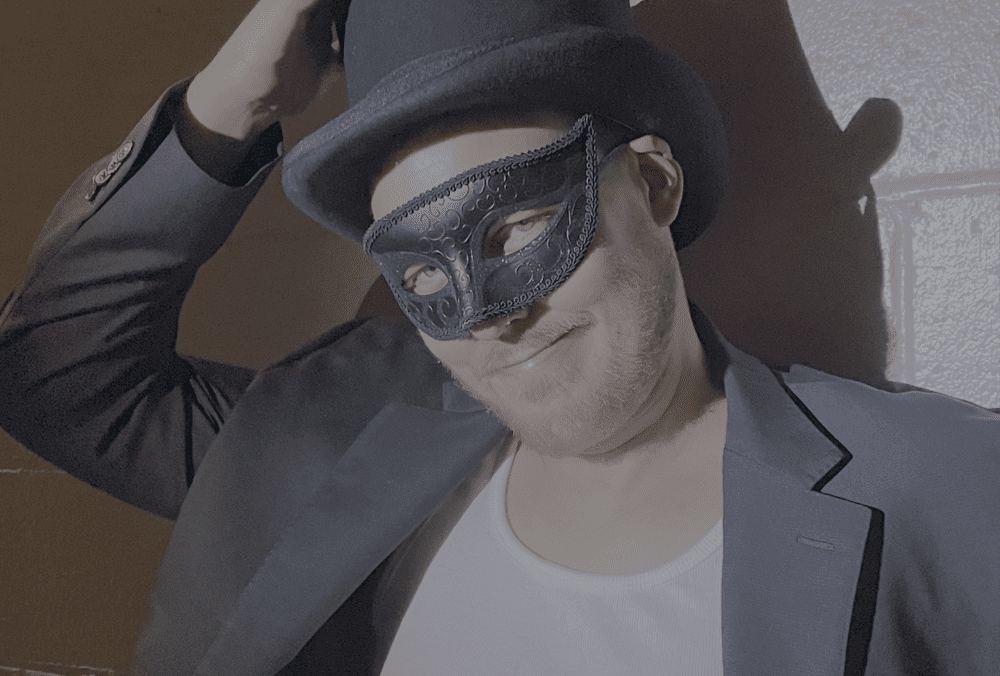
Masque doesn’t make music to soothe the listener. He makes it to sit with what hurts, to let tension linger instead of resolving it neatly. Wrapped in anonymity and driven by emotion rather than ambition, his work exists in that fragile space where vulnerability and control collide.
In this interview, Masque opens up about surrendering to feeling on Save Me Lady Gaga, the protective power of the mask, and why discomfort is often more honest than closure. He reflects on writing in the middle of emotional chaos, choosing instinct over genre boxes, and the quiet strength of solitude. There’s no oversharing here, no tidy explanations—just a candid look at an artist who believes mystery still matters, pain isn’t a prerequisite for truth, and that beneath the persona, there’s simply a human trying to be heard.
Q: Your music doesn’t chase comfort. It sits in discomfort and lets it breathe. When you’re writing, are you trying to survive a feeling, confront it, or fully surrender to it?
A: In Save Me Lady Gaga, I am surrendering to my feelings. I am letting the feelings of hope and sadness spread through my body, so that I can fully express them. In my other songs, it varies quite a bit, though I usually prefer to confront the feeling.
Q: The mask has become inseparable from your identity as an artist. Do you feel more exposed wearing it, or more protected by it?
A: I feel protected wearing it. It helps me transform into a confident performer and allows me to express myself without shame.
Q: A lot of your songs feel like they’re written at the exact moment things are about to break. Do you usually write in the middle of emotional chaos, or after the damage is already done?
A: Half of my life has felt like I’m about to break, so I guess I usually write during the emotional chaos. That said, I do write some of my songs during times of reflection.
Q: You’ve spoken about music as a lifeline rather than an ambition. At what point did creating stop being a choice and start feeling like a necessity?
A: I wouldn’t call making music a necessity so much as a calling, one that I am determined to answer. And I know exactly when it happened – Thanksgiving of 2020. For obvious reasons, I spent a lot of time that year reflecting on my life and what I wanted to do with it. And on that day, I finally heard the call.
Q: There’s desperation in your work, but never self-pity. How do you draw that line when you’re pulling from such raw places?
A: When I listen to the music of other artists, I don’t like hearing too much pity. A little self-indulgence can be healthy, but I prefer pity to be rather muted. So when making my music, I ask myself, “Would I enjoy this?”
Q: Your sound doesn’t follow trends or obvious genre lanes. Was that a conscious rejection of expectations, or did you just stop caring what boxes you were supposed to fit into?
A: I kept going back and forth between whether I wanted to focus on hard rock or dance. I still frequently make songs that are one or the other, but for this song, I really wanted to find the meeting point. So I guess I just stopped caring about choosing a single box and followed my own path.
Q: Lady Gaga played a pivotal role in helping you through the darker chapters of your life. What did her example teach you about vulnerability that still shows up in your music today?
A: She taught me that vulnerability can both inspire others and make people feel like they’re not alone. To help people know that their struggles are shared, and to continue moving forward even when you can’t see the light at the end of the tunnel.
Q: Isolation is a recurring theme, but it’s presented almost as a state of clarity rather than loneliness. Do you see solitude as something that hurts you, or something that sharpens you?
A: I’m more comfortable with solitude than most people, so I see it as a lens through which I see the world. That said, it can still be painful – I do think humans are meant to connect.
Q: When listeners connect deeply with your most personal lyrics, does that feel validating, invasive, or somewhere in between?
A: It feels both validating and surprising. I mentioned that when I write music, I hope that others can feel like they are not alone; that connection also lets me know that I myself am not alone. Not only do other people share my experiences, but I also share theirs.
Q: Your persona feels controlled, intentional, and guarded — yet the music itself is anything but. How do those two sides coexist without collapsing into each other?
A: The persona itself is a balance of control and vulnerability. I can be a guarded person in general, but putting the mask on gives me the power to be vulnerable. It’s one distinct layer on top of another.
Q: You’ve said that the greatest fear of an artist is being known. What part of yourself do you still feel hasn’t been heard yet?
A: I have gone through many unusual experiences in my life, and it will take a long time to open up and sing about all of them. But stick around, and you’ll definitely get to hear about them.
Q: In an era where artists are expected to constantly explain themselves online, why does mystery still matter to you?
A: I listen to a lot of other artists, and while we all sell our experiences, it sometimes feels like people are trying too hard to sell their stories. I’d prefer to keep a bit of mystery. It’s like many people prefer to strip down to their underwear, but so many people do it that it feels generic. Only teasing a little feels like a novelty these days.
Q: When you look at your catalog so far, what emotional chapter do you feel you’ve closed — and which one are you only just beginning to explore?
A: With my current music, I am moving towards the end of my self-focused mental health chapter. I’ll eventually add elements of friendship and resistance to my current themes, but I’ve still got a bit of time before I get there.
Q: Do you believe pain is a requirement for honesty in art, or is that a myth you’re actively trying to break?
A: While pain is a big part of my own art, you definitely don’t need pain to be honest in art. Joy and love can be perfectly honest emotions; they’ve just been oversaturated and artificially recreated in the pop market.
Q: Finally, when the mask eventually comes off — metaphorically or literally — what do you hope people realize about who you’ve always been underneath?
A: I hope they realize that, above all else, I am a human. My mask hides me, and I balance that with human elements in my music. When I take off the mask, I think my humanity and music will come into perfect sync.