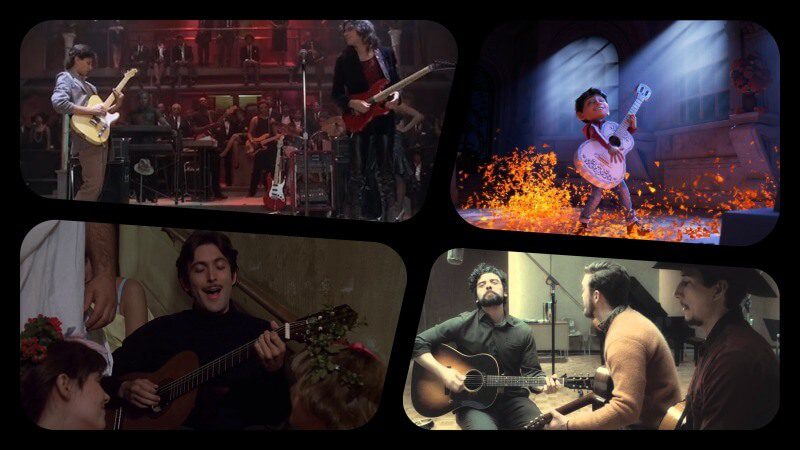
As Guitar Week plucks on, we’re taking stock of our favorite guitar-featuring scenes in film and TV history. There aren’t any real guidelines for eligibility here, but we unintentionally stayed away from biopics and Elvis movies. Most of the scenes we’ve highlighted are from comedies, which wasn’t intentional, but what can you do? We left a few guitar scenes behind, from Almost Famous, Purple Rain, Howard the Duck, and Walk the Line, but the ones we do have here are pretty dang good, if I do say so myself. And there are no repeats, otherwise this entire list would just be scenes from School of Rock. This ranking is alphabetical by film/TV show title, so don’t hound us in the comments about what’s too low or what’s too high. Instead, hound us in the comments about the scenes we forgot. Or, even better, let us know in the comments what your favorite guitar scene of all time is. Many thanks to Matt Melis, Grant Sharples, Sam Rosenberg, and Cassidy Sollazzo for pitching in with some great picks. Here are the 21 greatest guitar scenes in film and TV history, as chosen by the Paste team.
“I gave my love a cherry” (Animal House)
John “Bluto” Blutarsky (John Belushi) taught us many things as the senior brother and “sergeant at arms” of Delta house in 1978’s classic comedy Animal House. He taught us how to work a buffet, fashionably don a toga, and that it wasn’t “over” when the Germans bombed Pearl Harbor. And given that he ended up getting the girl and later winning election to the United States Senate, just maybe “fat, drunk, and stupid” is a viable lifestyle choice. However, what might get lost in all the drunken shenanigans of Animal House is that Bluto was also one of the first serious rock and roll critics. Upon coming down the stairs to find a young songwriter serenading a bevy of co-eds with his guitar, Bluto ponders the merits of the song before rendering a scathing review that left the guitar in about three separate pieces. In an utmost act of professionalism, he then apologized to the artist, thus demonstrating that the harsh critique was nothing personal. Oh, well. They can’t all be the next Otis Day. —Matt Melis
[embedded content]
Marty McFly plays “Johnny B. Goode” (Back to the Future)
On one level, Back to the Future tells the tale of how time travel changes the course of history for a small town none of us have ever heard of. On a slightly deeper level, it’s a father-son story as a teenager accidentally goes back in time and changes his family’s future for the better. However, peel back just one final layer and you have a true rags-to-riches story of rock and roll glory. Rockstar wannabe Marty McFly (Michael J. Fox) can’t catch a break. He’s blown out his amp (which went to way more than 11), doesn’t have the courage to send off his demo to the record label, and his band, the Pinheads, are “just too darn loud,” even for Huey Lewis. And yet, Marty will forever shape the future of rock and roll with his incendiary performance of “Johnny B. Goode” at the Enchantment Under the Sea Dance. How lucky for us that the guitarist he replaced, Marvin Berry, had a cousin, Chuck, who happened to be looking for a new sound. And while Marty might take the guitar theatrics a bit too far for 1955, he’s right: “[Their] kids are gonna love it.” —Matt Melis
[embedded content]
Battle of the Bands (Bill & Ted’s Bogus Journey)
In the sequel to 1989’s Bill & Ted’s Excellent Adventure, the bro-y, less-than-decent guitarist besties (Alex Winter and Keanu Reeves, respectively) must face off against evil robot doppelgängers whose sole mission is to prevent them from winning the San Dimas Battle of the Bands. The phonebooth time-travel premise is turned inside out as Bill and Ted careen not only through the future and the past, but into the afterlife itself (good and bad), chasing their metallic counterparts across existence. Everything funnels back to the Battle of the Bands stage for an on-stage identity crisis (“We’re Wyld Stallyns!” “No, we’re Wyld Stallyns!”), ending with Bill and Ted literally blowing their robot-selves’ heads off. With the threat neutralized, they hop back into the phone booth for 16 months of intensive guitar training, completed in roughly 30 seconds. When they return, clad in leather vests and elaborate facial hair, they’ve achieved full Rock God status. “The best place to be is here,” Ted says into the mic. Bill completes the thought: “The best time to be is now.” The only thing left to do is rock like they’ve never rocked before, launching into a shreddy, dueling, circling guitar medley spawned from “God Gave Rock and Roll to You” (the KISS version). The closing credits say it all: Wyld Stallyns create world harmony, stabilize the climate, tame the stock market, and generally prove the ultimate power of rock and roll. —Cassidy Sollazzo
[embedded content]
Nobody’s dancing to The Yardbirds (Blow-Up)
In high school, my best friend and I tried to get everybody in our class to watch Michelangelo Antonioni’s Blow-Up because we were obsessed with it. Herbie Hancock’s non-diegetic score is awesome, but can we talk about the brief scene in which the Yardbirds play “Stroll On” to a lifeless crowd? When Jeff Beck gets frustrated over a buzzing sound in his amplifier and smashes his guitar to bits in protest, the audience explodes into a disastrous stampede trying to collect the broken guitar neck. It’s such a WTH moment made all the better when a passerby picks the neck up and tosses it in the wastebin. Antonioni, who initially asked Eric Burdon, Tomorrow, and, supposedly, the Velvet Underground to do the scene first, filmed the Yardbirds’ performance in a replica of the Ricky-Tick club in Hertfordshire. —Matt Mitchell
[embedded content]
Marshmallow at open mic night (Bob’s Burgers)
Marshmallow has been part of the Bob’s Burgers universe since the show’s first season. Initially, she was written as a transphobic punchline. But fans have welcomed her as a beloved character, one whose questionable origins Loren Bouchard, the show’s creator, has apologized for and since remedied, giving the character a Black trans voice actor, Jari Jones, to replace the original VA David Herman. Marshmallow gets the (literal) spotlight in Season 15’s “Hope N’ Mic Night,” in which she picks up a blue Jaguar guitar to cover Alessi Brothers’ “Seabird.” Her parents, whom she doesn’t get to see often, are in town for the performance. Shortly after she starts playing, her dad reaches over to grab her mom’s hand, and it’s incredibly touching. For a show that focuses on comedy first and foremost, its earnest moments are just as compelling, and we have Marshmallow to thank for one of its more recent tugs at the heartstrings. —Grant Sharples
[embedded content]
Miguel sings “Remember Me” to Mamá Coco (Coco)
Not all guitar heroics require windmill strums, stage slides, or towering pyrotechnics as stacks of amps send tidal waves of raw power into the ether. In the final scenes of Pixar’s Día de los Muertos-inspired Coco, a young Miguel plays his Great-Great-Grandfather Héctor’s guitar and sings his song, “Remember Me,” to his great-grandma, Mamá Coco, in the hopes that she’ll remember her long-forgotten father before he fades away forever. No pressure, mi amigo. As Miguel strums along through his tears, the ailing Mamá Coco starts to tap her finger along to the tune and begins to sing along with her great-grandson. “My papá used to sing me that song,” she says through a wrinkled smile before revealing that she had saved her father’s letters, poems, and torn photos all these years. From that day on, music was no longer seen as a curse in Miguel’s family but rather as a blessing that allowed them to remember their past and celebrate the present. Now, that’s some good fingerpicking. —Matt Melis
[embedded content]
Steve Vai vs. The Karate Kid (and Ry Cooder) (Crossroads)
When we were in high school, a friend of mine convinced me to get high as fuck and watch Crossroads, a movie inspired by the tale of Robert Johnson selling his soul to the devil, with him. A brilliant choice, I’d say. At the end of the flick comes a final duel—between two white boys in motion—for Willie Brown’s (Joe Seneca) soul. Here’s a guitarist named Jack Butler, played by the great Steve Vai, whose satanic blessing has turned him into the greatest picker in Heaven or Hell, going into battle with… the Karate Kid (Ralph Macchio)—I mean, Eugene Martone, Willie’s only hope. And Vai was really putting a beating on Macchio in this thing, until Daniel LaRusso—I mean, Eugene Martone—starts playing Niccolo Paganini’s Caprice No. 5 and ends the legato picker’s shit. Has a Telecaster ever been so powerful? The reason I dig this scene so much is that it’s Steve Vai doing most of the work (his parts and Macchio’s) along with some seriously great Ry Cooder slide guitar overdubs. Crossroads chaps my ass. What a terrific and insane picture. —Matt Mitchell
[embedded content]
Dueling banjos (Deliverance)
I think I was seven, maybe eight years old when my dad let me watch Deliverance for the first time. It took me a while to understand what “squeal like a pig” really meant, but I was simply charmed by the dueling banjos scene. Once I grew up it got more terrifying to watch, as the consequence of a family’s inbreeding unfurls around Lonnie (Billy Redden) and Drew (Ronny Cox) seemingly lighthearted jam session. At some point “Dueling Banjos” was the only song that all of my guitar-playing friends knew. But then I saw the Darlings singing it during an episode of The Andy Griffith Show (my dad’s a devoted rewatcher) and learned more about its history and how Arthur “Guitar Boogie” Smith wrote it way back in 1954 before it wound up in Deliverance. Later on, while doing research for my write-up about 1973 #1 hit songs, I learned that, when Roberta Flack’s “Killing Me Softly With His Song” was at the top of the Hot 100 chart, “Dueling Banjos” was #2 (it went to #1 on the Cashbox and Record World charts, though). Talk about a cultural moment. —Matt Mitchell
[embedded content]
Auditioning for the Wango Tango showcase (Freaky Friday)
One of the best revisions the 2003 remake of Freaky Friday made to the original was turning its rebellious teen protagonist Anna (Lindsay Lohan) into a pop-punk musician. In the beginning of the film, Anna and her band Pink Slip jam out to “Take Me Away,” a genuine banger with catchy, angst-soaked lyrics and a twitchy guitar hook that is guaranteed to activate any millennial like a sleeper agent code. The song also naturally gets on the nerves of Anna’s high-strung workaholic mom Tess (Jamie Lee Curtis), who cuts off her daughter’s rehearsal time to maintain some semblance of order in their household. After the two switch bodies though, “Take Me Away” takes on an even more narratively and emotionally urgent role when Anna and her band play it for a Wango Tango audition at the House of Blues during the film’s climax. Without Anna’s musical knowledge and rock-star confidence, Tess-as-Anna struggles to get through the live performance, but right as her big guitar solo comes up, Anna-as-Tess comes to the rescue, performing the solo for her backstage. The scene is pure joy to watch, but it also strikes a chord (literally) as a satisfying, earned, and cathartic payoff to Tess and Anna’s generational and familial clashing. —Sam Rosenberg
[embedded content]
The recording of “Please Mr. Kennedy” (Inside Llewyn Davis)
There are so, so many great guitar moments from the Coen Brothers’ 2013 masterpiece Inside Llewyn Davis that it’s hard to pin down just one. Thanks in large part to legendary music producer T-Bone Burnett, the film’s acoustic-heavy soundtrack not only contains a gorgeous, devastating collection of folk music, but also plays an important function in tracking the brutal emotional journey of its hopelessly adrift titular protagonist (Oscar Isaac), who can’t seem to get out of his own way despite his undeniable talent. The ongoing tension between Llewyn’s tender, soulful guitar playing and the chaos of his life unfolds in beautifully tragicomic harmony during the film’s sole upbeat number “Please Mr. Kennedy,” a reworked political novelty song from the ‘60s. The scene itself is amusing as a winking satire of what it’s like making creative concessions for quick-buck commercial work (and the consequences of not agreeing to get paid royalties), but it also excels due to the committed sincerity of its performers, with Isaac’s energetic vocals bouncing sweetly off of Justin Timberlake’s spirited delivery and Adam Driver’s goofy ad-libs. Though it’s not exactly the best song from Inside Llewyn Davis—that would be the achingly tender cover of “Five Hundred Miles”—it’s notable for being a light and endearingly silly moment in an otherwise very sad and bleak drama. —Sam Rosenberg
[embedded content]
Nil’s guitar school / Imminent Death Syndrome (Mr. Show with Bob and David)
Even guitar prodigies might need a lesson or two to get started. Then again, Larry (David Cross) isn’t a guitar god in the making. He’s just a dying kid with a worried mom. Or is he? Sadly, that’s the true tragedy of Imminent Death Syndrome (IDS); it puts us all in … “an awkward position,” as guitar teacher Nil (Bob Odenkirk) and his bandmate Blackie (hey, it’s Spongebob Squarepants!) soon learn. When Larry comes in for his first guitar lesson, Nil has been tipped off by Larry’s mother that her son hasn’t got much time to live. To cheer him up, Nil and Blackie pretend Larry is Jimi, Jimmy, and Jeff (Beck!) rolled into one. As phone calls from Larry’s doctor come in with differing updates, Larry has to figure out if he’s really destined for guitar hero greatness or if his new bandmates are just blowing smoke up his amp. Either way, it’s going to put everyone in a very, all together now, “awkward position.” If nothing else, we get to hear Nil deliver the greatest motivational speech ever uttered by a guitar teacher: “No, you can’t [learn]. You suck, and you’re wasting my time!” —Matt Melis
[embedded content]
“The devil can’t write no love song” (Saturday Night Live)
In 1999, SNL brought Garth Brooks in to host the show with musical guest Chris Gaines. A modern-day equivalent would be Joe Keery hosting and Djo circa-2019 performing. At the end of the ‘90s, Brooks was one of the biggest stars in America, dropping platinum record and platinum record. He’s a great pop-country guy but a horrible comedy show host. But his episode wasn’t all bad, because it gave us the “Devil Can’t Write No Love Song” sketch, which features Lucifer (Will Ferrell) showing up to help guitarist Milo Jenkins (Brooks) write a hit single. The only problem is that Lucifer is a talentless hack who can’t play for shit. Milo, unaware of the Devil’s limitations, agrees to sell his soul and gets nothing but songs about Fred owning slacks, hating Mondays, and getting bit by a love bat (with zoinkas and boinkas in tow) in return. Lucifer blames it on the guitar being out of tune and it’s a damn riot. —Matt Mitchell
[embedded content]
“Rock got no reason, rock got no rhyme” (School of Rock)
All of School of Rock could be on this list. It’s a quintessential comedy, maybe one of the best comedies ever. It arrived to me at a time when I was deep in an AC/DC obsession, so seeing Jack Black wail on a Gibson SG not unlike Angus Young’s altered my brain chemistry. I can probably quote the whole thing. Picking one scene from it is a foolish errand, but how could it be anything but the Battle of the Bands sequence? Dewey Finn (Black) leads his elementary school cohort into a delicious rendition of Zack Mooneyham’s (Joey Gaydos Jr.) original tune, “Teacher’s Pet,” and it’s spectacular. I rewatched School of Rock a few months ago and still got chills when this scene came on. This movie—this moment—is why I asked my parents for a guitar for Christmas and why I sobbed uncontrollably when I finally saw a Fender Squire tucked behind the tree. The only flaw in School of Rock’s Battle of the Bands spot is that No Vacancy won the whole damn thing. Fuck those guys, even if I do hum “heal me, I’m heartsick, I’m hungry and A minor, G” to myself all the time. —Matt Mitchell
[embedded content]
Eddie plays “Master of Puppets” (Stranger Things)
Eddie Munson’s (Joseph Quinn) shining Stranger Things moment comes in the Season 4 finale when he and Dustin (Gaten Matarazzo) are tasked with distracting Vecna’s Demobats while Steve (Joe Keery), Robin (Maya Hawke), and Nancy (Natalia Dyer) attempt to burn his entranced body in the Creel house. Once Eddie plugs in his black Warlock guitar, says, “This is for you, Chrissy,” and launches into the opening riff to Metallica’s “Master of Puppets,” it becomes an instant-classic moment in the show. After eight episodes of running away, Eddie stands tall atop his uncle’s trailer in the Upside Down and spins out one of heavy metal’s toughest, meanest anthems. In the episode prior, Robin ribbed Eddie’s cassette collection, which didn’t include “real music” like Blondie or the Beatles, but held a plethora of Iron Maiden—to which Eddie yelled, “This is music!” The same can easily be said about his rendition of “Master of Puppets,” a Metallica-approved highlight of his quick, bittersweet rise to becoming—unbeknownst to him or the masses—Hawkins’ hero. This was, finally and truly, Eddie Munson’s year. —Matt Mitchell
[embedded content]
“Check this riff, it’s fucking tasty” (Tenacious D in The Pick of Destiny)
Dave Grohl’s greatest post-Nirvana moment was playing Satan in Tenacious D in The Pick of Destiny. With their lives in danger, JB (Jack Black) and KG (Kyle Gass) challenge the devil to a rock-off. If Tenacious D wins, Satan has to pay their rent. If Satan wins, KG becomes his sex slave. Cue a badass guitar showdown full of so many what-the-fuck visuals, hellfire, and shredding that my head almost explodes every time. It’s the most face-melting scene in movie history—as absurd and mental as it is cinematic. What a way to complete Tenacious D’s hero’s journey: by defeating a supernatural sex pest underlord ripper played by a Foo Fighter. —Matt Mitchell
[embedded content]
Bobby vs. Satan (The Kids in the Hall)
Faustian bargains date back several centuries, with modern music traditions like the blues and rock and roll having heavily adapted the idea of meeting the Devil at the crossroads into their folklore. Everyone from Robert Johnson and the Rolling Stones to Charlie Daniels’ Johnny and Tenacious D have offered up their souls to the Prince of Darkness in exchange for worldly gain. Of course, no rock-off with Satan can match the sheer guitar wizardry of Bobby Terrance, who, after a quiet ham dinner and forgetting to take out the garbage, defeated the “front man of evil” in his parents’ garage. As Bruce McCulloch’s Bobby tells it, “Taking crap from my parents is my life, but excellence in the face of rock is my creed.” And despite the Devil’s (yeah, that’s Glenn from Superstore) two extra hands, green demon spit, and ability to shape-shift, Bobby sends him back from whence he came with the power of a Deep Purple riff, a wah-wah pedal, and an unwavering fidelity to his high school girlfriend, Laura. Needless to say, Lucifer finally met his match in the Canadian suburbs that evening. —Matt Melis
[embedded content]
“I’m a Goofy Goober (rock!)” (The SpongeBob Squarepants Movie)
Maybe this is an odd inclusion, but I imagine thousands, maybe even millions of millennials and zoomers like rock and roll because of The SpongeBob Squarepants Movie 20 years ago. SpongeBob doing a Twisted Sister, “I Wanna Rock” parody near the film’s end, all while decked out in a wizard get-up and shredding on a peanut-shaped ax? Hell yes, dude. Dee Snider was reportedly resistant to the idea of changing his song to say “I’m a Goofy Goober,” but they paid him a shitload of money for it. I think in one interview he even said the licensing helped put his kids through college. Maybe it’s corny to look back on, but at six years old it really did feel like rock and roll could save the world, even if that world was just a plankton brainwashing a bunch of fish with radio-controlled bucket helmets. —Matt Mitchell
[embedded content]
“Somebody kill me, please!” (The Wedding Singer)
“I just want to warn you that when I wrote this song, I was listening to The Cure a lot.” That’s a perfect introduction to “Somebody Kill Me, Please,” Robbie Hart’s (Adam Sandler) tale of angst. The Wedding Singer isn’t a top five Sandman flick for me, but this scene absolutely is. When I was a kid I just thought it was funny, but the older I get the more real it becomes. It’s a joke, for sure, but I do think the song captures a deeply human emotion of feeling aimless and heartbroken. It was all bullshit and it was all a goddamn joke. Not to mention, Sandler’s singing chops are legit and so is that Gibson ES-335 that he’s playing. He’s losing his mind, and I’m reaping all the benefits. —Matt Mitchell
[embedded content]
“These go to 11” (This Is Spinal Tap)
I’d reckon that no scene in film history is funnier than Nigel (Christopher Guest) talking to Marty Di Bergi (Rob Reiner) about his guitars, which he plays and cherishes, in This Is Spinal Tap. Nothing even comes close for me. As Nigel holds up his ‘59 Gibson Les Paul and talks about its sustain (a sustain that goes on for so long that you can leave, have a bite to eat, come back, and still hear it ringing… if it were playing), I’m bowled over. Then there’s the teal Fender Bass VI that’s still got the “tagger” on it. That one can’t be played, never. You can’t even look at it. But this is the scene where all the amplifier knobs go up to 11. “Does that mean it’s louder? Is it any louder?” Di Bergi asks Nigel. “Well, it’s one louder, isn’t it?” Nigel, lit cigarette in hand, responds, his gum-chewing hilariously becoming more pronounced. When you’re at a ten on your guitar, where can you go from there? —Matt Mitchell
[embedded content]
“Just you and I” (Twin Peaks)
Season 2 of Twin Peaks gave new meaning to the concept of “fever dreams,” because David Lynch stepped away from directing most of it once the twist that power Season 1 got buttoned up. It got pretty weird from then on. Two episodes after Laura Palmer’s killer was revealed, we were gifted this iconic clip of James Hurley (James Marshall) singing “Just You” with Donna Hayward (Lara Flynn Boyle) and Maddy Ferguson (Sheryl Lee) in the Hayward family’s living room. The scene is a precursor to Maddy having a vision of BOB, and I’d like to believe his arrival was because he absolutely hated “Just You.” David Lynch wrote the lyrics and Angelo Badalamenti composed the music, and I think it really captures what teenagers were doing in the 1990s: singing doo-wop songs after their friend died tragically. But “Just You” is incredible: the echo effect, the high-pitched vocals, the tense eye contact. Even better: it gets reprised in Twin Peaks: The Return. What a strange little tune. I’ll play it forever, because James has always been cool. —Matt Mitchell
[embedded content]
“No ‘Stairway,’ denied!” (Wayne’s World)
Wayne Campbell (Mike Myers) and his spectacled, blond bestie, Garth Algar (Dana Carvey), schwinged their way into our hearts as both a popular SNL sketch and later a movie franchise. However, the pair cast such a wide net as they poked fun at pop culture through lists and spoofs that sometimes Wayne’s metalhead roots—stretching way back to “Wayne’s Power Minute” on CBC telly—got lost in the mayhem. Myers made sure that wasn’t the case when Wayne’s World got tapped to be a feature film. Not only did The Decline of Western Civilization filmmaker Penelope Spheeris get brought on to direct, but many of the flick’s most memorable moments ended up being metal-based gags. We’ll never forget head-banging in the “Mirth Mobile” to “Bohemian Rhapsody,” Garth’s “Foxy Lady” mating ritual in Stan Mikita’s Donuts, or a totally “not worthy” history lesson from Alice Cooper. But tucked away in the abundance of silliness is a 10-second gag just for the guitarheads. When Wayne goes to test out the guitar of his dreams, a vintage 1964 Fender Stratocaster dubbed “Excalibur,” the store’s sales assistant quickly shuts down the jam sesh with extreme prejudice. Let’s just say that Guitar Center employees have probably seen this joke reenacted thousands of times since. Guilty here. —Matt Melis
[embedded content]