The lush artistic output of the 1970s pushed musicians to the forefront of cultural conversation; even bands like Led Zeppelin and Pink Floyd, which were poorly reviewed at the start of their careers, amassed cult followings in the London underground scene due to their raw authenticity. Bands like these found their fans on the outskirts of the mainstream and broke through from there, letting live shows and word of mouth spread their gospel. It’s worth noting, though, that these bands were male-led. The all-female British post-punk band the Raincoats was conceived in the late ‘70s, a time of low visibility for female musicians within the phallocentric rock scene. The band’s vocalist and bassist, Gina Birch, recalls the epiphanic moment of seeing the Slits play in 1977, one of the few punk groups to stick it to the masculine milieu. “It was as if suddenly I was given permission,” said Birch to She Shreds. “It never occurred to me that I could be in a band. Girls didn’t do that.” Unlike their male counterparts at the time, there wasn’t a charted path for a band made up of women to get their break. In fact, of the few female rock bands at the time, like Fanny or the Runaways, most followed in the footsteps of the popular rock sound of the time, touting catchy, singable melodies and typical song structures.
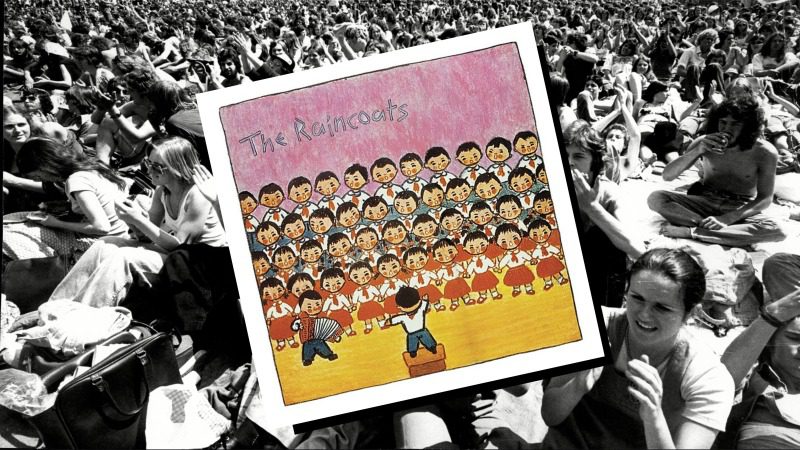
The Raincoats, however, aimed to subvert the popular notion of rock music and create their own sound, one that felt true to them and far away from constraining norms. Birch and Ana da Silva (vocals, guitar), Birch’s friend and classmate at Hornsey College of Art in London, started the band after seeing that fateful Slits concert, eventually getting signed to Rough Trade before producing their first album, The Raincoats. Their push for singularity lit a fire under them, an energy that is omnipresent in their debut; each song buzzes with discovery. The band’s cultural context is inextricable from the music they made, which is especially evident in that self-titled first album. The record reads like a patchwork of the sounds of their world— schoolgirl chants that sound straight from the playground, drums that pound like London rain, and the broken-down violin sounds of classical music gone awry.
The Raincoats’ debut marks their entry into the post-punk scene, a movement in music that championed minimalist production and accompaniment, paired with the experimental flair of DIY musicians. da Silva’s gritty guitar tone colors every song on the album with a distinctively homegrown attitude. Even on the produced record, it’s clear the songs really shine when played live—the punchy, slackly-sung refrain of “Fairytale in the Supermarket” beckons you to shout along, “Honey, don’t worry!” There’s a presence of spontaneity in these tracks that’s bolstered by the imperfections of their performances—the band leaves in notes that veer off-key, the soft hum of guitar feedback, and impassioned voice cracks. In his liner notes for the vinyl re-release of The Raincoats, Kurt Cobain illuminated this phenomenon, writing, “When I listen to the Raincoats I feel as if I’m a stowaway in an attic, violating and in the dark. Rather than listening to them I feel like I’m listening in on them.” The Raincoats make you feel like you’re invited into their secret club—they provide an opportunity to sit in that attic with them, listening as they play to the cobwebs in the corners.
While their later projects are more lyrically dense, The Raincoats zeroes in on succinct songwriting, letting a handful of themes permeate the record. “No Side to Fall In” rejects the typical verse/chorus structure, opting to build the song from one melodic sequence alone. The first verse houses the song’s only lyrics, which are repeated over a squeaky violin and a lone brushed beat. The song is an anthem about the metamorphic quality of making music, with da Silva singing, “I hear the music outside, and I am the music inside” as an ode to her songwriting practice. The record’s sparse lyricism gives leave to extensive repetition—the band doesn’t make you guess the thesis of their songs, rejecting thematic subtlety and its proximity to restraint. The outros of “No Looking,” “In Love,” and “Life on the Line” settle on one lyric to restate into oblivion, leaving a lingering impression of each song’s prime takeaway. After a few verses that detail a destructive romance, “In Love” ends on the lasting iteration of “I don’t need your feelings, I do what I want,” spoken in a hushed, indignant tone. The record is essentially half-sung, half-moaned, channeling unpolished vocals into unbearably human expressions of joy and pain. The track “You’re a Million” is an extreme example of the record’s chant-like vocals, where da Silva communicates the lyrics through a downright wail. “My feelings were fueled by yours,” she cries. “The walls that surrounded my city stop here.”
Even musically, the band invites tension into their arrangements, overlaying half-sung vocal lines with shrieking violins and jangly guitars. The track “Life on the Line” begins with a violin that’s outright grating, playing a purposefully off-key melody before slotting into place with the rest of the accompaniment. The percussion is just as dynamic, alternating between a rapidly pounding bass drum and half-time feel throughout the song. The band is adept at creating a synergistic relationship between their music and lyrics, representing feelings that don’t coalesce in the chorus of “Adventures to Close to Home.” Birch and da Silva sing “I follow love, I follow hate” in rounds, yielding a kind of echoing effect that hammers in these conflicting desires.
For all of the Raincoats’ experiments with songwriting, by far their most popular song, which can be heard on this record, is one they didn’t write. You’ve likely heard of the band from their cover of The Kinks’ “Lola,” the 1970 single that recounts an evening rendezvous with a woman who “walks like a woman and talks like a man.” 50 years later, there have been spirited debates over whether the song is really transpositive or transphobic, but regardless, the Kinks were faced with controversy when they released the song from those that feared the representation of transgender people in any regard. The Raincoats’ version occupies a slightly different space in this discourse, as “I’ve never kissed a woman before” has more contentious connotations when sung by a group of women, especially in 1979.
Though the band didn’t change any of the lyrics, their version can be read through a queer lens solely based on the fact that they’re a group of women singing it. Their faithfulness to the original arrangement just hammers in this point—the cover is a sly acknowledgement of the space the Raincoats take up in the music scene as women. 46 years ago, the odds were against a female-led band that resisted the sounds of the mainstream music scene. The Raincoats really feels like the band struck gold on the first try. They went on to make only two more albums before parting ways to focus on solo projects, but their debut as a band will forever be a turning point in post-punk for years to come. The Raincoats came at a time in music and pop culture that desperately needed a messy, female-centric modicum of expression, and luckily for the world, the Raincoats were just the ones to fill that void.