The first time I killed a boy, I could only do it in writing—in the form of a poem I penned and recited in secret over and over again until my eyes weakened, imagining myself nailing the severed head of then-long-gone Rolling Stones co-founder Brian Jones to a wall. As many young people mistakenly believe, poetry seemed the easiest method for the deed, if only to translate viscera in as few words as possible, pricking my reader (then likely a trusted friend given access to a notebook or a scratchy voice memo) quickly enough that I would have time to duck away afterwards. I can’t find a copy of this poem now, but I remember obsessively tracing those lines, trying to hold both my love of an artist’s work and destructive actions in messy, uneven halves. It is one thing to purchase an album and let it live in you until you grow sore from gripping it close. It is another thing to think of times you did not live through and what you would look like to the person who had made that album: in a world where genius only visits and graces the few, where spit and bile and sweat are only beautiful coming from his skin, where you are only collateral damage on the path to creation. My body, at the hour of Brian Jones’ death, was not meant to create. At least, not like his was.
When I wrote this now-disappeared poem, it had already been over 40 years since Jones, a person I did not know, left this mortal coil facedown in his swimming pool—had gone out beating his girlfriends in hotels where the walls were thin enough that everyone could hear and having lost his support system in the form of his band. Yet, my cruelty only stung because of how deeply I loved the Rolling Stones’ music. In that moment, my compulsive need to avenge someone like Anita Pallenberg—who made them dangerous, made them more—in my own harmless, hypothetical way crept up on me. I was a teenage girl who had devoured one too many books about her heroes, and though these stories recounted the life of a man already buried, I felt a sick urge to take up the undertaker’s spade and force him deeper into the earth through an amateurish high school attempt at poetry that no one would discover or care about. In those moments, these now-legendary stories are not dreams, but our lives—composed by hands allowed to grab us because no one will stop them, hands that will only be severed if we do it ourselves.
I am the cuts on Anita Pallenberg’s face in Morocco in 1967. I am every ‘70s magazine spread dissecting an artist with tits like a frog with a pin through its limb. I am my father yelling at me in a parking lot a decade ago because I refused to shave my legs, and the sidelong look the waitress gave me once he and I sat down in a diner afterwards and I could not keep the hot, disgusting tears from dripping onto my dinner plate. I am the state’s womb worth dying for, a vessel ruled by a handbook which I do not get to read or revise for myself. I am the extra ten pounds a government doctor told me I should lose when I was still a child. I am the tabloid age during which I became a woman: crisp, cheaply-printed pages of actresses getting fat and doing drugs and holding hands with People magazine’s pin-up of the week. I am the shame I was oblivious to reading those pages then (I think I simply assumed that these were just things that glamorous women did and served as instructions for how I could become one of them), but have since taken on like a weighted crucifix fastened to our backs. I am the excess afforded to the boys in bands and the graces they rack up in the meantime. I am the men I have had to bolt out of venues to escape, making me miss the set I came for. I am all of this and therefore too heavy to drag along tied to the back of a tour van—dead, doe-eyed weight. I seek the nerves under your skin. I may as well write the nail into your neck now, scythe swinging.
And I know It’s not fair that I picked out Brian Jones specifically for my diary decapitation. Others who came after him in his profession have probably done much worse behind closed doors. It’s not like he holds the mythos that other rock stars who had died tragically young hold with some young women today either, so what was there for me to react to? He was simply in my line of sight, as a member of a band that I loved, and when I was 15, I wrote that stupid poem thinking of how even powerless men spoke to people like me—like a dog whose head comes up to their knees before they take it out back to shoot it—and I wanted them all dead by my own hand. How can these furies not burst out of me from time to time?
IT WAS AROUND THAT same time in my life that I first read Gillian McCain and Legs McNeil’s Please Kill Me, a snapshot of punk’s birth in the wrecked shadow of my hometown, and I sat at the feet of those sentient for these countercultural histories that had passed me by. Memorably, for me, the book contained performance artist Penny Arcade’s recollection of being with Patti Smith on a July night in 1969, when the pair first learned that Brian Jones had died: “She was just hysterical. Just crying hysterically. I mean, I was upset too, but she just kept talking about ‘Baby Brian Jones’ and ‘Baby Brian Jones’s bones.’ It was like she was involved with these people, but it was all in her head. Other people have imaginary playmates, but Patti had imaginary playmates who were Keith Richards and people like that.”
Before there is Patti Smith, New York artist and celebrated poet and musician for the masses and patron saint of St. Marks Place and the bodies buried in the walls of the Chelsea Hotel, there is Patti Smith, music fan. I understand her urge to access the worlds these artists occupy, to lock yourself in your childhood bedroom and learn every crevice of the part of themselves they’ve given you. I fear now that I’ve failed by holding them at arm’s length, for digging my nails into the paltry piece of flesh I’d purchased on record and scratching to my satisfaction until I think I can hear blood spill. No, Patti Smith understood, through her devotion to and deep study of these same cultural artifacts, that she could subsume these men—build herself up with her own version of her mythology and her words shaped by literary greats, fusing them as only a few had attempted before, transcending all the groundwork they laid with no guilt or fear. In her art, she is no longer her body, but a channel for us all.
I have landed on perfect womanhood as an impossible game of restraint, of terror that must be contained, of wondering whether I loved a boy or simply wanted to be him. It is a game of longing for a body that moves wildly, a hunter’s crawl where you pick and covet his freedoms in the hope that it might be your own one day. She wasn’t quite the first of us to accomplish the feat, but to witness the sound Patti Smith made 50 years ago still stings so close to the skin’s surface, still pricks tears from me. It is the sound I was killing him and myself to make. I am the rush of the animal’s legs storming the Bowery barn door, just as she taught me.
And yet, when I was in college and finally saw Patti Smith perform at a free show in Central Park, having elbowed as close to the stage as a rush of bodies would allow so I could see one of the most complicated and influential figures of my lifetime sing the songs that changed me, I was present for a brief pause between songs when a man behind me in the crowd called out, condescendingly, “Are you having fun, Patti?” I could wring God from my fingers and call stallion forces forward and rewrite the course of rock music with the plaudits that only poetry affords the greats, but every man would still be my father, my keeper, my teacher, my warden—speaking to me as he would to a kindergartener who has just presented her first paper snowflake and is looking for a grown-up to cut the tape to hang it on the classroom window. I will never know what that man looked like, but I will hear his voice every time I hear hers from that moment on.
A then-74-year-old Patti Smith squinted in the general direction of this call for several silent, agonizing seconds. “Nnnnooo,” she finally sneered back at him, met with whoops and cheers. “You know, after all these years,” she continued, shaking her head and turning to the other side of the crowd as if a more sympathetic ear would meet her there, “men still keep yelling shit at me.” This hierarchy is a curse and a circle. You may as well spin the fuck out of the wheels to throw it off its rhythm, if not break it entirely.
“When I’m writing a poem or drawing,” Smith told David Marchese in 2008, “I’m not a female; I’m an artist.” But 50 years ago, Patti Smith was the only woman aside from Jayne County playing in those downtown clubs early on in a New York City the president told to drop dead, and when Horses first hit the record store shelves, it was a woman who made one of the few albums that all historians point to as the genesis of what we would now call alternative music. It was a woman who did it, and that matters whether she believes it does or not.
I spent all of my childhood imagining myself as the men who created the things I loved, but in the early aughts, young boys I knew never dreamed of being a woman, never play-acted as something a woman would be. Still, even in the immediate aftermath of the record’s release, someone like Paul Simonon of the Clash would have his face plastered in every widely circulated music weekly in the U.K., and in those images, he had a sticker of Horses’ cover affixed beneath the strings of his bass or a ripped t-shirt, displaying a picture of Smith hunched over in a leather jacket, hanging off his shoulders. Horses created a world where someone like Patti Smith could be aspirational, a religious idol for Brixton’s answer to James Dean who had barely learned to play his bass. It created decades of a musical chain reaction that I spend my life documenting and debating. It created Sonic Youth and the Smiths and R.E.M. and Courtney Love and Polly Jean Harvey and Kathleen Hanna and every person I have ever seen myself in since. All of it is refracted through Horses. I’m not sure I can say any other “ground zero” event in music has mattered more to me.
And so, listening to this record now, there is endless context to wade through, not only through the history written in its wake, but all that preceded it: Smith’s journey from the backend of South Jersey to New York (with a baby given up for adoption along the way), her time sleeping on benches long before sleeping at the Chelsea, her gig working at Scribner’s bookstore, her foray into acting in plays with the Warhol superstars, her first performance of her poetry backed by future Patti Smith Group stalwart Lenny Kaye, her signature on Clive Davis’ contract for a seven-album deal. It’s difficult to imagine how those who stumbled upon Horses in 1975 heard the record without all of this background, seeing as we live in a world with Just Kids, Smith’s first memoir chronicling her “twin flame” connection with photographer Robert Mapplethorpe and all the life lived that would gestate into the unvarnished whirlwind of her band’s live show, capturing obscenity in our most populist form.
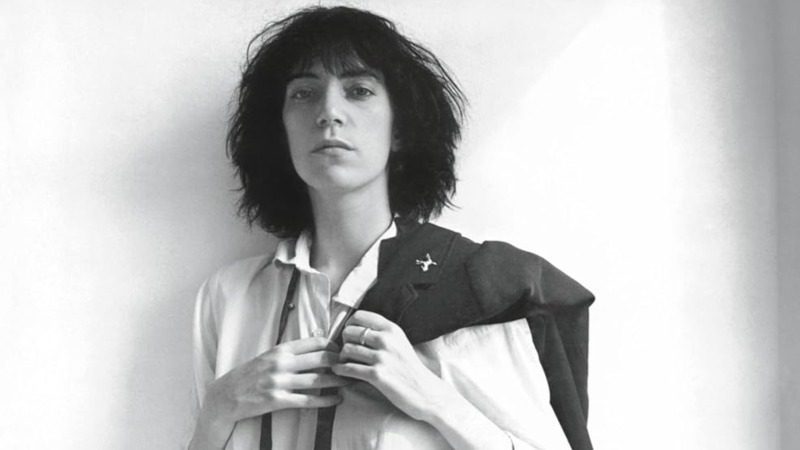
THESE STORIES AND IMAGES now serve to inform Mapplethorpe’s genderless, stark portrait of Smith on Horses’ cover, now more ubiquitous than the music the record holds, and a poem above the credits on the back, ending with the line, “sweet angels—you have made me no longer afraid of death.” One of these images included is of the pair of artists in the late ‘60s in Coney Island with the curve of the Cyclone perched in the image’s corner, and they look like said “sweet angels,” all long limbs and smooth faces. Mapplethorpe sports a fishnet shirt and a fedora, all in black but for a white kerchief tied around his neck to match Smith, who stands beside him nearly all in off-white. For the looming legend hovering above the record’s grooves that images like this one hold, it’s striking how near traditional it is; Smith’s hair still hangs long and straight, not yet sheared into her punk-ready shag. You understand these two artists as just another couple baking under the South Brooklyn sun, petulantly posed for a stranger to preserve the memory. They look of this planet, for maybe the last time. They look like they belong to the city they’ve chosen as their home, rather than standing in for the idea of it.
New York’s bohemian cool, of course, serves as the heart-sore backdrop of Just Kids, but I when I revisit Horses, I strain to figure out whether I can truly hear the city in the music without any clear indication of a concrete setting. The record takes place in our pop cultural imagination, above all else—blending and reforming dusty corners of underground history, like a girl worshipping a pin-up of Brian Jones at an altar in a rotting hotel, visiting Burroughs in the Bunker, staging Peter Reich’s Book of Dreams set to Chubby Checker’s “Birdland.” Chafing against the freshly corporate world of rock, then just a spry two decades old, Horses carries the sound of our city in its propulsion alone—a breakneck rush of bodies in motion connecting if only because they all live on top of each other, skulls smashing together if only because something brilliant could be breathing down your neck at any given time. It carries the mythology of the city, but of pop music’s history too, something which had so long the providence of the boys, even among Smith’s contemporaries; see, for instance, Richard Hell’s studied explanation behind his decision to spike his hair in the days when he and Tom Verlaine first dreamed up Television, cultivating his own future and informed by the iconoclasts of the past.
Smith, too, made herself myth by writing herself in romantic shapes and historical strides, as memory so often does. And why shouldn’t she? In Horses, there is the breathless half-fiction of a Manhattan street, dressed up in the grainy black and white that colors all hindsight. My version of New York exists within in me in figures and fables that might not be documentary, but which feel real—sitting on the filthy sidewalk in Midtown as a child waiting for my father to get off work, scraping up my knees searching for Easter eggs in a park in Harlem, swooning on a bar floor off Avenue A before reeling through a subway turnstil, fidgeting in bed beneath the barren walls of a boy in Brooklyn who cannot sleep when I’m next to him, as if he can sense the devil dormant within me. He knows what boys’ heads hang on my wall, how I stalk any street that will take me, looking for a chance to swing—with Horses in my headphones, more often than not.
With that said, it’s easy to hear those opening notes of “Gloria” and not quite hear them as they’ve become such an elemental part of my being, like the pictures displayed in a room you walk through dozens of times a day, if only because I’ve heard them so many times. One thing that I reflect upon frequently now, as my relationship with the record grows and deepens with time, is the near-invisible but crucial guiding hand of John Cale, then in a fruitful period of his solo career post-Velvet Underground alongside his gig as a producer of several someday-classic proto-punk records. After all, his ex-partner Lou Reed was one of the first people to ask why radical artistic ideas couldn’t be fused with accessible pop music for the masses to consume, which would theoretically make him an ideal co-conspiritor for Smith.
“All I was really looking for was a technical person,” she told Rolling Stone the year after Horses’ release. “Instead, I got a total maniac artist. I went to pick out an expensive watercolor painting and instead I got a mirror.” Still, in those warped reflections, Cale saw a wildness that only needed to be gently molded, if not entirely contained—producing a record which is minimal and frenetic, the sound of avant-garde live-performance art rounded out with the gentle suggestions of Cale’s overdubs. It is often the beauty with which the sound Smith makes is captured that stirs something furious and gorgeous within me, as if I am hearing her delivery of “Jesus died for somebody’s sins, but not mine” for the first time again, set ablaze. Sometimes, that opening salvo, culled from a pre-existing Smith poem titled “Oath,” begins to fade with repetition, like the way I’d be made to say the Hail Mary so many times in a wooden church pew that they became only a string of words I could sound out, but assigned no meaning to.
And then, you will pray the line “Thick heart of stone, my sins my own, they belong to me” along with the sourest, slyest voice imaginable, just to see how the syllables feel in your mouth, and the nerve is frayed and raw again. There is simply no one like her, no matter how rote the proclamation that she goes to this here party and she just gets bored would sound coming from anybody else’s lips. You hang onto every crest and collapse of the short story that unfolds over the course of “Birdland,” beginning with the gentle call for Peter Reich’s deceased father and soon writhing its way into a crescendo, as if she can’t wait to escape her own skin: “Take me up quick, take me up, up to the belly of a ship / And the ship slides open and I go inside of it / Where I am not human.”
You hear the quavering devotion in her voice on “Redondo Beach,” the way her fist beats against her chest in the final verse of “Break it Up,” crowning Jim Morrison our modern Prometheus. He hadn’t been dead for even five years and Smith had already cast him in amber, already penned her funeral psalm for Jimi Hendrix as she cooed over “Elegie,” wrote herself in their lineage, took their staff up as her own. She writes herself hiding from the debt collectors behind the living room blinds with her mom on “Free Money” and cradles her sister as the bats screech inside a burning barn on “Kimberly,” sketching them at a scale just as grandiose as she has for any of her rock stars. “Land” rambles and breaks into a feverish sprint headlong into a violent surrealism then only reserved for the Beats, careening around the Cyclone track, bound to spark, clutching saintly visions of A Season in Hell and the Billboard chart—quite literally “Go Rimbaud and go, Johnny, go”—as the cart lifts ever so slightly off its steel path.
YET, IT IS ONLY in the opening five minutes of Horses’ tracklist that Patti Smith does her signature magic trick for a crowd gathered, taking Van Morrison’s spell-it-out singalong and forcing herself into his body, taking a woman between her own fingers in a desperate ploy to bewitch and possess her, as is their birthright. There’s a sleaziness absent in Them’s 1964 version of “Gloria” that Smith shoehorns in herself, as if mimicking a grotesque, prowling caricature of the men who have watched her, curled a finger towards a girl in the back room of Max’s Kansas City like he’s owed a show. She gets down on hands and knees, resorting to their basest instinct. There’s a moment in the Rolling Stones documentary Crossfire Hurricane where Bill Wyman, who famously ran through young women like someone was waiting in the wings to castrate him if he pumped the brakes for even a second, remembers the frenzy of the band’s shows circa 1965, deadpanning about the crowd’s behavior: “Girls wet themselves when they’re excited.” In this mold, Smith spins their horndog antics into something primal and vicious, measuring “the success of a night,” as she would put it on album track “Babelogue” three years later, “by the amount of piss and seed I could exude over the columns that nestled the PA.” This ecstatic state—the ability to sweat and shake and scream, eliciting the desire of others, fulfilling their own—is not their mandate, not their right alone.
In the mouth of Patti Smith, “Gloria” is no longer a woman to conquer, but a holy epithet to repeat with the intention to raise the dead, to see yourself as a force worthy of excavating our history of song, of stealing the mantle when no one is looking, of standing in the center of fucking Shea Stadium and hearing 20,000 girls call their name out to you as you commune with the dead. There is sheer pleasure and no guilt—an emotion foisted onto so many endlessly—in the rabid proclamation that she’s “got to tell the world that I made ya mine, made ya mine, made ya mine, made ya mine, made ya mine, made ya mine!” The girl she’s conquered may as well be her own body, supposedly not built for the mode of expression she’s craved, unclean in the eyes of a birthing world. There is no shame of her family, of her gender, of the way she clung to the facade of those rock stars like they chose her, like they owed her something for how they’d shaped her, trying to sap the divinity from them by breaking skin. There is a reverence for the giants who have come before her, but a knowledge that they do not own the utopia she imagines. There is naked ambition in the swings taken, but naked belief in herself as well—an animalistic want buried beneath the poetry. It is the thrill of rising above a body told it is not fit to thrash or drink deeply and downing the fucking glass anyway.
At one point during the night I saw Patti Smith answer her heckler, gripping us all in fist, she spit directly out into the audience with no hesitation, as if still playing her residency slot on the Bowery in a building now decked out with designer menswear that not a single soul in that audience (at CBGB nor the kids at the foot of the stage in Central Park on that night, I’d imagine) could afford. Listening back to videos of this night now, I listen not so much to her, but to the people around me singing every word of every song from Horses like an incantation—like the Hail Marys I counted rosary beads to in hopes that God would take time away from world conflict to hear me recite the prayer in clear, dutiful line breaks—with what can only be described as a bloodthirstiness in their voices, cracking and breaking and sliding into shrieks between gasps of air.
On the album track, when Smith repeats that first line of “Gloria” to make it the last, you hear a shallow breath leave her, as if she means to chuckle at your doubt. But that night, she yelled the phrase out, as if to join our moment of catharsis, like she’s done this enough times to know how that line cracks something within every girl who set up camp on line early to get a good general admission spot, like she knows a body betrayed and yearning for more when she sees one. It’s like your new God passing around orders to take up your scythe and walk, to hack at heads, to write our history anew stalking Avenue A—to write a world with no bodies in trouble, only a path to creation that a body like mine will conquer again and again. Maybe you’ll ask if I’m having fun. Maybe you’ll duck too late, long after I say when.
Elise Soutar is a New York-born-and-based music and culture writer. Listen to a Patti Smith perform at the Cellar Door in January 1976 below.